Drone Cleaning Trailer: What to Look for in a Professional Cleaning Rig

Table of Contents
- Drone Cleaning Trailer: What to Look for in a Professional Cleaning Rig
- Start With Enough Trailer
- Waterproofing Isn't Cosmetic
- A Purpose-Built Interior
- Pop-out Window Command Port with Centralized Controls
- Pure Water Production Has to Keep Up With the Drone
- Dedicated Pure and Dirty Water Tanks Matter—a Lot
- True Multi-Operator Capability Requires More Than Two Hoses
- Plumbing Size Matters More Than Most People Realize
- More Hose Means More Working Range
- Don't Forget Traditional Water-Fed Pole Cleaning
- Remote Controls Keep the Operator Where the Work Is
- Power Should Be Integrated Too
- A Drone Cleaning Trailer Should Do More Than Drone Cleaning
- Build the System Around the Workflow
- Build for Tomorrow, Not Just Today
- Support Matters After the Trailer Leaves the Shop
- The Lowest-Priced Drone Cleaning Trailer Can Become Expensive
- More Than a Trailer Full of Equipment
- FAQs
Drone Cleaning Trailer: What to Look for in a Professional Cleaning Rig
Drone cleaning is changing the way contractors approach large commercial buildings, solar arrays, facades, roofs, and other difficult-to-access surfaces. But the drone itself is only one piece of the system, you need a drone cleaning trailer or rig.
Behind every professional drone cleaning operation is the equipment responsible for producing water, storing it, pumping it, delivering chemicals, managing hoses, supplying power, and keeping the entire operation running.
That is why choosing the right drone cleaning trailer matters.
A professional drone cleaning trailer shouldn't simply be a cargo trailer with a drone pump and a few tanks installed inside. It should be designed as a complete cleaning platform where water production, storage, plumbing, pumps, controls, reels, power, and operator workflow all work together.
Just as importantly, the decisions made when that trailer is built can create limitations—or expensive problems—years down the road.
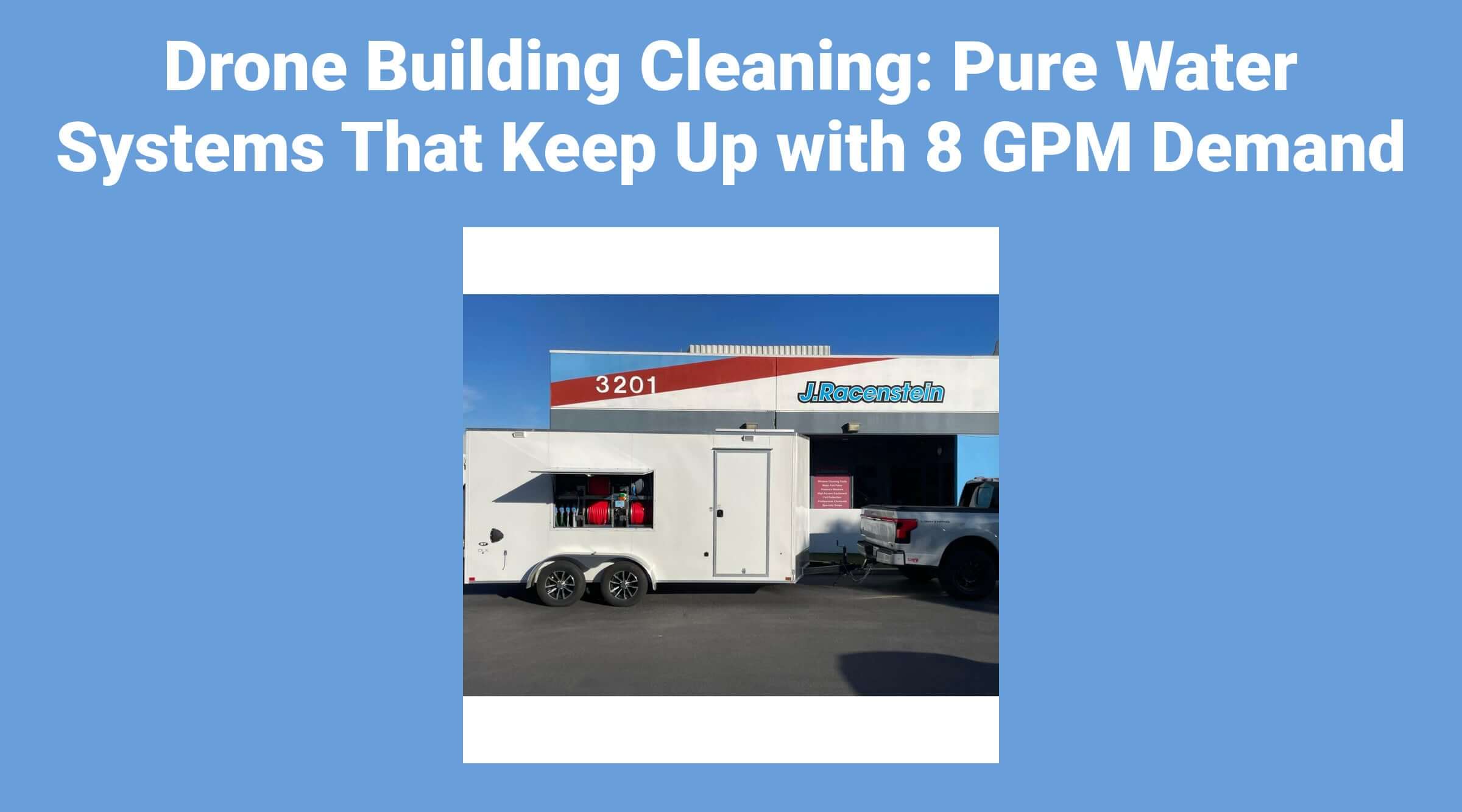
The ProTool Drone Cleaning Trailer takes a complete-system approach from the beginning. Rather than building around one impressive component or the lowest possible price, the entire system is designed around how professional cleaning actually happens in the field.
Here's what to look for when comparing drone cleaning trailers—and what can happen when important details are overlooked.
Start With Enough Trailer
It is easy to focus on pumps, pressure, tanks, and drones while overlooking the platform carrying everything.
That's a mistake.
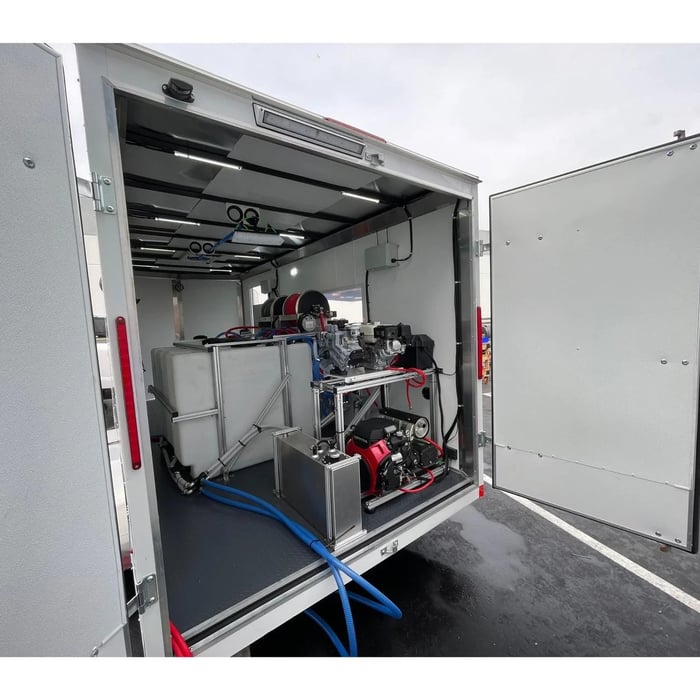
A drone cleaning trailer needs enough room for the cleaning equipment itself while still providing usable workspace, storage, service access, and room for supporting equipment.
Our larger ProTool systems use a 7' × 16' enclosed trailer rather than the more common 7' × 14' platform.
Those additional two feet create valuable working space for:
- Drone and drone case storage
- Generators
- Larger generators for tethered drones
- Tools and spare parts
- Integrated workbench and drawers
- Water-fed poles
- Service access
- Additional cleaning equipment
What Happens When the Trailer Is Too Small?
A smaller trailer may work when the system is first delivered, but what happens when your business grows?
You may want to add another pump, larger generator, additional hose, water-fed poles, tools, spare parts, a workbench, or new equipment that didn't exist when the trailer was originally built.
If every available inch is already occupied, your options become limited.
Equipment may have to be mounted wherever space remains rather than where it works best. Service access becomes more difficult. Storage disappears. Future upgrades may require moving existing equipment—or simply may not fit at all.
The extra room isn't there just to make the trailer bigger.
It's there so the trailer doesn't restrict your business later.
Waterproofing Isn't Cosmetic
A drone cleaning trailer is a wet working environment.
Hoses get disconnected. Tanks get filled. Filters get serviced. Equipment gets rinsed. Water spills.
Some amount of water inside the trailer is inevitable.
That's why waterproof flooring isn't simply a cosmetic upgrade.
What Happens When Water Gets Into the Floor?
Many enclosed trailers use wood-based flooring. If that flooring is repeatedly exposed to water without adequate protection, moisture can eventually penetrate the material.
Over time, saturated flooring can swell, soften, weaken, or deteriorate.
And remember: your equipment is mounted to that floor.
Tanks, pumps, reels, frames, and other components can place substantial loads on their mounting points. If the flooring underneath them deteriorates, hardware can loosen, mounting points can weaken, and damaged sections of flooring may eventually require major repair or replacement.
Water intrusion can turn what appears to be a small construction shortcut into a much larger problem later.
That's why ProTool rigs use waterproof flooring designed around the reality that these trailers operate around water every day. Available vinyl-covered walls provide additional interior protection as well.
A Purpose-Built Interior
A professional trailer should also be easy to work inside.
ProTool interiors include:
- Interior 12-volt LED lighting
- Real Rubber Vinyl Waterproof flooring
- Interior Wall Protection and Water Proofing
- Workbench and drawer storage
- Integrated 110V External Shore Plug
- Integrated 110V Battery Charger
- Integrated 110V power suppl
- Optimized Tank and Gear placement for weight distribution and balance
Good organization isn't just about making the build look better
When equipment is logically positioned and accessible, operation is easier, training is simpler, and routine maintenance doesn't require dismantling half the trailer to reach a component.
Pop-out Window Command Port with Centralized Controls
Complex cleaning systems become difficult to operate when controls are scattered throughout the trailer.
Our pop-out Command Port creates a centralized workstation on the exterior side of the trailer.
From one location, operators can access and monitor:
- Pump controls
- Chemical selection
- Remote-control functions
- Flow controls
- Indicator lights
- System interfaces
Clearly labeled status lights provide immediate visibility into which applications, chemicals, and systems are active.
Without centralized controls, operators may need to repeatedly enter the trailer, move between different pieces of equipment, or check individual valves and controls to determine what is operating.
That gets old quickly when the actual cleaning is taking place hundreds of feet away.
A centralized Command Port makes the drone cleaning trailer easier to understand, easier to operate, and easier to monitor.
Pure Water Production Has to Keep Up With the Drone
Pure water production is one of the most important—and most commonly underestimated—parts of a professional drone cleaning system.
Drone cleaning can consume a tremendous amount of water.
A small RO/DI system designed for a single water-fed pole may have a nice big pump and produce water, but that doesn't mean it can keep pace with sustained drone operation. a 5.3 gpm pump doesn't mean it produces 5.3 gpm of pure water. Often times systems come with a big pup but only produce 1.5-2 gpm of water. Read about pure water production here:
What Happens When Pure Water Production Is Too Slow?
Eventually, the tank runs out.
And then everybody waits.
The drone waits.
The operator waits.
Employees wait.
The entire rig can sit idle while the purification system catches back up.
On a commercial job, that isn't simply inconvenient. Those are paid labor hours producing zero revenue.
If multiple employees are on site, the cost of that downtime multiplies quickly. You may also lose productive working hours, extend a project into another day, or reduce the number of jobs the crew can complete.
A large storage tank can delay the problem, but it cannot solve an undersized production system.
Once the stored water is gone, the production rate becomes the limiting factor.
ProTool systems use complete high-output reverse osmosis and deionization systems designed around the actual water demand of drone cleaning, providing:
- High pure-water production
- Reduced DI resin consumption
- Faster tank replenishment
- Sustained commercial operation
- Support for multiple operators
- Efficient pure-water production at scale
Want to understand why pure-water production matters so much for drone cleaning?
Dedicated Pure and Dirty Water Tanks Matter—a Lot
This is one of the biggest differences to understand when comparing a drone cleaning trailer.
Some systems use a single tank—or a divided/shared tank—for both pure water and recovered dirty water.
It may look efficient on a specification sheet.
Operationally, it creates serious limitations.
Pure Water and Dirty Water Should Not Share the Same Storage
Pure water has been processed through an RO/DI system specifically to remove dissolved minerals and contaminants.
Recovered water is exactly the opposite.
It may contain:
- Dirt
- Minerals
- Organic material
- Cleaning residue
- Chemicals
- Contaminants removed from the building
Those two water sources have completely different purposes.
If the same tank is used for both, you can't simply switch from dirty water back to pure water and start working again.
The tank must first be completely drained and emptied.
Any dirty water remaining in the tank contaminates the new pure water entering it.
That creates another problem.
Contaminated Pure Water Wastes DI Resin
If contaminated water gets mixed with your purified water, you've just undone part of the work your RO/DI system performed.
If that contaminated water is then circulated back through purification equipment to correct it, you're using filters and potentially expensive DI resin to clean water that you already paid to purify once.
You're wasting:
- Pure water
- DI resin
- Filter life
- Pump runtime
- Labor
- Time
That becomes expensive very quickly.
A Shared Tank Also Means Choosing One Function at a Time
There is another fundamental limitation.
A shared tank can only effectively be one type of tank at a time.
If it's carrying pure water, you don't have that capacity available for dirty-water recovery.
If it's being filled with recovered water, you've sacrificed your pure-water storage.
As dirty water enters the tank, usable clean-water capacity disappears.
That makes simultaneous cleaning and recovery difficult or impossible depending on the system design.
ProTool systems use dedicated pure-water and dirty-water tanks.
Depending on the configuration, that can include:
- 200 gallons of pure water with 100 gallons of dirty-water capacity
- Up to 200 gallons of pure water and 200 gallons of dirty-water capacity on larger systems
Pure water stays pure.
Dirty water stays separate.
And the operator can use both systems for their intended purpose without constantly draining, cleaning, switching, and sacrificing capacity.
For serious commercial work, that distinction matters.
True Multi-Operator Capability Requires More Than Two Hoses
"Dual user" sounds simple.
Add another hose and now two people can work, right?
Not necessarily.
True simultaneous operation depends on the capacity of the entire system:
- Water production
- Pure-water storage
- Pumps
- Plumbing
- Manifolds
- Hose diameter
- Reel capacity
- Controls
- Electrical supply
If one component becomes the bottleneck, adding another operator simply divides the available performance.
A properly designed drone cleaning trailer can support multiple cleaning processes at the same time. Depending on configuration, one operator may be drone cleaning while another performs water-fed pole work, pressure washing, or another service.
That's real multi-operator capability.
Plumbing Size Matters More Than Most People Realize
You can install an impressive pump and still get disappointing performance.
Why?
Because a system can only perform as well as its most restrictive component.
Undersized plumbing creates friction loss and restricts the amount of water reaching the equipment.
ProTool systems use larger plumbing and higher-capacity manifolds where appropriate, including 3/4-inch manifolds rather than restrictive 1/2-inch plumbing.
When supported by the incoming water source, our larger hose manifold and float-valve systems can provide approximately 9–10 GPM of incoming water.
That additional flow becomes important when simultaneously filling tanks, producing pure water, supplying pumps, or supporting multiple operators.
A high-output machine isn't very useful if the plumbing feeding it can't provide enough water.
More Hose Means More Working Range
Commercial drone cleaning frequently requires significant distance between the trailer and the actual cleaning area.
That's why hose capacity matters.
ProTool rigs can be configured with up to 300 feet of high-pressure hose, compared with systems limited to approximately 200 feet.
Higher-capacity reels also allow larger hose diameters to be used where necessary.
Larger hose can reduce friction loss over long runs, helping maintain better water delivery at the working end of the system.
It's another example of why the specifications surrounding the pump matter just as much as the pump itself.
Don't Forget Traditional Water-Fed Pole Cleaning
A drone is an incredibly useful tool.
But it isn't always the right tool for every square foot of every property.
Trees, overhangs, restricted flight areas, unusual architecture, pedestrian traffic, site restrictions, or other obstacles can make traditional water-fed pole cleaning the faster or more practical solution.
That's why a complete drone cleaning trailer should give the crew another option.
ProTool systems can incorporate a complete professional water-fed pole system with:
- Adjustable electronic pump controller
- Remote pump control
- Electric hose reel
- High-capacity hose
- Dedicated pole storage
- ProTool Apex carbon-fiber water-fed pole
What Happens When the Rig Can't Handle Water-Fed Pole Work?
You may need to send another vehicle.
Now a second truck or van has to travel to the same job carrying equipment your primary rig could have included from the beginning.
That can mean:
- Another vehicle on the road
- Another vehicle taking up space at the jobsite
- Additional fuel and operating costs
- Another employee tied to that vehicle
- Reduced availability of that truck for another crew or project
That last point is easy to overlook.
If another truck and operator are supporting a drone job, they aren't available to generate revenue somewhere else.
A properly equipped drone cleaning trailer allows the crew to transition between drone cleaning and traditional water-fed pole work from the same platform.
One rig. More ways to complete the property.
Remote Controls Keep the Operator Where the Work Is
Walking several hundred feet back to the trailer every time you need to change a setting wastes time.
Integrated remote controls allow operators to manage important functions from the work area.
Depending on the build, ProTool systems can provide remote control over:
- Pumps
- Chemical selection
- Cleaning applications
- Water-fed pole delivery
Long-range remote capability is available on equipped systems, while status indicators at the Command Port clearly show which systems are active.
The result is less walking, fewer interruptions, and a more efficient workflow.
Power Should Be Integrated Too
Electrical power is another part of the system that can easily become an afterthought.
Our enclosed rigs incorporate a centralized 110-volt shore-power connection.
Connecting the trailer to a single power source can supply:
- Interior LED lighting
- Installed 110V equipment
- Integrated power outlets
- Battery charging
- Other electrical accessories
This simplifies setup while keeping onboard batteries maintained and ready for operation.
The trailer can also accommodate generator storage, including the larger generators necessary for some tethered drone systems.
A Drone Cleaning Trailer Should Do More Than Drone Cleaning
One of the biggest advantages of building a complete cleaning platform is versatility.
Depending on configuration, one ProTool rig can support:
- Drone pressure washing
- Drone soft washing
- Tethered drone operation
- Traditional pressure washing
- Traditional soft washing
- Water-fed pole window cleaning
- Pure-water production
- Pure-water delivery
That flexibility matters.
You may arrive at a property expecting to clean everything with a drone and discover trees, power lines, architectural obstructions, restricted areas, or surfaces better suited to another cleaning method.
Instead of the equipment determining what jobs you can perform, the equipment should give you options.
Build the System Around the Workflow
This may be the most important consideration when choosing a drone cleaning trailer.
Individual specifications don't tell you whether the complete system will perform well.
A high-output pump doesn't help if undersized plumbing starves it.
A large pure-water tank doesn't solve anything if the RO/DI system takes all day to refill it.
A second hose doesn't create true dual-user capability if the water-delivery system can't support two operators.
A sophisticated remote system doesn't save much time if the operator still has to return to the trailer for other essential controls.
Every major component affects another component.
That's why ProTool designs the complete cleaning system around:
- Water supply
- RO/DI production
- Pure-water storage
- Pumps
- Controllers
- Plumbing
- Manifolds
- Hose size
- Reel capacity
- Chemical delivery
- Remote controls
- Electrical systems
- Battery charging
- Ventilation
- Exhaust
- Maintenance access
The goal isn't to win a specification comparison with one oversized component.
The goal is to make the entire drone cleaning trailer perform better.
Build for Tomorrow, Not Just Today
A professional cleaning rig is a major investment.
Your business may start with one drone and one operator, but the equipment shouldn't immediately become a limitation as your operation grows.
Higher-capacity plumbing, larger reels, adequate pure-water production, organized controls, accessible equipment, dedicated storage, and multi-operator capability create room for growth.
The same applies to physical space.
Maybe you don't need another generator, additional reel, larger drone case, more tools, or additional cleaning equipment today.
But you might two years from now.
A properly designed drone cleaning trailer should be something your business can grow into—not something you begin working around shortly after buying it.
Support Matters After the Trailer Leaves the Shop
The complexity that makes a professional cleaning rig powerful also makes knowledgeable support important.
Because ProTool designs and builds the complete system, our team understands how the individual components interact.
Support can include:
- Detailed system walkthroughs
- Pickup or delivery training
- Custom instructional videos featuring your actual rig
- Employee training materials
- Troubleshooting assistance
- Maintenance support
- Replacement parts
- Warranty support
You're not left trying to determine which unrelated manufacturer is responsible for which part of the system.
The Lowest-Priced Drone Cleaning Trailer Can Become Expensive
Price matters.
But the lowest purchase price shouldn't be confused with the lowest cost of ownership.
Building a complex cleaning system to the lowest possible price requires compromises somewhere.
Those compromises may appear in:
- Trailer quality
- Waterproofing
- Ventilation
- Exhaust design
- Plumbing size
- Water-production capacity
- Tank configuration
- Pumps and components
- Reel capacity
- Electrical systems
- Controls
- Storage
- Serviceability
Some compromises are obvious on day one.
Others don't become apparent until the rig has been working for months.
Poor waterproofing can lead to damaged flooring.
Poor ventilation can create excessive heat around engines, generators, or other equipment.
Undersized plumbing can restrict expensive high-output pumps.
Insufficient RO/DI production can leave employees waiting for water.
Shared tanks can force operators to choose between pure-water storage and wastewater capacity.
A trailer that's too small can limit future upgrades.
Saving money on the original build doesn't save much if the operator spends the next several years paying for those compromises in downtime, labor, consumables, repairs, and lost productivity.
More Than a Trailer Full of Equipment
The best drone cleaning trailer isn't necessarily the one with the biggest pump, the largest tank, the longest specification sheet—or the lowest price.
It's the one where everything works together.
Water production needs to support consumption.
Storage needs to support the work being performed.
Plumbing needs to support the pumps.
Reels need to support the hose.
Controls need to support the operator.
Waterproofing and ventilation need to protect the equipment and trailer.
And the trailer itself needs to support both the business you operate today and the business you're trying to build tomorrow.
That is the philosophy behind ProTool cleaning rigs.
Backed by J. Racenstein's experience serving professional cleaners since 1909, ProTool systems combine commercial equipment, purpose-built engineering, training, support, and long-term serviceability into one complete cleaning platform.
When comparing a drone cleaning trailer, don't look only at what is included.
Look at how everything works together—and what happens when it doesn't.
Explore ProTool Drone Cleaning Trailers and build a system designed for the way you work.
FAQs
What should I look for in a drone cleaning trailer?
Look beyond the headline specifications and price. A professional drone cleaning trailer should have adequate pure-water production, properly sized plumbing, sufficient tank capacity, dedicated pure- and dirty-water storage when recovery is required, quality waterproofing, accessible controls, adequate hose capacity, and enough physical space for future equipment and growth.
How much pure water does a drone cleaning trailer need?
The answer depends on the drone, flow rate, number of operators, and length of the workday. More important than tank size alone is whether the RO/DI system can replenish pure water fast enough to support the operation. An undersized purification system can leave an entire crew waiting for water once the storage tank is depleted.
Why is RO/DI production important for drone cleaning?
Drone cleaning can consume large amounts of pure water. A properly sized RO/DI system produces spot-free water efficiently while reducing dependence on expensive DI resin. Poor production rates can create downtime, wasted labor hours, and fewer productive cleaning hours each day.
Should a drone cleaning trailer have separate pure- and dirty-water tanks?
For systems performing water recovery, dedicated tanks provide a major operational advantage. A shared tank can only effectively hold one type of water at a time. Switching from recovered dirty water back to pure water requires completely draining the tank to prevent contamination, which can waste water, time, and potentially expensive DI resin.
Should a drone cleaning trailer include water-fed pole equipment?
For a versatile commercial cleaning operation, it can be extremely valuable. Drones cannot practically access every area of every property. Integrated water-fed pole equipment allows the same crew to handle areas affected by trees, obstructions, flight restrictions, or other site conditions without necessarily bringing another vehicle and operator to the job.
Why is waterproofing important in a drone cleaning trailer?
Cleaning trailers operate around water every day. If moisture repeatedly penetrates inadequately protected wood flooring, the material can eventually swell, weaken, or deteriorate. Because heavy equipment may be mounted to that flooring, proper waterproofing also helps protect the integrity of equipment mounting points and the trailer itself.
What size trailer is best for a drone cleaning rig?
The correct size depends on the equipment and services being carried, but it's important to consider future needs as well as today's equipment. A trailer that is already completely full leaves little room for additional generators, reels, tools, drone equipment, storage, or future upgrades. ProTool's larger enclosed systems use a 7' × 16' platform to provide additional working and expansion space.
Why are centralized controls useful on a drone cleaning trailer?
Centralized controls allow operators to access pumps, chemical selection, system status, flow controls, and other functions from one location. This reduces unnecessary trips in and out of the trailer and makes a complex cleaning system easier to operate and monitor.
Is the cheapest drone cleaning trailer always the least expensive option?
Not necessarily. A lower initial price can come with compromises in trailer construction, waterproofing, ventilation, pure-water production, tank configuration, plumbing, components, controls, or serviceability. Those differences can affect downtime, labor efficiency, consumable costs, repair costs, and the ability to expand the rig later.
What makes a ProTool drone cleaning trailer different?
ProTool designs the trailer as one complete cleaning system rather than a collection of individual components. Water production, storage, pumps, plumbing, reels, controls, power, ventilation, equipment access, and operator workflow are considered together so the entire rig can perform as a cohesive commercial cleaning platform.