Drone Cleaning: The Ultimate Guide for 2026

Table of Contents
- Why Clean With Drones?
- 1. Drones Clean Faster—Much Faster
- 2. Dramatically Safer Operations
- 3. Long-Term Cost Savings
- Who Should Consider Drone Cleaning?
- Choosing a Drone
- Choosing a Drone Skid (The Most Important Part)
- Why You Need a HydroPanel for Drone Cleaning (Non-Negotiable)
- Chemicals and Cleaning Techniques
- Batteries and Power Management
- Regulatory Requirements
- Conclusion: Drone Cleaning Is the Future—If You Build the Right System
- FAQs

How to Choose the Right Drone, Skid, Chemicals & Pure Water System for High-Efficiency drone Cleaning
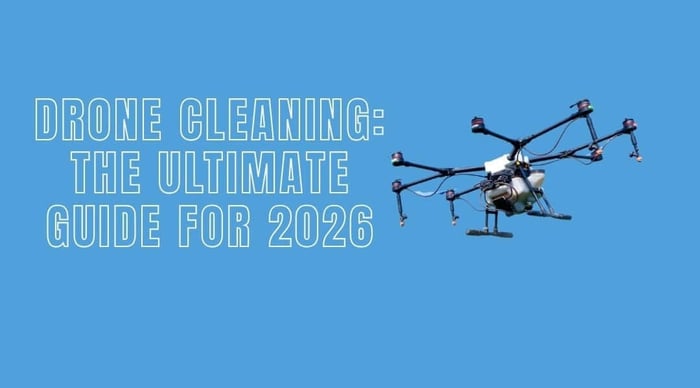
The cleaning industry is changing fast—and drone cleaning is at the center of that transformation. As technology evolves, commercial cleaning companies are looking for safer, faster, and more profitable ways to handle high-rise windows, solar panels, building exteriors, and large commercial surfaces.
Drone cleaning is not just a trend—it’s a major operational shift. When implemented correctly, drones dramatically increase production, reduce risk, and open new revenue streams that traditional cleaning methods can’t touch.
This guide breaks down everything you need to know before launching a drone cleaning division.
Let’s dive in.
Why Clean With Drones?
Drone cleaning is exploding for three main reasons: speed, safety, and long-term savings.
1. Drones Clean Faster—Much Faster
A drone can clean buildings much faster and safer than humans using traditional tools.
Drones move at consistent speeds, don’t get tired, and can cover massive surface areas in a fraction of the time.
Benefits:
More jobs per day
Higher revenue per crew
Lower labor cost per job
More competitive bidding
2. Dramatically Safer Operations
Falls represent about 13% of all workplace fatalities (OSHA).
Drones eliminate the risk of sending crews up ladders, lifts, or ropes.
Workers stay safely on the ground while the drone handles all high-risk areas.
3. Long-Term Cost Savings
Labor, lifts, insurance claims, training, and turnover all make traditional operations expensive.
A drone crew usually needs 1–2 operators, not 4–6.
Even with the high upfront cost, drone operations quickly pay for themselves as efficiency increases.
Who Should Consider Drone Cleaning?
Cleaning with a drone isn’t for everyone. It’s ideal for companies that already:
Have multiple revenue streams
Maintain a steady flow of commercial work
Want to expand into high-margin services
Have the resources for equipment financing or purchase
Are ready to capture large contracts fast
Drone systems, rigs, pure-water equipment, and trucks can run $30,000–$100,000+.
If your company is already stable and profitable, drone cleaning becomes a major multiplier.
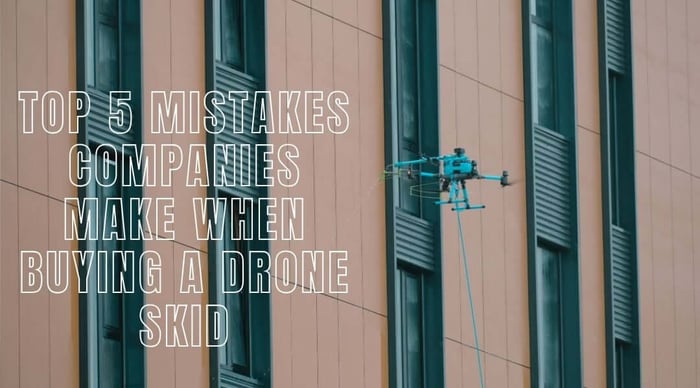
Read more about Drone Skids here:
https://jracenstein.com/expert-advice-learning/what-do-i-need-on-a-drone-cleaning-skid
https://jracenstein.com/expert-advice-learning/top-5-mistakes-companies-make-when-buying-a-drone-skid
https://jracenstein.com/expert-advice-learning/category/drone-cleaning
Choosing a Drone
Drones don't just come in small
Top U.S. Drone Manufacturers
- Lucid Bots
- Apellix
Aquiline Drones
When evaluating drones, consider three critical areas:
1. Cost to Purchase & Operate
Most drones run $10,000–$35,000+ before accessories.
2. Cleaning Capability
Key specs:
PSI capability
GPM required
Max altitude
Spray pattern quality
Hose management
Payload ability
High-end drones can exceed 12 GPM and 4,000 PSI with the right ground-support system.
3. Additional Features
Autonomous operation
GPS patterning
Obstacle detection
Training/support availability
Integration with cleaning skids
Ease of use and manufacturer support are major differences—choose a brand with reliable training and service.
Choosing a Drone Skid (The Most Important Part)
A drone is only as good as the skid feeding it.
Your skid must supply 5–8+ GPM continuously with clean, low-TDS water.
Skid options vary:
Truck-mounted
Trailer-mounted
Van-mounted
Flat bed
But the biggest factor is water production.
Here is a full breakdown on what you need for a drone skid:
https://jracenstein.com/expert-advice-learning/what-do-i-need-on-a-drone-cleaning-skid
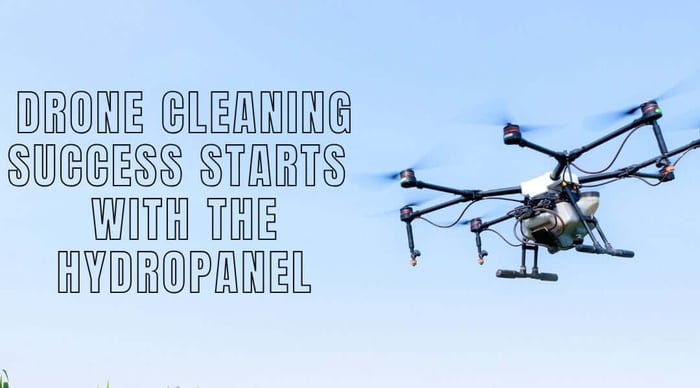
Why You Need a HydroPanel for Drone Cleaning (Non-Negotiable)
Drones consume massive volumes of ultra-pure water.
DI-only systems cannot keep up—they burn through resin instantly and produce inconsistent TDS.
A HydroPanel solves all these problems:
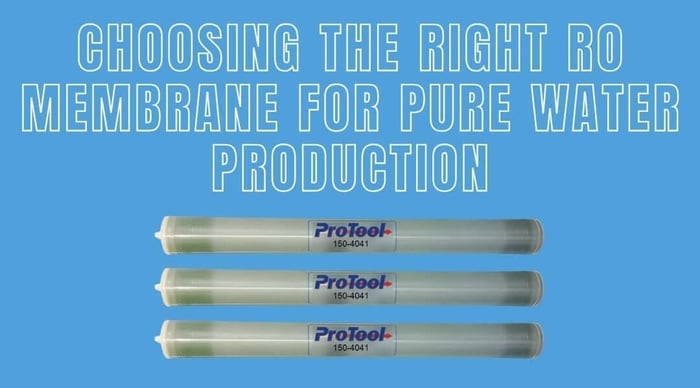
✔ High-Flow RO Membranes
Provides up to 4.5+ GPM of pure water, nonstop.
✔ Cuts DI Costs by 90%
RO removes 95–99% of TDS before DI, protecting your resin.
✔ Required for High-TDS Regions
If your city water is above 100 TDS, the HydroPanel becomes essential.
✔ Stable Water Quality for Drones
Stable TDS prevents spotting across glass - DI only can quickly spike in TDS and leave spots on windows.
A drone cleaning business cannot operate efficiently or affordably without a high-flow RO system. The HydroPanel is the backbone of every serious drone setup.
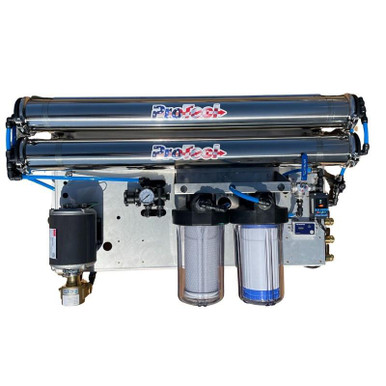
More on how you can save thousands on DI costs with the ProTool hydro panel:
ProTool HydroPanel RODI Wall Mount
$5,410.56
ProTool HydroPanel — All-in-One Wall-Mounted RO/DI Pure Water System The ProTool HydroPanel is your turnkey solution for premium pure water on demand. Designed for easy...… read more
Chemicals and Cleaning Techniques
Unlike humans, drones cannot scrub—so chemistry becomes your “agitation.”
Recommended chemical approach:
Use a good cleaning soap with a good rinsing agent to help rinse soap and dirt to make the windows pop
Select surfactants that improve cling on vertical surfaces when using bleach
Use low-foaming formulas to prevent spray pattern disruption
Heat water when possible for faster reaction times
If you typically soft wash or pressure wash with certain chemicals, most can be adapted for drone use—just follow safety guidance and test coverage.
For building washing, the focus shifts from purity to chemistry. You’ll need to identify what type of contamination you’re dealing with:
Organic growth (mildew, algae, mold) → Soft wash mix with sodium hypochlorite (bleach) and surfactant.
Oxidation on siding or metal panels → Specialized oxidation removers or restoration soaps.
General dirt, grease, or atmospheric buildup → Mild degreasers and rinsing agents.
Having multiple mix options available allows you to switch between cleaning modes on the fly—literally.
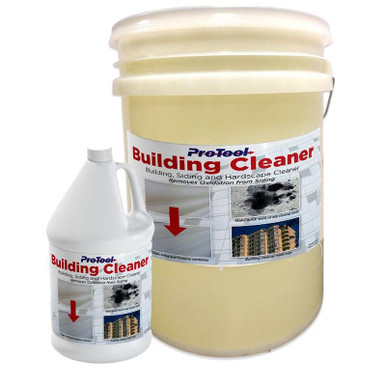
The best soap for building cleaning with a drone is the ProTool Building Cleaner. It has degreasing properties, oxidation removal, slight adhesive removal, and has a great rinsing agent to make the glass POP.
ProTool Red Building Cleaner
$138.90
Building Cleaner is great for all your building surface cleaning. It can be used with various spraying systems to coat the surface with a ...… read more
Batteries and Power Management
Most drone batteries last 15–20 minutes per flight.
You will need:
Multiple batteries on rotation
Fast chargers on your skid or in your truck
A generator or inverter to keep all chargers powered
Strict battery maintenance protocols
Downtime kills efficiency—the fastest drone wins nothing without power.
Regulatory Requirements
To operate a cleaning drone legally in the U.S., you must have:
✔ FAA Part 107 Remote Pilot License
Allows commercial drone operation.
✔ Aviation Insurance
Often required for government, municipal, and commercial contracts.
✔ Airspace Compliance
Follow FAA rules regarding:
No-fly zones
Maximum altitude - 400 ft or when payload reaches 55 lbs (the higher you flyer the more hose and water you carry)
Proximity to airports
Payload limitations - 55 lbs max payload (bigger hose means more weight limiting max height)
Cities and states may have additional laws—research your region thoroughly before flying.
Conclusion: Drone Cleaning Is the Future—If You Build the Right System
Drone cleaning is a transformational opportunity for professional cleaners. With the right drone and more critically—the right ground support system , you can achieve:
Faster job completion
Higher profit margins
Safer operations
Better cleaning results
Expanded service capabilities
New jobs that weren't feasible before
But success only comes from building the right infrastructure.
Cut corners and your drone becomes an expensive paperweight.
Build your system correctly, and you’ll dominate your market.
Build your dream drone skid:
Request a FREE 15 minute design call
👉 Shop ProTool Skids
https://jracenstein.com/cleaning-skids/
FAQs
Do I really need pure water for drone cleaning?
Yes. Drones use high-volume water flow, and pure water prevents spotting on windows, solar panels, metal panels, and glass façades. A HydroPanel ensures consistent low TDS, reduces DI costs by 90%, and produces the GPM required for drone work.
Why is a HydroPanel important for drone cleaning rigs?
Drone cleaning requires 5–8+ GPM continuously. DI-only systems cannot keep up and burn through resin immediately. A HydroPanel provides high-flow RO water, stable TDS, and predictable performance—making it essential for professional drone operations.
How much water flow (GPM) does a drone need?
Most cleaning drones require 5–8+ GPM. Some high-output systems use even more. Anything less will cause downtime, poor spray pattern, and reduced cleaning coverage.
What type of drone is best for cleaning?
Lucid Bots, Apellix, and Aquiline Drones are the top U.S. manufacturers. The best drone depends on your budget, your target jobs, PSI requirements, and whether you need autonomous features or manual control.
How long do drone batteries last while cleaning?
Typically 15–20 minutes per flight. You’ll need multiple batteries, on-site charging, and a generator or inverter to keep chargers running during the job.
What chemicals can be used with cleaning drones?
Most traditional soft-wash and pressure-wash chemicals can be used, but drone-optimized chems like ProTool Building Cleaner provide the best results since drones cannot scrub surfaces.
Do I need a special license to operate a cleaning drone?
Yes. Any commercial drone pilot must hold a Part 107 FAA license. Some regions have local restrictions, and aviation insurance is strongly recommended.
Can drone cleaning replace traditional crews?
In many cases, yes. Drone cleaning dramatically reduces labor, improves safety, and increases speed. Most companies still maintain ground crews, but drones handle high-risk and large-scale work far more efficiently.
What kind of skid or rig is required for drone cleaning?
You need a dedicated drone cleaning skid with high-flow capabilities, large tank capacity, lightweight hose reels, proper pump sizing, and a HydroPanel for pure water production. Standard pressure-washing skids are not optimized for drone flow.
Can drones clean windows and solar panels effectively?
Absolutely. With proper PSI, pure water, and consistent flow, drones can clean windows, solar fields, and building façades faster and safer than most traditional methods.
How much does a drone cleaning setup cost?
Expect $35,000–$100,000+ depending on the drone model, skid, pure-water system, batteries, and truck/trailer build. Financing is common for companies adding drone services.