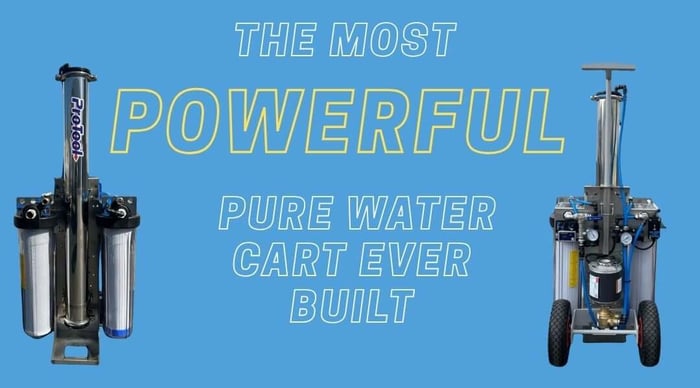
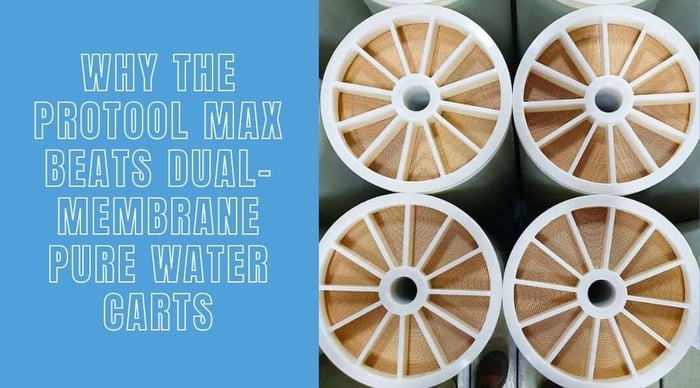
Why the ProTool MAX Beats Dual-Membrane Pure Water Carts

Table of Contents
- Why the ProTool Hi-Flow Cart MAX Uses One RO Membrane to Achieve 3+ GPM (When Everyone Else Needs Two or Three)
- How to Get More Pure Water Flow
- Option 1: Add More RO Membranes (The Common Industry Shortcut)
- Option 2: Use Better-Quality Membranes, Pumps, and Filtration (The ProTool Method)
- Why More RO Membranes Is Actually Bad Engineering
- 1. More RO Membranes = Higher TDS Output
- 2. More Membranes Increase Waste Water
- 3. More Components Mean More Failure Points
- 4. More Membranes Add Unnecessary Weight
- How the ProTool Hi-Flow Cart MAX Achieves 3+ GPM With a SINGLE RO Membrane
- 1. Higher-Quality, High-Output RO Membrane
- 2. High-Output Stainless Pump System
- 3. Oversized 20" Carbon Sediment Prefiltration
- 4. Advanced Flow Path Design
- Why Other Pure Water Carts Aren’t as Good
- Why “Bigger Number Better” Is a Terrible Design Policy
- Work it. We'll Back it. Lifetime Warranty on all ProTool Pure Water Carts.
- The ProTool Hi-Flow Cart: The Most Powerful Pure Water Cart Ever Built
- Final Thoughts
- FAQs
Why the ProTool Hi-Flow Cart MAX Uses One RO Membrane to Achieve 3+ GPM (When Everyone Else Needs Two or Three)
In the world of pure-water production for pure water carts, flow rate is everything. Commercial window cleaners, solar panel cleaners, and multi-operator crews all rely on high volumes of pure water to stay productive on large jobs. Traditionally, most manufacturers have tried to increase flow by simply adding more RO membranes—assuming that “more is better.”
But the ProTool Hi-Flow Cart MAX breaks this old rule.
It delivers 3+ gallons per minute using ONE high-performance RO membrane—while competing carts use two or three low-output membranes and still fall short.
The reason?
ProTool uses higher-quality membranes, high-output pumps, and advanced engineering that push performance without sacrificing purity.
In this article, you’ll learn why adding more membranes is actually worse, how ProTool achieves unmatched performance with a single membrane, and why “bigger number = better” is one of the biggest fallacies in the industry.
How to Get More Pure Water Flow
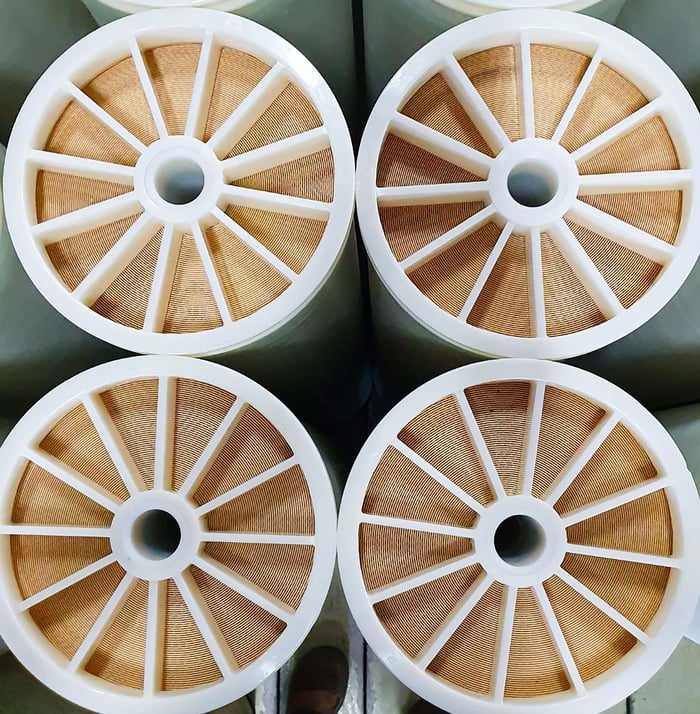
When a pure-water system needs higher flow, manufacturers typically choose one of two paths:
Option 1: Add More RO Membranes (The Common Industry Shortcut)
This is the method almost every other brand chooses.
Why? Because it’s easy.
If one membrane makes ~1 gallon per minute, adding a second brings you closer to 2 GPM… on paper. In reality, however, doubling membranes introduces an entire list of engineering problems:
More membranes mean efficiency loss
More components increase weight
Weight makes the cart harder to move
More membranes = more waste water
More membranes = higher TDS output
Higher TDS output = way more DI resin cost
Manufacturers take this “shortcut” because it looks good in marketing: two membranes must be better than one, right?
No.
And ProTool proves it.
Option 2: Use Better-Quality Membranes, Pumps, and Filtration (The ProTool Method)
Instead of band-aiding the system with more RO cylinders, ProTool takes a different approach:
Ultra-high-quality, high-output 4040 XLE RO membrane
A high-flow stainless pump designed to push serious volume
Oversized 20" carbon sediment and DI filtration
Engineered system flow paths for maximum efficiency
Optimized pressure to drive RO performance without damage
This results in:
✔ Higher flow
✔ Lower TDS
✔ Less DI resin use
✔ Lower operating costs
✔ Less weight
✔ Less complexity
✔ Better longevity
In other words, using one great membrane outperforms using two mediocre ones in pure water carts.
Why More RO Membranes Is Actually Bad Engineering
Adding more RO membranes is one of those choices that seems like it makes sense, but almost always results in worse performance.
Here’s why:
1. More RO Membranes = Higher TDS Output
RO membranes have an ideal operating pressure and rejection rate. When you split flow across multiple membranes, each one receives:
Lower pressure
Less water
Less rejection efficiency
More pass-through solids
This means your “pure water” comes out with higher TDS.
And higher TDS means your DI resin burns out faster, dramatically raising operating costs.
2. More Membranes Increase Waste Water
RO membranes always create waste water, and the more membranes you add, the more waste volume you generate. This increases:
Water usage
Job-site setup time
Environmental impact
ProTool systems are engineered to minimize waste rather than multiply it.
3. More Components Mean More Failure Points
Every added membrane introduces:
More fittings
More flow paths
More leak points
More pressure drop
More servicing complexity
A simple, well-engineered system always outperforms a patched-together one.
4. More Membranes Add Unnecessary Weight
Extra RO housings, brackets, fittings, and tubing add major weight to a cart. This:
Makes transport harder
Slows techs down on job sites
Increases strain lifting in/out of vehicles
Reduces overall usability
Weight kills efficiency—and ProTool refuses to do that to you.
How the ProTool Hi-Flow Cart MAX Achieves 3+ GPM With a SINGLE RO Membrane
The ProTool Hi-Flow MAX isn’t magic. It’s engineering done right.
Here’s how it produces 3+ GPM with one membrane when other brands barely reach that using two:
1. Higher-Quality, High-Output RO Membrane
ProTool uses a premium 4040 RO membrane designed for high-flow commercial purification—not the bargain membranes many brands rely on. These membranes:
Have higher permeate flow rates
Have lower TDS output
Maintain stronger rejection
Perform better at ProTool’s optimized pressures
Last longer under high-volume operation
One ProTool membrane outperforms two or three low-end membranes.
Every. Single. Time.
2. High-Output Stainless Pump System
Power matters.
The MAX uses a high-output stainless pump engineered specifically for:
High flow
High pressure stability
Long duty cycles
Commercial cleaning environments
It pushes the membrane hard—but safely—extracting maximum GPM without sacrificing TDS.
3. Oversized 20" Carbon Sediment Prefiltration
Good water in = good water out.
With XXL carbon filtration:
The RO membrane stays protected.
Pressure stays stable
Flow stays consistent
Membrane life increases significantly
Smaller filters choke performance and increase the risk of RO failure—ProTool’s don’t.
4. Advanced Flow Path Design
ProTool engineered every flow path, hose diameter, and internal connection for maximum efficiency. Many competitors throw components together without optimizing them internally.
Small improvements compound into big performance gains.
Why Other Pure Water Carts Aren’t as Good
Most pure-water carts on the market follow a predictable pattern:
Commodity membranes
Basic pumps
Small carbon filters
Restrictive flow paths
“Patchwork engineering”
High TDS output
High DI resin usage
Heavy carts due to extra RO housings
They rely on adding more RO membranes to make up for weak component choices.
The ProTool MAX relies on better components—not more of them.
Why “Bigger Number Better” Is a Terrible Design Policy
In the pure-water world, “more membranes” is a false shortcut.
More does not mean better.
It often means:
More weight
More waste
More resin cost
Less efficiency
Higher TDS
Lower lifespan
More servicing
More potential failures
Great engineering is about balance, not brute force.
The ProTool MAX proves that quality beats quantity every time.
Work it. We'll Back it. Lifetime Warranty on all ProTool Pure Water Carts.
Every ProTool MAX 110V Cart is protected by the ProTool Lifetime Warranty—because serious equipment should come with serious backing.
The ProTool Hi-Flow Cart: The Most Powerful Pure Water Cart Ever Built
If you haven’t yet read the full breakdown of the Cart MAX, check it out here:
👉 ProTool Hi-Flow Pure Water Cart MAX – The Most Powerful Pure Water Cart Ever Built
(insert link)
https://jracenstein.com/expert-advice-learning/the-protool-pure-water-cart-revolutionizing-cleaning-efficiency
Shop the ProTool Pure Water Cart Collection
Explore all ProTool carts—including the MAX, Standard Hi-Flow, and battery-powered options:
👉 Shop ProTool Pure Water Cart Collection
https://jracenstein.com/water-fed-cleaning/pure-water-carts/protool-pure-water-carts/
👉 Shop ProTool Pure Water Collection
https://jracenstein.com/water-fed-cleaning/pure-water-systems/
👉 Shop All:
Final Thoughts
The ProTool Hi-Flow Cart MAX isn’t just a cart—it’s engineering done right. Instead of adding unnecessary membranes, ProTool builds smarter systems with premium components, high-output pumps, and optimized performance that outclass every competing cart in its category.
More membranes don’t make a system better.
Better membranes—supported by real engineering—do.
And that’s why the ProTool Hi-Flow MAX stands alone as the most powerful, most efficient, and most cost-effective pure water cart ever built.
FAQs
How does the ProTool MAX get 3+ GPM with only one RO membrane?
The ProTool MAX uses a high-quality high-output commercial-grade RO membrane, paired with a high-flow pump and oversized 20" prefilters. This combination pushes more water through a single membrane than competing carts can achieve with two or three lower-quality membranes.
Why do other pure water carts use two or three RO membranes?
Other brands rely on multiple membranes because their pumps, filters, and membrane quality can’t support high flow. Adding more membranes is a shortcut used to mask poor design, low flow rates, and weak components.
Isn’t more RO membranes always better?
No. In fact, more membranes often make performance worse. Multi-membrane systems suffer from:
Higher TDS output
Lower rejection efficiency
Increased DI resin consumption
More weight and bulk
More failure points
More wasted water
A single high-performance RO beats multiple low-performance ROs every time.
Why do multi-membrane carts produce higher TDS water?
When water is split between 2–3 membranes, each membrane receives less pressure and operates below ideal rejection levels. This results in more dissolved solids passing through, which spikes TDS and burns through DI resin much faster.
Does the ProTool MAX really reduce DI resin costs?
Yes—dramatically. The MAX produces lower-TDS water, which means the DI stage lasts much longer.
Is the ProTool MAX lighter than dual- or triple-RO carts?
Absolutely. Multi-RO systems add significant weight due to extra housings, brackets, tubing, and hardware. The MAX’s single-membrane design keeps the system lighter, easier to move, and easier to load.
Does the ProTool MAX waste less water than dual-membrane carts?
Yes. Multiple membranes require higher waste ratios, which increases the amount of water dumped during filtration. The MAX’s efficient single-membrane layout minimizes waste water and maximizes output.
Is one RO membrane harder to maintain than multiple?
No. It’s easier.
One membrane means:
Fewer fittings
Fewer leak points
Fewer clogs
Faster servicing
Lower replacement costs
Maintaining one premium membrane is simpler than managing several mediocre ones.
What makes the ProTool MAX better for commercial and multi-operator work?
The MAX delivers steady 3+ GPM output, enabling long hose runs and multiple water fed pole. Multi-membrane carts struggle to maintain flow under real-world conditions due to pressure losses and inefficiency.
Can the ProTool MAX replace a multi-membrane cart?
For many small- to mid-sized crews, yes. With its 3+ GPM production, low TDS output, and stable performance, the MAX can often replace bulky dual- or triple-membrane cart at a smaller size, less weight, and less cost.
Why is the ProTool MAX considered the most powerful pure water cart ever built?
Because no other pure water cart matches its combination of:
3+ GPM output
Single-membrane efficiency
Low TDS production
Reduced DI cost
Superior pump performance
Simplified servicing
Lighter, stronger engineering
It outperforms dual- and triple-membrane carts in every major category.