
How Reverse Osmosis (RO) Works for Window Cleaning

Reverse osmosis is the filtration stage that makes water fed pole cleaning possible. Without it, every mineral in your tap water ends up as a white spot on glass — and your customer sees every one. Understanding how reverse osmosis works for window cleaning is the difference between burning through DI resin every week and running a system that actually pays for itself.
This guide covers the mechanics of RO membranes, why three-stage filtration is non-negotiable, how to read TDS numbers that matter on the job, and which pure water systems match different crew sizes.

What Reverse Osmosis Actually Does
Normal osmosis moves water from a low-mineral side to a high-mineral side of a membrane until the concentrations equalize. Reverse osmosis flips that: pressure forces contaminated water against a semi-permeable membrane so only H₂O molecules pass through. The dissolved solids — calcium, magnesium, silica, sodium — stay behind and flush out as wastewater.
That pressure can come from your municipal supply if it's strong enough, or from a booster pump when it isn't. Either way, the membrane does the separation. Energy goes in, minerals come out.
Inside the RO Membrane
The membrane is a thin-film composite (TFC) wound in a spiral inside a pressure vessel. Microscopic pores — roughly 0.0001 microns — let water molecules through and reject anything larger. Here is the sequence on every pass:
- Feed water enters — tap water flows into the housing under pressure.
- Permeate exits — purified water passes through the membrane and routes to your DI stage or storage tank.
- Concentrate flushes — rejected minerals exit through a brine line. This flush is what keeps the membrane from scaling.
A quality 4040 membrane like the ProTool RO Membrane 4040 Ultra Low Pressure rejects 95–98% of total dissolved solids in a single pass. That is the bulk of the work — your DI resin only has to clean up the remaining 2–5%.
Why Three Stages, Not One
An RO membrane alone gets you to roughly 10–20 ppm TDS. That sounds low, but above 10 ppm you risk visible spotting on glass. And the membrane itself has a vulnerability: chlorine. Municipal water is chlorinated to keep it potable, but chlorine degrades the TFC layer and shortens membrane life from years to months.
The three-stage layout solves both problems:
Stage 1 — Carbon Pre-Filter
A carbon filter strips chlorine and chloramines before they reach the membrane. Replace it on schedule (typically every 3–6 months depending on volume) and the membrane stays intact.
Stage 2 — RO Membrane
The membrane removes 95–98% of dissolved solids. This stage does the heavy lifting — dropping a 300+ ppm feed down to single digits.
Stage 3 — DI Resin Polish
A DI resin cartridge catches whatever the membrane missed and brings the output to 0 ppm. Because the RO already removed the bulk, the resin lasts dramatically longer than it would on raw tap water — which is the entire economic argument for running RO in the first place.
TDS Numbers That Matter on the Job
Total dissolved solids (TDS) is measured in parts per million (ppm) with an inline or handheld TDS meter. Know these benchmarks:
- Tap water: 100–500+ ppm depending on region. Anything above 200 ppm eats DI resin fast if you skip RO.
- Post-RO: 5–20 ppm. Acceptable for some exterior commercial work; not reliable for residential glass at arm's length.
- Post-DI: 0 ppm. The standard. If your meter reads above 5 ppm at the pole, swap the resin.
Monitor TDS at three points — feed, post-RO, and post-DI — and you will catch membrane degradation or resin exhaustion before it shows up on glass.
Choosing the Right RO/DI System
The system you need depends on daily water demand, which is driven by crew size and job type.
Solo or Part-Time — Portable Cart
The ProTool 511 Pure Water Cart is a compact stainless-steel RODI cart built for one operator doing residential routes. Garden-hose inlet, single RO membrane, and enough DI capacity for a full day of houses. Roll it out of the van, connect, and go.
Full-Time Crew — HiFlo Cart
The ProTool HiFlo Pure Water Cart steps up flow rate for crews running two poles simultaneously. Dual-membrane options and 12V or 110V pump plates handle higher TDS feed water without slowing output.
Multi-Crew or Commercial — Wall Mount or Skid
A ProTool HydroPanel wall mount or pure water skid produces water at the shop or in the truck. Fill tanks overnight, run multiple crews off one system. This is where the ROI on RO gets obvious — your per-gallon cost for 0 ppm water drops to almost nothing.
Membrane Maintenance That Extends Life
An RO membrane should last 2–3 years. Operators who get less than that are usually making one of these mistakes:
- Skipping carbon filter changes. A spent carbon filter passes chlorine straight to the membrane. Set a calendar reminder based on gallons processed, not gut feel.
- Never flushing. Most ProTool carts have a flush valve. Run it for 30–60 seconds before and after each use to clear concentrated brine off the membrane surface.
- Ignoring TDS creep. If your post-RO reading climbs 20% above its baseline, the membrane is scaling or degrading. Investigate before it fails completely.
- Storing wet without use. If the system sits idle for more than a week, flush it or add a preservative solution to prevent biological growth inside the membrane.
Common Operator Mistakes
Running DI-only to save money upfront. A DI-only setup on 300 ppm tap water will chew through resin in days. The math never works — an RO membrane pays for itself in resin savings within the first few months.
Assuming tap pressure is enough. If your feed pressure is below 40 psi, the membrane's rejection rate drops and output slows to a trickle. A ProTool 90 PSI regulated pump solves this and keeps production consistent regardless of the job site's plumbing.
Not checking output TDS at the brush. The meter on your cart reads post-DI, but fittings, old hose, or a cracked cartridge housing downstream can reintroduce minerals. Periodically test at the pole tip with a handheld TDS meter.
Products Mentioned
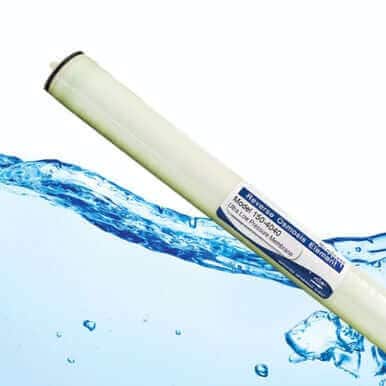 ProTool RO Membrane 4040 Ultra Low Pressure SKU: 150-4040 | 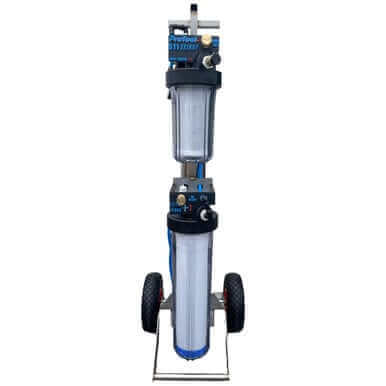 ProTool 511 Pure Water Cart SKU: 150-0515 | 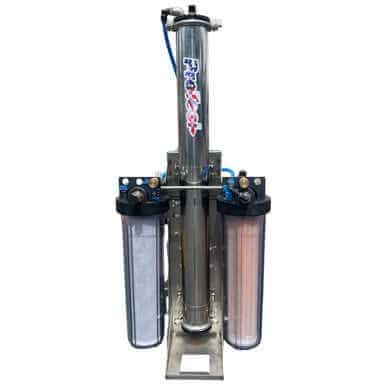 ProTool HiFlo Pure Water Cart Stainless Steel SKU: 150-0521 |
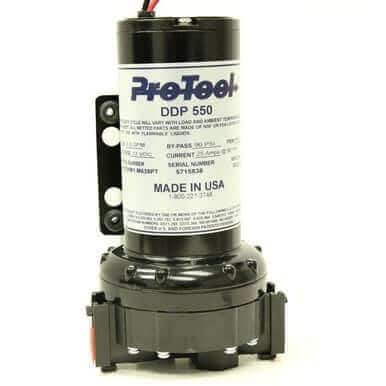 ProTool Pump 90psi 5.0gpm Pump Regulated SKU: 150-0856 | 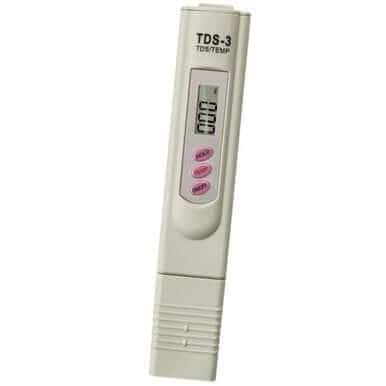 TDS Meter Handheld TDS-3 SKU: 150-0199 |