
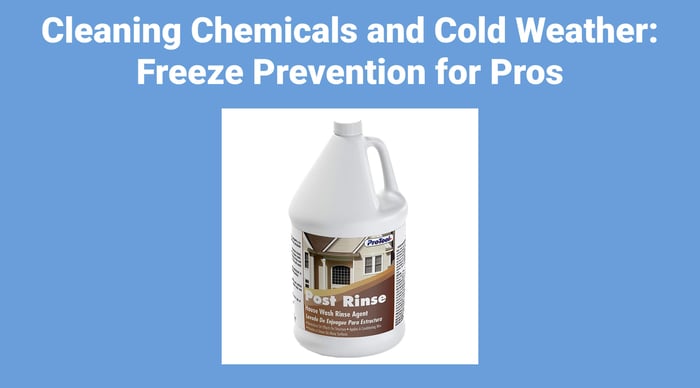
Cleaning Chemicals and Cold Weather

Cold weather creates real problems for cleaning chemicals — and most of them are invisible until you try to use the product and get bad results. Knowing which chemicals survive a freeze, which ones are destroyed, and how to protect your inventory is basic operational knowledge for any contractor working through winter.
What Freezing Actually Does to Cleaning Chemicals
Most water-based cleaning products — window soaps, surfactants, neutralizers — are ruined by a hard freeze. The freezing action breaks the emulsion or chemical bond that holds the formula together. Once that bond is gone, warming the product back up does not restore it. It may look fine in the jug, but the active ingredients are no longer suspended correctly. You will get inconsistent results, streaking, or no cleaning action at all.
Products high in polymers — sealers, protective coatings, and glass protectants — are even less forgiving. A single freeze cycle destroys the polymer structure permanently. Follow the product label disposal instructions and replace them. No amount of shaking or warming brings these back.
Semi-frozen or slushy chemicals are deceptive. Different ingredients freeze at different temperatures, so part of the formula may be solid while the rest is liquid. The active ingredients could be the frozen portion. Using the product in that state means you are applying an incomplete formula. Let it thaw fully, shake or stir thoroughly, and inspect before use — but understand it may still be compromised.
Cold temperatures above freezing can also cause separation. If you see layering, color variation, or a cloudy film in a product that is normally uniform, warm it to room temperature and mix well before deciding whether it is still usable.
Preventing Chemical Freeze Damage
The simplest rule: when overnight temps drop near 32°F, bring every chemical container into a heated space — garage, shop, basement — kept at 40°F or above. This applies to everything from window soaps to post-rinse surfactants to soft wash additives.
Chemicals left on an open truck bed freeze faster than the ambient temperature suggests. Wind chill during highway driving can push effective temperatures well below 32°F even on a 38°F day. Protect containers by storing them in a locked toolbox, behind a windscreen, or wrapped in insulation blankets. An insulated tote or job box on the truck bed is a cheap insurance policy.
For glass protectants and sealers, which are the most freeze-sensitive products you carry, consider keeping them inside the cab during transit rather than on the truck.
Cleaning Windows in Freezing Temperatures
When cleaning windows below or near freezing, most pros add winter washer fluid or methanol to their bucket solution to lower the freeze point. The right amount is not a fixed ratio — it depends on the air temperature, wind speed, sun exposure, and how warm the glass surface is. South-facing glass in direct sun may stay above freezing even when the air is 25°F, while north-facing glass in shade and wind freezes your solution almost instantly.
Start with a small amount of additive and increase until your solution stops freezing on the glass. More is not always better — too much methanol can leave haze or interfere with squeegee glide. The practical answer is to dial it in on the first pane and adjust from there.
For water-fed pole work in cold weather, the pure water itself does not freeze as fast as tap water (fewer dissolved solids means a slightly lower freeze point), but it will still freeze on glass below about 28°F. Some operators switch to traditional cleaning below that threshold and reserve the water-fed pole for milder days.
Check With the Manufacturer
Every chemical formula reacts differently to freezing. If you are unsure whether a product survived cold exposure, contact the manufacturer or supplier before using it on a customer's property. Using a compromised chemical costs more in callbacks and re-cleans than replacing the jug.
Products Mentioned
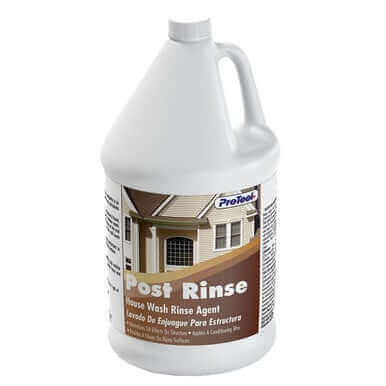 ProTool Post Rinse SKU: 83-03M | 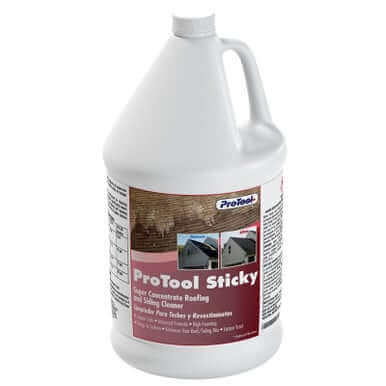 ProTool Sticky SKU: 83-07M | 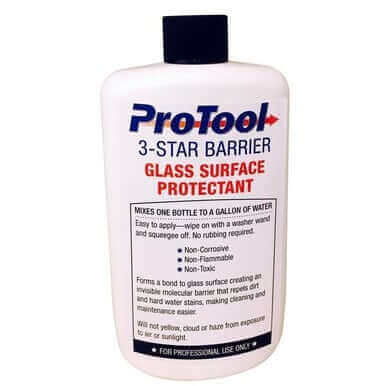 ProTool Barrier Protectant 6.4oz SKU: 87-00 |