
Estate Window Cleaning Skid

ProTool Window, Softwash and Pressure Washing Skid
Estate Window Cleaning Company
Change the Carbon Filter every 3 months of regular use
Change the DI Filter Resin when the TDS meter reads above 10 TDS
Pictures for this System are at this link: 890-04641
Parts List for the components are at this link: 890-0464
- SO 2595094:
- A 80 gallon bleach tank
- 120k gallon Carbon Filter
- 7 Gallon Water Buffer Tank for Softwash
- 7 Gallon Surfactant Tank for Softwash
- Twin 5GPM open flow, 90 psi Softwash Spraying Pumps - offers 7GPM at 45psi
- Metering System for Water, Bleach (SH) and Surfactant to the Softwash reel
- 16 gallon RO buffer tank for Water Fed
- Twin 4040 RO Membranes, DI Resin Housing and Cartridge
- V16 Controller and Delivery Pump, RO Boots pump, TDS meter
- 4 gpm Pressure Washer
- 2 Output reels, 1 input water reel with electric aluminum and stainless steel manifold construction for delivery of soft wash and pressure washing
- A ProTool Reel with 150 ft pf hose
This is the Skid Walk Around prior to Shipment to NJ
This is the Softwash 12v Metering System Instructional Guide
This is the RODI Pure Water Instructional Guide
Pressure Washer connection
Daily Operating of the RODI Water Fed System
3) RO water on valve (on cross on top of the small tanks) is (On) - [ Valve is In line with plumbed line]
Lower left (labeled) (on)
Wait for a minute [Valve is left of small hand reel]
Water should start filling the larger small tank now….
8) Press the right button on the pump controller to turn on Water Fed Delivery water
This draws water from the RO buffer tank (Larger of the small water/surfactant tanks)
10) Select the Water Output to send the water to the reel you are using for the Water Fed Pole.
END OF JOB
1) Turn off the V16 Controller that manages the pump to the water fed pole
2) Turn the RO Flush Vale to Open position and let flow for 1 minute
Wait
3) Turn off the RO Water Valve at the Water inlet Cross
4) Disconnect from the tap and Reel up the Inlet Water Hose
Daily Operating Softwash Metering
This is not meant to be a complete guide to Softwashing, plant protection, property protection are an important part of the cleaning process, receive the proper training and understand how to protect the property, fixtures, vehicles nearby, foliage, etc from the chemical spray
1) Set the three metering Valves to (Off)
2) Attach water in reel hose to tap.
3) Turn on the Tap
4) Insure there is sufficient surfactant in the 7 Gallon tank [closest tank to side of truck]
RINSING/WATERIG THE FOLIAGE
A) Un-Reel the hose out to the areas to be softwashed.
B) Turn on the Water Metering Valve to full open (5 on dial)
C) Turn on both Softwash pumps 1 and 2
D) Use the Softwash gun with a large fan tip to liberally spray down, water the foliage to avoid bleach burning
Note: It is also possible to use a standard garden hose and hose end sprayer to perform this watering
For heavily foliage and trees and shrubs close to the structure, use this garden hose and sprayer to follow the Operator that is spraying the building surfaces to rinse the foliage immediately after the operator passes through the area.
SPRAYING YOUR MIX/CHEMISTRY
- In general the water valve will be fully open to (5 on the valve),
- if the bleach mix is weak and the bleach valve is at (5) then start to reduce the water metering valve
1) Review the surface to be cleaned to decide on the metering valve settings
A. Bleach Valve
- For Roofs Set the Water to (5) and the Bleach from (4) to (5) - Less if the cleaning is going well
- For Siding Set the Bleach from (2.5) to (4) - Less is the Cleaning is going well
- Set the Valve to 1 or less - Use Less if the cleaning is going well
2) In general you turn on only ONE of the Softwash Pumps to spray Chemistry
Large surface areas like Commecial Membrane Roofs on Big Box stores, Public Pool Area cleaning, Large structures, it can be more efficient to turn on the second pump.
Using one pump makes it easier to manage overspray, rundowns, etc.
3) When spraying if the Mold and mildew is taking longer than expected to clear, then turn the Bleach up [and perhaps the surfactant a smidge more too]
4) When the entire area to be cleaned is covered in mix, review any area that needs another spray to remediate the mold.
5) Once the area that was sprayed with chemical has come clean then you can rinse.
RINSE
1) Set the Bleach and Surfactant mixing valves
2) Turn on both Softwash pumps
3) using a larger tip size rinse the surfaces just cleaned
Note: There are some roofs that do not need to be rinsed, if there if foliage below the roof drip line, we recommend rinsing and heavily watering the foliage
COMPLETED
The Softwash hose and pumps, when used for rinsing will no longer be impacted by the bleach, if you did not use the Softwash reel and pumps to rinse then you should run Tap Water through the pumps and hose on the reel to store only tap water in the reel and hose.
1) With the Pump and Reel flushed with tap water, turn off the Softwash pumps #1 and #2
2) Disconnect the tap water inlet and reel in the hose
3) Reel in the softwash hose
4) Secure the hose end for transport
Pressure Washer Daily Operation
The pressure washer is being run at tap water pressure from the input reel, the Carbon filter will remove the chlorine from the ater and sediments down to 5 micron, this will improve the chemicals performance and extend the life of the pressure washer.
Review the oil site gauge on the motor and pump to insure the level and quality of oil
Daily
1) Attach water in reel hose to tap.
2) Turn on the Tap
3) Release the trigger on the PW Tool attached to let the water run into the PW
4) Turn on the PW
Note: Do not operate the PW for longer tan a few minutes without the Trigger open on the PW tool, allowing the water to "bypass" through the unloader and back into the PW can cause the pump to over heat and become damaged5) Perform the cleaning
COMPLETED
1) Turn off the PW
2) Turn off the Tap water line and Reel in the hoses
One thing to double check for Pressure Washer connections in the amount of flow from the water tap and through the input reel and hose
(and over time as well the hose in the center gets compressed) and reduces flow
AIR IN Line
Air in the line. We use clear braid hose to be able to watch for "bubbles" in the line.
Vibration can cause a threaded connection, radial clamp at the barb to loosen and allow a leak
PRESSURE SIDE
The water path to the pressure washer is the simplest one, as it is under pressure and a loose connection or Carbon Filter sump will exhibit as a water leak … vs "sucking Air" air…The pressure from the tap to the PW is least likely to see the air in line issues.
When it does, this this points to some air still left in the top of the carbon filter housing/sump it has a big air pocket on top.,
Symptom: The line from the tap water to the pressure washer causing “stumbling”.
Try disconnecting the water into the PW at the inlet and run the water full flow through from the reel to evacuate any air at the top of the carbon filter.
Pressure Side Water Flow
- From the Reel hose Male GH connection into the Reel with a GH Female and a nipple into the manifold
- Out the Reel manifold into a swivel with a hose barb and a clamp on the clear braid
- On to the inlet side of the Carbon filter, a hose barb and a clamp on the clear braid
- Carbon Sump, the sump has a seal on the top and if that were mis-aligned during tightening there would be a water leak down the sump.
- Out the Carbon Filter hose barb and clear braid to the "4 way Cross" which is three barbs and a RO water On Off Valve
- The Cross sends water to three destinations.
- Pressure Washer connection
- The Softwash Buffer tanks
- The RO on and off valve which send the tap water pressure to the RO Boost pump and on to the RO Membranes (top of the SS housings)
Watch for bubbles in the line at:
- Reel Swivel to the Carbon Filter
- Carbon filter to the cross
- Cross to the Pressure Washer inlet
The Pressure side of the water fills a Softwash Buffer tank and through the RO Membranes the RO Buffer Tank and also send water direct to the Pressure Washer.
SUCTION SIDE
Air in line when drawing Water, Bleach or chem.
Checking the system
Turn off all mixing valves
One at a time use both pumps to pull fluid from each tank
WATER
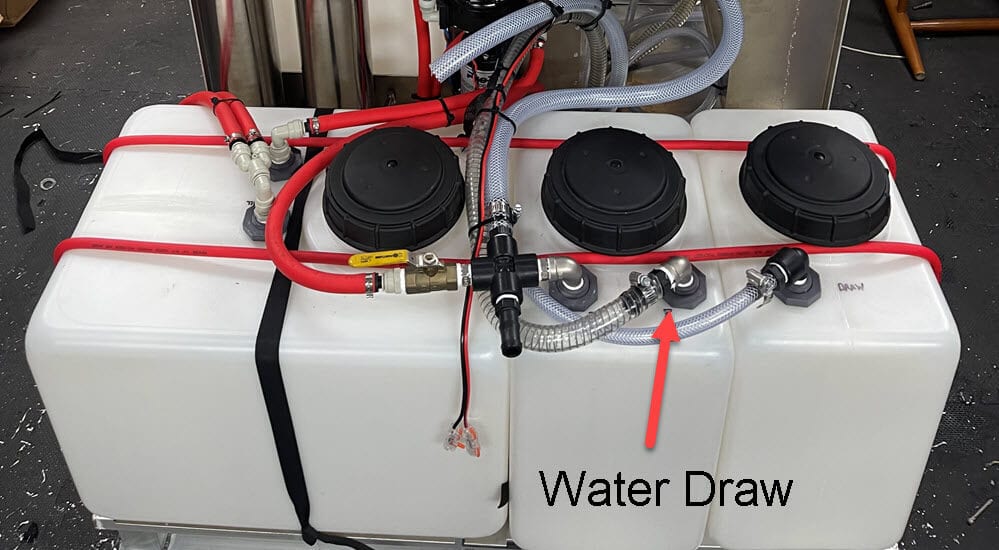
Water draws from the 7 gallon water buffer tank,
There is a draw tube, that screws into the bulkhead fitting at the top of the tank
The top of the Bulkhead has a SS Elbow with a hose barb and suction hose with a clamp
The suction hose goes to the hose barb on the Left Side mixing valve.
BLEACH
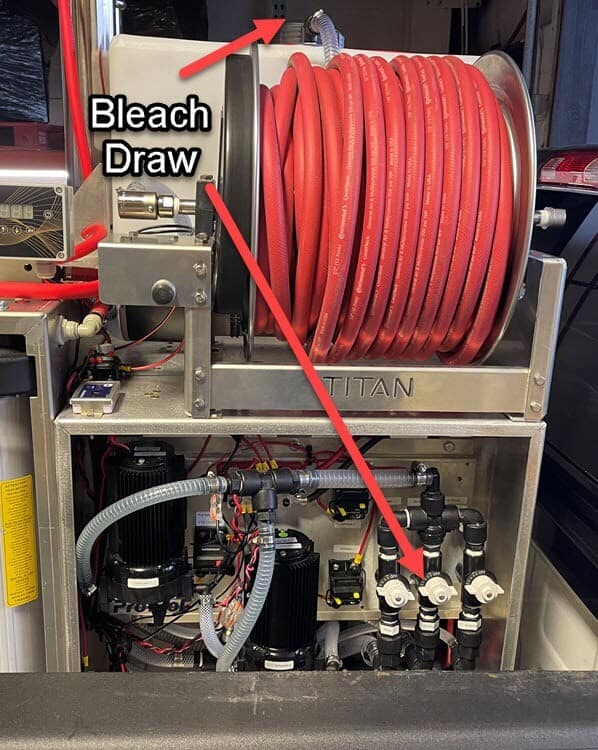
With the bleach tank empty... fill with a few gallons of water for testing to avoid managing what to do with the bleach
There is a draw tube in the top of the bleach tank, the draw tube screws into the bulkhead fitting
The bulkhead fitting has an elbow and a barb connected to a suction hose
The Suction hose connects to the Center barb on the mixing system
SURFACTANT
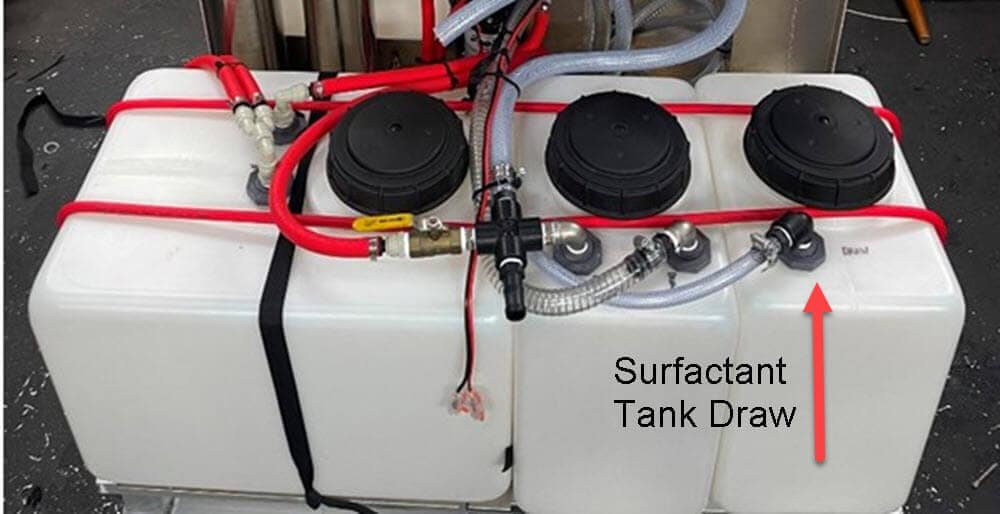
The surfactant tank has a draw tube that screws into the bulkhead fitting
There is a street elbow and a barb with a clamp that connect to a 3/8 clear braid line
This line connects to the right connection on the Mixing station
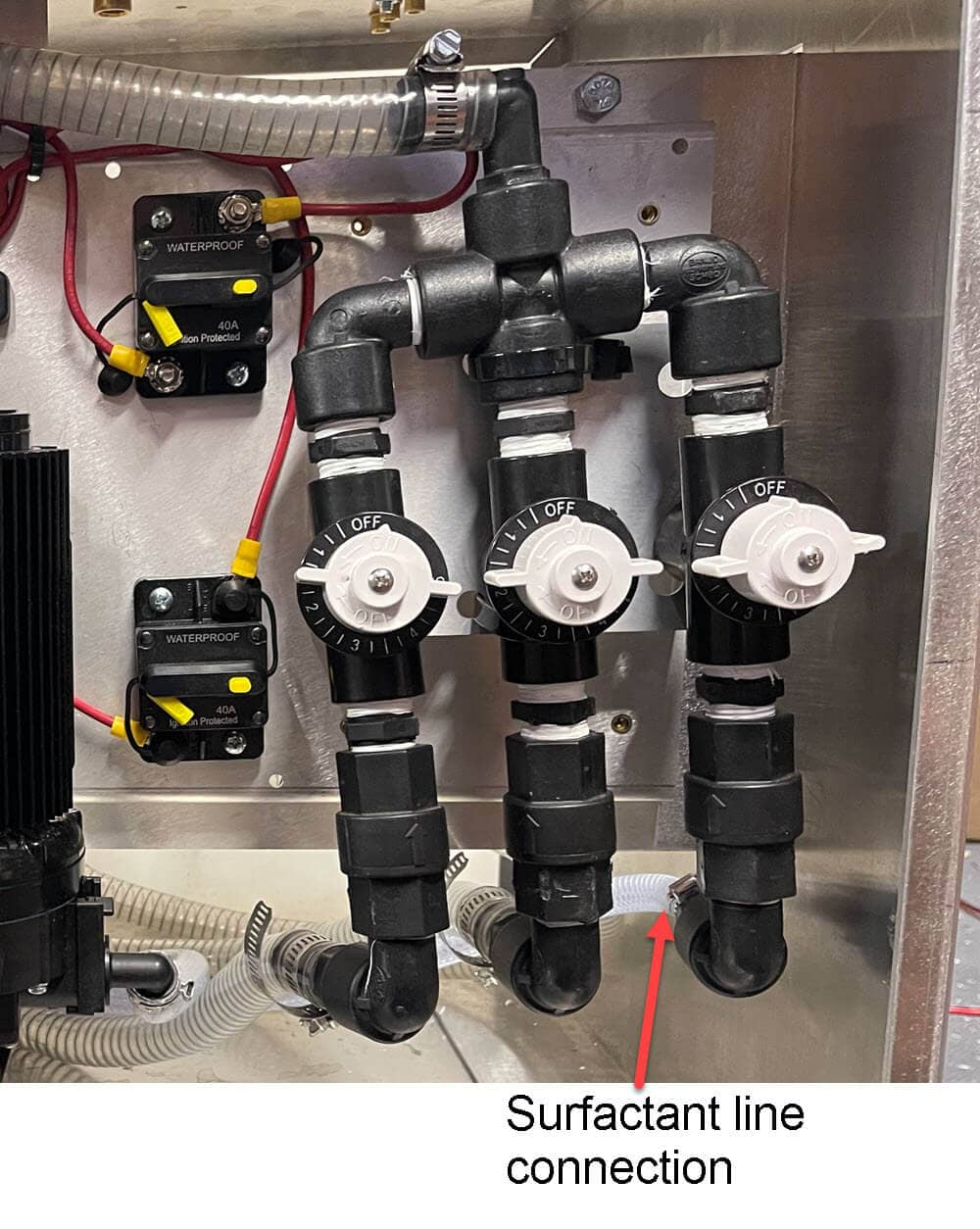
Flow test
WATER
Turn off the bleach and surfactant mixing valves
Turn on both Softwash pumps and draw water only from the water buffer tank
Open the valve on the end of the softwash gun
Look for bubbles in the suction line.
Note: Often there may be a "stationary bubble at a low spot in the line.
BLEACH
Turn off the Water and the Surfactant metering valves.
Turn on the two RO Spraying pumps
Open the valve on the end of the softwash gun
SURFACTANT
Fill the surfactant tank with soapy water.
Turn off the Water and the Surfactant metering valves.
Turn on the two RO Spraying pumps
Open the valve on the end of the softwash gun
Look for bubbles in the suction line.
Note: Often there may be a stationary bubble at a low spot in the line.
RO PUMP DRAW from Mixing Cross
The top of the Mixing system has a Elbow and a Barb to a Suction line.
That Suction line has Tee with barbs and a clamp to split the mix draw to the two softwash pumps
SOFTWASH PRESSURE
The pressure side will exhibit leak of the mix where a connection is loose.
The softwash pumps combine their flow into a Clear braid hose these two hoses are combined through a barb tee with clamps on the barbs
The mix then heads off to the Softwash reel