ProTool Drone Cleaning Trailer vs. the Competition: What Are You Really Paying For?

Table of Contents
- ProTool Drone Cleaning Trailer vs. the Competition: What Are You Really Paying For?
- ProTool vs. a Typical Lower-Cost Drone Cleaning Trailer
- The Little Things Add Up
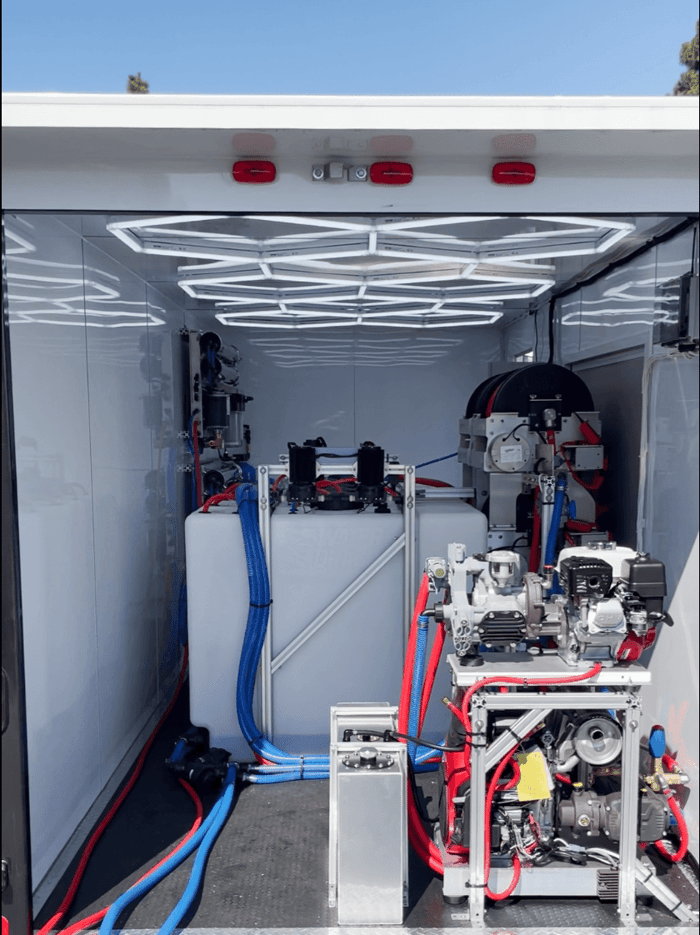
- 12V LED Interior Lighting
- Vinyl Interior Walls
- Stronger Trailer Frame & Supports
- Integrated Workbench & Drawers
- Matching High-Capacity Reels
- Organized Electrical & Wiring
- Integrated Battery Charging
- Central Shore Power
- Easy-to-See Status Lights
- Equipment & Pole Storage
- Service Access
- Ventilation & Exhaust Planning
- Room for the Drone—and Everything Else
- Battle #1: Are You Actually Comparing the Same Drone Cleaning Trailer?
- Battle #2: What If the Rigs Really Are Similar?
- Here’s What Those Shortcuts Look Like in the Real World
- Smaller Trailer = Less Room
- Basic Floor Protection = Greater Risk of Water Damage
- Smaller RO/DI = Downtime
- Shared Tanks = Cross-Contaminated Pure Water
- Smaller Reels & Plumbing = Less Flow and Reach
- A Second Hose Doesn't Automatically Mean Dual-User
- No WFP System = Another Truck on the Job
- Scattered Controls = Wasted Steps
- Poor Ventilation = Heat, Equipment Problems and Fire Risk
- Piecemeal Electrical = More Complexity
- No Room to Grow = Buy It Twice
- The Lowest Price Has to Come From Somewhere
- We're Not Trying to Build the Cheapest Drone Cleaning Trailer
- Support Doesn't End at Delivery
- So What Does the Extra Money Actually Buy?
- Already Have Another Drone Cleaning Trailer Quote?
- FAQs
ProTool Drone Cleaning Trailer vs. the Competition: What Are You Really Paying For?
We recently spoke with a customer comparing one ProTool drone cleaning trailer with another manufacturer's trailer.
The other trailer was approximately $20,000 less.
That's not a small difference.
If two products appear to do the same thing, saving $23,000 sounds like an easy decision.
But there were two problems with that comparison.
First, the two rigs weren't actually equivalent.
Different equipment. Different capacities. Different capabilities. Different construction. Different pure-water systems. Different tank configurations.
Once we configured a ProTool rig closer to what the customer was actually comparing, that price gap became considerably smaller.
But here's the second—and more important—point:
We were still more expensive.
And we're okay with that.
Because even when we build a ProTool Drone Cleaning Trailer with similar headline specifications, there are places where we intentionally use more equipment, larger components, better materials, additional labor, or a more complete design.
We know how to make our rigs cheaper.
We could use a smaller trailer. Install a smaller RO/DI system. Share tanks. Use smaller plumbing. Include less hose. Eliminate equipment. Simplify controls. Reduce waterproofing. Skip the water-fed pole system. Build around today's minimum requirements instead of tomorrow's growth.
The price would go down.
But every dollar removed from a build has to come from somewhere.
So instead of asking only:
"Why does this Drone Cleaning Trailer cost more?"
Ask:
"What am I getting—or giving up—for the difference?"
Let's compare.
ProTool vs. a Typical Lower-Cost Drone Cleaning Trailer
| What You're Comparing | ProTool Drone Cleaning Trailer | Typical Lower-Cost Rig | What the Difference Can Cost You |
|---|---|---|---|
| Trailer Size | 7' × 16' on larger builds, with room for equipment, drone and case, generators, tools, workbench and future expansion | 7' × 14' or smaller | An overcrowded trailer limits storage, service access and expansion—and may not even leave a practical place to carry the drone case |
| Waterproof Flooring | Single-piece solid rubber/vinyl waterproof flooring made from one roll with no seams and waterproofed to the walls | Basic or no protection; spray-on bed-liner style coatings may be used | Water intrusion can saturate wood flooring, causing swelling, deterioration and weakened equipment mounting points |
| Interior Protection | Available vinyl interior walls for additional protection in a wet working environment | Standard trailer walls or limited protection | Repeated water exposure can damage unfinished interior surfaces over time |
| Trailer Construction | Heavy-duty trailer platform with stronger frame and support construction | Lower-cost platforms may use lighter construction | The trailer carries thousands of pounds of water, tanks and equipment. The structure underneath it matters |
| Interior Lighting | Integrated 12V LED lighting inside the trailer | Basic lighting or may be omitted | Operators regularly enter the trailer for equipment, batteries, the power strip, HydroPanels and system access. Good lighting makes the rig easier to work out of |
| Controls | Pop-Out Command Port puts controls, switches and interfaces outside the trailer with easy-to-spot system and chemical-status indicator lights | Controls may remain scattered across individual components inside the trailer | More trips inside the trailer, more time checking individual components and less immediate visibility into what's running |
| Pure-Water Production | Complete high-output RO/DI system sized around commercial drone, WFP and multi-operator demand | Smaller RO/DI system or lower-output purification | Downtime. When production can't keep up, stored water eventually runs out and the drone and crew wait for more |
| Pure & Dirty Water Storage | Dedicated tanks, with configurations up to 200 gal. pure + 200 gal. dirty | Shared tank or reduced dedicated capacity | Dirty water can cross-contaminate pure water, wasting already-produced water and potentially expensive DI resin. You also lose the ability to use the same tank for both functions simultaneously |
| Hose Reels, Manifolds & Flow | Larger-capacity reels, larger manifolds and larger hose, including ¾" manifolds where required, up to 300' of pressure hose and approximately 9–10 GPM inlet capability when the source supports it | Smaller reels, manifolds, hose and/or shorter hose runs | Less reach and more restriction. High-output equipment can't perform properly if the delivery system feeding it becomes the bottleneck |
| Water-Fed Pole System | Dedicated WFP system with pump, electronic controller, remote operation, electric high-capacity reel, extended hose, Apex carbon-fiber pole and pole holders | Basic/manual system or not included at all | Reduced control and productivity—or another truck and operator may be needed to finish areas where the drone can't work |
| Multi-Operator Capability | Water production, tanks, pumps, plumbing and delivery designed around simultaneous work | May simply provide multiple outlets/connections | Two operators can compete for available water and flow if the complete system isn't actually sized for simultaneous operation |
| Remote Operation | Integrated remote control with long-range options for key cleaning functions | Limited, component-by-component or no remote capability | More walking back to the trailer, more interruptions and slower changes during the job |
| Power & Charging | Single shore-power connection, installed 110V equipment, power strip, battery charging and organized 12V electrical | Individual connections or less-integrated electrical | More setup, more cords, inconsistent charging and additional potential failure points |
| Ventilation & Exhaust | Engines, generators and heat-producing equipment considered as part of the complete ventilation and exhaust design | Ventilation and exhaust may be more basic or treated as an afterthought | Excessive heat can damage equipment, while improper ventilation and exhaust routing can create a serious fire hazard |
| Equipment Layout | Designed around workflow, accessibility and serviceability, with an integrated workbench and drawers available for tools, fittings, parts and supplies | Equipment may primarily be positioned wherever space allows | Routine operation and maintenance become harder when components are buried, storage is limited and there is no usable workspace |
| Future Expansion | Physical space, plumbing capacity, electrical and layout designed with future growth in mind | Often built around today's minimum requirements | Adding another reel, generator, drone, pump or service later may require major modifications—or simply may not fit |
| Whole-Job Capability | Drone PW/SW, tethered drones, traditional PW/SW, traditional WFP cleaning, pure-water production and ground work from one rig | May be primarily designed around drone operation | Site conditions can force you to deploy another vehicle, operator and equipment just to finish the property |
| Training & Support | Walkthroughs, custom videos of your actual rig, troubleshooting, maintenance assistance, parts and ProTool warranty support | Limited or not offered at all | When a complex multi-system rig needs help, lack of knowledgeable support can mean significantly more downtime |
Not every competing rig will have every limitation shown above.
That's exactly why the specification sheet matters.
If one Drone Cleaning Trailer is substantially cheaper, compare what's actually included before comparing the bottom-line price.
The Little Things Add Up
The difference between two drone cleaning trailers isn't always found in the biggest components.
It's also in the dozens of smaller decisions that affect how the rig works every day—and how well it holds up over time.
12V LED Interior Lighting
Operators are constantly going inside the trailer to grab equipment, change batteries at the charging station, access the power strip, start the HydroPanels or check components.
Integrated LED lighting simply makes the trailer easier to work out of—especially early in the morning, late in the day or inside a packed enclosed trailer.
Vinyl Interior Walls
Available vinyl interior walls provide additional protection in an environment where water is part of everyday operation while also creating a cleaner, more finished working interior.
Stronger Trailer Frame & Supports
Water is heavy.
Add hundreds of gallons of it to tanks, pumps, reels, engines, generators and everything else inside the trailer, and the underlying platform matters.
We start with a trailer designed to support the system we're putting inside it.
Integrated Workbench & Drawers
A dedicated workbench creates an actual working area inside the trailer, while built-in drawers provide organized storage for tools, fittings, spare parts and everyday supplies.
Instead of toolboxes and loose equipment taking over the trailer floor, there's a place for them.
Matching High-Capacity Reels
Properly sized reels provide capacity for longer and larger hose while keeping the complete system organized and consistent.
Organized Electrical & Wiring
The electrical system is treated as part of the build—not a collection of unrelated components added wherever they fit.
Integrated Battery Charging
Onboard batteries can remain maintained and ready while equipment batteries can be charged from the trailer's power system.
Central Shore Power
One connection can supply installed 110V equipment, the onboard power strip, battery charger and other electrical needs.
Easy-to-See Status Lights
Clearly labeled indicator lights at the exterior Command Port let an operator quickly identify active systems and chemical selections without climbing into the trailer.
Equipment & Pole Storage
Water-fed poles and other equipment have dedicated storage locations instead of being laid wherever space happens to remain.
Service Access
Pumps, filters, plumbing and electrical components are positioned with future maintenance and repair in mind.
Ventilation & Exhaust Planning
Engines, generators and other heat-producing equipment require proper airflow and exhaust routing.
Poor ventilation isn't simply uncomfortable or hard on equipment.
Improper ventilation, excessive heat or poorly managed exhaust can create a serious fire hazard.
Room for the Drone—and Everything Else
It sounds obvious, but the trailer actually needs somewhere to carry the equipment it's built around.
A larger platform gives us room for the drone and its case, generators, tools, cleaning equipment, storage and an integrated workbench with drawers.
A smaller, completely packed trailer may not even have a practical place to store the drone case—much less provide usable workspace for the operator.
None of these features alone explains the difference between two rigs. Together, they show why two trailers that look similar on a quote can be very different once you start working out of them every day.
Battle #1: Are You Actually Comparing the Same Drone Cleaning Trailer?
This is the first thing we look at when someone tells us another rig is thousands—or tens of thousands—less expensive.
Are they actually the same rig?
Two enclosed drone cleaning trailer can both have:
- A drone pump
- A water tank
- An RO system
- Hose reels
- Remote controls
and still be dramatically different systems.
"Includes RO/DI" doesn't tell you how many gallons per minute it produces.
"200-gallon tank" doesn't tell you whether pure and recovered water share that capacity.
"Dual user" doesn't tell you whether the water-production and delivery systems can actually sustain two operators.
"Includes hose reel" doesn't tell you reel capacity, hose length, hose diameter or manifold size.
"Enclosed drone cleaning trailer" doesn't tell you its size, frame construction, waterproofing, ventilation or how much usable space remains after the equipment is installed.
And "drone cleaning rig" doesn't necessarily mean there's even room inside to store the drone and its case.
Before comparing prices, normalize the builds.
Compare equipment for equipment, capacity for capacity and capability for capability.
A $20,000 difference isn't a $20,000 savings if one trailer contains substantially less equipment and capability.
But then we get to the more interesting comparison.
Battle #2: What If the Rigs Really Are Similar?
This is where we're willing to say something many manufacturers won't:
ProTool may still be more expensive.
We've developed more price-competitive configurations specifically so customers can make closer apples-to-apples comparisons.
But even when the equipment lists become much closer, we don't eliminate every difference.
Why?
Because there are places where reducing the price would mean building a system we believe is less capable, less efficient, harder to use, harder to expand or more likely to create problems later.
Here's where some of that additional cost goes.
Here’s What Those Shortcuts Look Like in the Real World
Smaller Trailer = Less Room
A 7' × 14' or smaller trailer costs less.
Our larger builds use a 7' × 16' platform to provide room for the drone and case, generators, tools, WFP equipment, integrated workbench and drawers, service access and future additions.
The shortcut: Save money with a smaller trailer.
The cost: Less storage, tighter service access, fewer expansion options—and potentially nowhere practical to even carry the drone case.
Basic Floor Protection = Greater Risk of Water Damage
A cleaning trailer gets wet. That's unavoidable.
ProTool uses single-piece solid rubber/vinyl waterproof flooring made from one roll with no seams and waterproofed to the walls.
The shortcut: Basic protection or spray-on coatings.
The cost: Spray on coatings can get etched, cut or damaged, exposing the plywood. If water reaches the wood underneath, flooring can swell, deteriorate and weaken—including the areas holding mounted equipment.
Smaller RO/DI = Downtime
A large tank doesn't solve slow pure-water production. It only delays the problem.
ProTool uses high-output RO/DI systems sized around commercial drone, WFP and multi-operator demand.
The shortcut: Install a smaller, cheaper purification system.
The cost: Once stored water runs out, the drone and crew wait for more.
That's paid labor producing zero revenue.
Shared Tanks = Cross-Contaminated Pure Water
ProTool systems can provide up to 200 gallons of dedicated pure water AND 200 gallons of dedicated dirty-water storage.
The shortcut: Use one tank for both functions.
The cost: You can only use the tank for one type of water at a time. Switching from dirty water back to pure requires completely emptying the tank or residual contamination can ruin newly produced pure water—wasting water, time and potentially expensive DI resin.
One tank doing two jobs isn't the same as two tanks doing two jobs simultaneously.
Smaller Reels & Plumbing = Less Flow and Reach
ProTool uses larger-capacity reels, larger hose and ¾-inch manifolds where higher flow is required, with up to 300' of pressure hose and approximately 9–10 GPM inlet capability when the source supports it.
The shortcut: Smaller reels, shorter hose and smaller manifolds.
The cost: Less working range, greater restriction and high-output equipment that may not receive the flow it needs.
A Second Hose Doesn't Automatically Mean Dual-User
True multi-operator performance requires enough water production, storage, pump capacity, plumbing and delivery capacity to support both operators.
The shortcut: Add another connection and call it dual-user.
The cost: Both operators compete for the same limited water and flow.
Dual-user capability is determined by system capacity—not hose count.
No WFP System = Another Truck on the Job
Drones can't practically clean every part of every property.
ProTool can integrate a dedicated WFP pump, electronic controller, remote operation, electric high-capacity reel, extended hose, Apex carbon-fiber pole and pole storage.
The shortcut: Install a basic WFP setup—or leave it out entirely.
The cost: When the drone can't access an area, you may need another vehicle, another equipment package and another operator just to finish the job.
And that truck and employee aren't somewhere else generating revenue.
Scattered Controls = Wasted Steps
The ProTool Pop-Out Command Port puts key controls, interfaces and easy-to-see system and chemical-status lights together on the exterior of the trailer.
The shortcut: Leave controls wherever the individual equipment is mounted.
The cost: More trips inside the trailer, more walking between components and more time figuring out what's running.
Poor Ventilation = Heat, Equipment Problems and Fire Risk
Engines and generators create heat and exhaust. In an enclosed trailer, both have to be managed correctly.
The shortcut: Treat ventilation and exhaust as an afterthought.
The cost: Excessive heat can damage equipment, while improper ventilation and exhaust routing can create a serious fire hazard.
Piecemeal Electrical = More Complexity
ProTool integrates shore power, 110V equipment, battery charging, interior LED lighting, the onboard power strip and organized 12V electrical.
The shortcut: Power everything individually.
The cost: More cords, more setup, inconsistent battery charging and more potential failure points.
No Room to Grow = Buy It Twice
Your business may not need another reel, generator, drone, pump or cleaning service today.
That can change quickly.
The shortcut: Build around today's absolute minimum requirements.
The cost: Future equipment may require major modifications—or simply may not fit.
The Lowest Price Has to Come From Somewhere
If two genuinely comparable Drone Cleaning Trailers have substantially different prices, something is creating that difference.
It could be a smaller trailer, lower-output RO/DI, shared tanks, smaller plumbing, shorter hose, smaller reels, less waterproofing, fewer controls, less ventilation work, fewer integrated systems, less storage, less fabrication labor or limited post-sale support.
That doesn't automatically make a lower-priced trailer bad.
It means you should understand where the cost was removed.
Because price doesn't simply disappear.
Cost is removed somewhere. Your job is to find out where.
We're Not Trying to Build the Cheapest Drone Cleaning Trailer
We know how.
Smaller trailer. Smaller RO/DI. Shared tanks. Smaller plumbing. Less hose. Smaller reels. No WFP system. Simpler controls. Less waterproofing. Less storage. Less room for expansion. Less integration. Less support.
The price goes down.
So does the system you're buying.
Our goal is different:
More capacity. Better performance. Fewer limitations.
We spend money where we believe it makes the complete working system better.
Support Doesn't End at Delivery
A complex commercial cleaning drone cleaning trailer eventually needs maintenance, troubleshooting or training.
ProTool support can include:
- Detailed system walkthroughs
- Pickup or delivery training
- Custom instructional videos featuring your actual rig
- Employee training materials
- Real-person troubleshooting
- Maintenance assistance
- Replacement parts
- ProTool warranty support
Post-sale support elsewhere may be limited—or not offered at all.
With ProTool, you're working with the team that understands how the complete system was designed and built, backed by J. Racenstein's experience serving professional cleaners since 1909.
So What Does the Extra Money Actually Buy?
Maybe you're comparing two completely different rigs and much of the price difference disappears once they're configured equally.
Maybe you're comparing two genuinely similar rigs and ProTool is still more expensive.
Now you know what to compare.
Trailer. Waterproofing. RO/DI output. Dedicated tank capacity. Plumbing. Reels. Hose. WFP. Controls. Electrical. Ventilation. Storage. Workspace. Expansion. Training. Support.
Compare the rig first. Then compare the price.
Already Have Another Drone Cleaning Trailer Quote?
Send it to us.
We'll help you compare the systems line by line so you can see what's included, what's different and where the price difference actually comes from.
No hiding the differences. No pretending price doesn't matter.
Compare the rigs first. Then decide which one provides the better value for your operation.
FAQs
Why does a ProTool Drone Cleaning Trailer cost more?
ProTool rigs may cost more because we invest in the complete system—not just the headline equipment. Depending on the build, that can include a larger trailer, high-output RO/DI, dedicated pure and dirty-water tanks, larger plumbing and reels, longer hose, complete WFP equipment, centralized controls, waterproof flooring, integrated electrical, proper ventilation and more room for storage and expansion.
How should I compare two Drone Cleaning Trailer quotes?
Compare the actual equipment and capacities before comparing the final price. Look at trailer size and construction, RO/DI production rate, pure and dirty-water capacity, plumbing size, hose length, reel capacity, WFP equipment, controls, remote functions, electrical integration, waterproofing, ventilation, storage and post-sale support.
Two trailers with similar equipment lists can still be very different systems.
Is a cheaper Drone Cleaning Trailer always a worse trailer?
No. A lower price doesn't automatically mean a poorly built rig.
But the price difference has to come from somewhere. Determine what's different between the two builds and whether you're giving up equipment, capacity, construction quality, integration, convenience, expansion room or support to achieve the lower price.
Why is waterproof flooring important in a Drone Cleaning Trailer?
Cleaning trailers are wet working environments. If water reaches the wood flooring underneath, repeated exposure can cause swelling, deterioration and weakened equipment mounting areas.
ProTool uses single-piece solid rubber/vinyl waterproof flooring made from one roll with no seams and waterproofed to the walls.
Cheap spray on liners can easily be etched, cut or damaged exposing the plywood to water.
Why does RO/DI production rate matter?
A large pure-water tank only stores water. The RO/DI system determines how quickly you can replace what the drone consumes.
If water consumption exceeds production for too long, the tank eventually runs dry and the drone and crew stop working.
For commercial drone cleaning, pure-water production directly affects downtime and productivity.
Why use separate pure-water and dirty-water tanks?
Dedicated tanks allow pure-water delivery and dirty-water recovery to remain separate and available simultaneously.
Using one tank for both requires completely emptying it when switching functions. Residual dirty water can cross-contaminate newly produced pure water, wasting water, time and potentially expensive DI resin.
Why are the Command Port and remote controls important?
The ProTool Pop-Out Command Port puts important controls, interfaces and easy-to-see status indicators together on the exterior of the trailer.
Combined with remote operation, this reduces unnecessary trips back into the trailer and gives the operator faster control over the system while working.
Why do ventilation and exhaust matter in an enclosed cleaning trailer?
Engines and generators produce significant heat and exhaust. Proper airflow and exhaust routing help manage operating temperatures and protect the equipment and trailer.
Poorly designed ventilation or exhaust can cause equipment problems and can create a serious fire hazard.
What support comes with a ProTool Drone Cleaning Trailer?
ProTool support can include system walkthroughs, pickup or delivery training, custom instructional videos featuring your actual rig, employee training materials, real-person troubleshooting, maintenance assistance, replacement parts and warranty support.
The goal is to support the complete system after delivery—not simply hand over the keys.
Can ProTool compare another Drone Cleaning Trailer quote for me?
Yes. Send us the quote or specifications and we'll help compare the systems line by line, including equipment, capacities, construction and included features.
That makes it easier to see what's actually different and where the price difference comes from.