Solar Panel Cleaning Brush: Powered Systems for Professional Contractors
Table of Contents
- Manual vs. powered: the efficiency case
- What makes a brush solar-safe
- Pure water and spot-free rinsing
- Safety: this is live-electrical work
- Manufacturer approval: what's actually approved
- Pressure: the distinction that matters
- Field SOP for powered nylon/poly brush cleaning
- Two ways to run it: the ProTool solar panel cleaning brush lineup
- Products Mentioned
- FAQs
A powered solar panel cleaning brush solves one expensive problem: soiling. Dust, pollen, bird droppings, salt, and industrial fallout scatter light before it reaches the cell. The IEA PVPS program puts the average global loss at 4–7% of PV energy output — enough to move the revenue numbers on any commercial array. The fix is consistent, well-rinsed cleaning done fast enough to justify the labor. That's where mechanically driven nylon and poly brushes earn their place over a hand-scrubbed water-fed pole.
Manual vs. powered: the efficiency case
Manual pole cleaning works on small residential systems, but quality drifts as the crew tires. Bird crust, pollen film, and baked-on agricultural dust need repeated passes, and operator pressure, angle, and fatigue are all variables you can't control at scale.
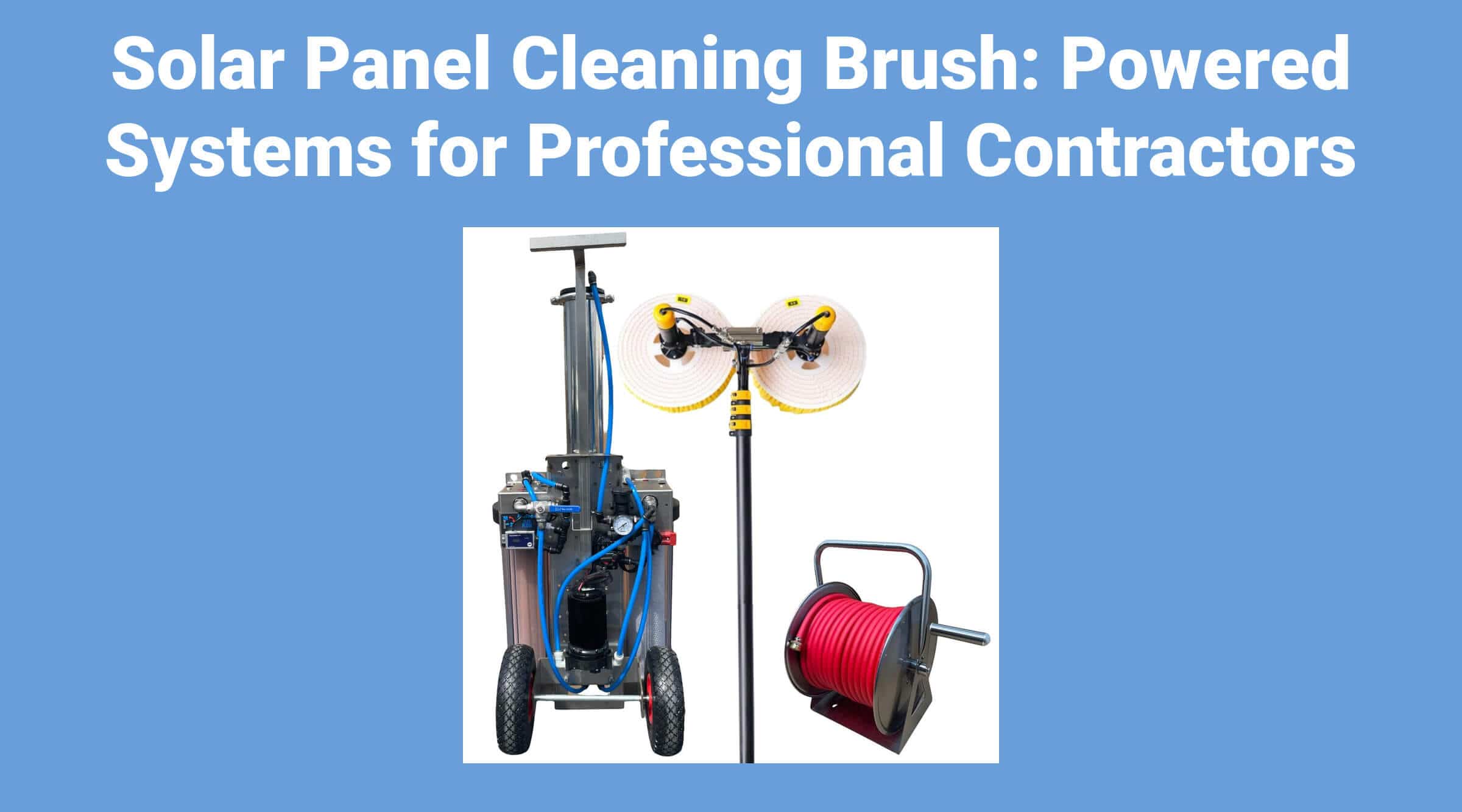
A powered brush removes that variable. The motor supplies even agitation across the panel face, and counter-rotating heads stabilize against the glass so the operator isn't leaning weight into it. On large rooftops and ground mounts that translates directly into labor hours saved. The ProTool SS Ultra Cart Solar Brush Kit pairs a stainless pure-water cart with a 25" double-brush head running at 300 RPM on a 24V drive — battery or 110V — rated at 5,000–8,000 sq ft/hour depending on access. Under good conditions the double-wide head clears a panel in under a minute. Where site power isn't available — or you'd rather run off a pressure washer you already own — the ProTool DualForce 25 Solar Brush takes the same counter-rotating approach in an 11-lb, ladder-friendly package, clearing up to 200 panels an hour.
The payoff is largest on repeat maintenance contracts, utility and community solar, and dusty, coastal, or high-bird-traffic sites — anywhere labor is the cost driver and consistency is the spec.
What makes a brush solar-safe
"Mechanically driven" means the head spins under its own power — motor, battery, or water drive — instead of the operator generating every stroke. Nylon and poly bristles suit solar work because they're non-metallic, durable, and non-conductive. But material alone isn't safety. A nylon brush still damages panels if it's stiff, gritty, run dry, spun too fast, or pressed too hard.
A genuinely solar-safe solar panel cleaning brush is:
- Soft and non-abrasive to glass and anti-reflective coatings.
- Non-conductive, preventing an electrical path from forming.
- Used wet, never dry — water lifts and suspends grit instead of letting it scour.
- Run at controlled contact pressure, so no localized load can start a cell micro-crack.
- Cleared for use against the module maker's own cleaning instructions.
Canadian Solar allows soft cloths, sponges, and soft-bristle brushes, but warns that poorly designed equipment can create localized heavy loads that crack cells and void the warranty — and that tools must not abrade glass, EPDM, silicone, aluminum, or steel. LONGi goes further: its cleaning instruction names nylon bristles in the 0.06–0.1 mm range as the recommended tool, exactly the soft, non-metallic bristle class a quality powered solar panel cleaning brush uses.
Pure water and spot-free rinsing
The best brush still leaves callbacks if the water is wrong. High-mineral tap water dries to scale and spotting that blocks light. JinkoSolar specifies neutral water at pH 6.5–8 to protect the coating layer; Canadian Solar calls for low-mineral water near neutral pH. RO/DI removes dissolved minerals so panels flash off clean. The ProTool HiFlo Pure Water Cart MAX SS 110V runs multi-stage RO/DI with DI polishing to 0 TDS at around 3 GPM for high-volume work. A simple field rule: test TDS before you start, watch it during production, and swap resin before spotting shows up. For more options, browse pure water cleaning systems.
Safety: this is live-electrical work
PV modules are electrical equipment. They produce DC voltage in any light, and full open-circuit voltage holds even at low irradiance. Shutting off an inverter or isolator reduces downstream hazards but does not make the glass, leads, connectors, or string conductors safe to treat casually — Canadian Solar is explicit that daytime array voltage and current can be lethal. OSHA flags arc flash, shock, falls, and thermal burns across solar O&M, with fall protection required at unprotected edges and elevated surfaces.
A defensible powered-brush program includes:
- Pre-clean inspection for cracked glass, exposed conductors, loose connectors, damaged junction boxes, and unsafe roof conditions.
- Isolation where it applies — while still treating modules and strings as live in daylight.
- Non-conductive brush assemblies and GFCI-protected power.
- Fall-protection planning for edges, skylights, fragile roofing, wet surfaces, and ladders. See fall protection equipment for harnesses, lanyards, and anchors rated for roof work.
- Weather limits: no work in lightning, heavy rain, high wind, ice, or extreme heat.
- Training specific to PV cleaning — not generic window-cleaning crew habits.
If your crew is new to powered solar work, watch the ProTool double-brush system walkthrough on our YouTube channel before the first job.
Manufacturer approval: what's actually approved
This is where most "safe for solar" marketing falls apart. The major module makers agree on the basics — soft non-abrasive tools, no dry scraping, no harsh chemicals, cool-panel conditions, low-mineral neutral water, qualified people, no work on damaged modules. They diverge on details, and the details are where warranties are won or lost:
- Canadian Solar permits wet cleaning with a non-conductive soft brush or sponge, but rotating-brush methods require advance consultation with Canadian Solar technical service, and only Canadian Solar-approved cleaning substances may be used.
- JinkoSolar calls for soft cloth, no abrasives, neutral water, cool low-irradiance timing, no chemicals (warranty/yield risk), and hose or backpack pressure below 675 kPa.
- Qcells requires qualified personnel, rules out abrasive materials, and excludes cleaning-tool or cleaning-agent damage from warranty — recommending only tools already tested with PV modules.
- LONGi is the most brush-friendly of the majors: it permits soft brushes, sponges, and non-woven fabrics, specifically recommends nylon bristles of 0.06–0.1 mm, caps wash pressure below 3,000 Pa on front glass (1,500 Pa on bifacial backs), wants low-mineral water at pH 6–8 within a few degrees of module temperature, and expressly allows cleaning machines or robots that meet its manual's requirements.
- Trina Solar allows a dry or wet soft cloth, sponge, or soft-bristled brush, as long as the tool won't wear glass, EPDM, silicone, or aluminum — and warns that improper cleaning procedures void the warranty.
- First Solar caps nozzle pressure at 35 bar (500 psi) with water within 20°C of the module, and on anti-reflective-coated modules prohibits dry brushing outright — any mechanical cleaning method needs advance approval from First Solar technical services.
A powered nylon brush is never "manufacturer approved" just because it's soft and sold for solar. The approval path is concrete: identify the exact module make, model, glass, and coating; pull the current O&M manual; confirm whether rotating brushes are allowed, restricted, or need written sign-off; verify bristle, pressure, water-quality, and chemical limits; get written confirmation where the manual is silent; keep it in the job file; and document a test area on the first service.
The honest marketing line is manufacturer-aligned, not manufacturer-approved — "designed to align with module-maker cleaning requirements when used with soft, non-abrasive, non-conductive bristles, purified neutral water, controlled pressure, and module-specific approval."
Once the warranty period for any coating or the top surface has expired then the needs to meet the manufacturer approved method dimishes dramatically.
Pressure: the distinction that matters
Direct pressure washing is discouraged for good reason — a narrow high-pressure jet can drive water past seals, hit connectors, and create shock paths. But a water-powered rotary brush uses line pressure to spin the head, not blast the glass. The ProTool DualForce 25 runs at roughly 600–800 PSI to turn its two counter-rotating heads off a standard pressure washer (plug-and-play with units around 3.0–3.2 GPM and 2,800–3,300 PSI), but the cleaning action is the soft brush in contact with the panel, not a concentrated stream. A wider 32" water-powered rotary brush works the same way for more coverage. Verify permitted brush types against the module's manual first. The safe policy: use the lowest effective pressure and flow for lubrication, rotation, and rinsing; never aim a jet at edges, junction boxes, connectors, or cable entries; and on mixed-module sites follow the strictest manufacturer requirement present.
Field SOP for powered nylon/poly brush cleaning
- Document the job. Site, owner, module brand/model, inverter status, weather, access, water source. Confirm whether the maker allows soft-bristle and rotating brushes, which agents, and what pressure.
- Inspect for hazards. Cracked glass, delamination, exposed conductors, damaged connectors, loose wiring, corroded frames, unstable racking, edge and skylight risks. Don't clean damaged modules until a qualified party evaluates them.
- Prep water. RO/DI or low-mineral neutral water; record TDS and pH where the owner requires it.
- Set up. Clean, soft, grit-free bristles; check head, motor, battery or 110V supply, hoses, GFCI, pole; on water-powered brushes verify the regulator and gauge before the brush touches glass.
- Clean. Wet first, keep the brush moving, never dry-scrub, never lean on it, never let it stall. Stay off corners, unsupported glass, junction boxes, and cable runs. Rinse thoroughly.
- Review. Check for residue, spotting, brush marks, and displaced cables. Photograph before/after, log water readings, and note any module left uncleaned for safety.
Two ways to run it: the ProTool solar panel cleaning brush lineup
ProTool covers both ends of the powered-cleaning decision — a corded production rig and a portable water-driven unit — so you can match the tool to the site rather than force one setup everywhere.
Maximum production — ProTool SS Ultra Cart Solar Brush Kit. A stainless pure-water cart delivering up to 125 PSI and 3+ GPM through RO/DI filtration, hose management, and the 25" double rotating electric solar brush (battery or 110V). This is the high-volume rig for crews running big commercial and utility arrays in one integrated system.
Maximum portability — ProTool DualForce 25 Solar Brush. A water-powered, counter-rotating 25" head that runs straight off a small pressure washer — no external electrical power needed. At 11 lbs it's built for ladder access and rooftop work, cleaning up to 200 panels an hour and 2,000 a day. It ships with the ProTool Apex carbon fiber pole, a 50 ft pressure hose with quick connects, pressure gauge, and ball valve — and the pole's insulated base handle adds an electrical-protection layer that matters on live arrays.
Whichever you run, the case is the same: high-speed, consistent cleaning inside a manufacturer-aligned process. Used with soft non-abrasive bristles, purified neutral water, controlled pressure, trained techs, and module-specific approval, a powered solar panel cleaning brush lifts production without harsh chemicals or aggressive hand-scrubbing. Browse the full range in solar panel cleaning equipment.
Products Mentioned
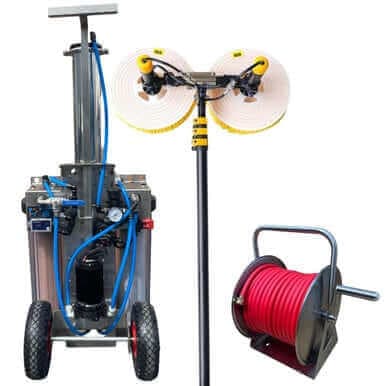 ProTool SS Ultra Cart Solar Brush Kit SKU: 150-05465 | 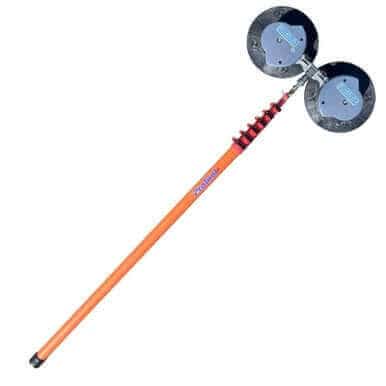 ProTool DualForce 25 Solar Brush SKU: 159-206 | 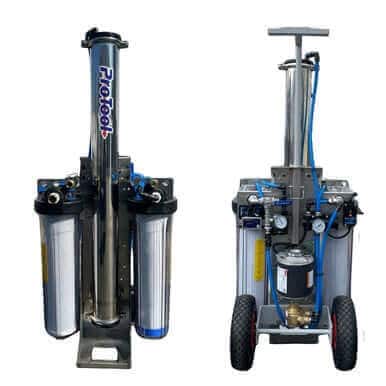 ProTool HiFlo Pure Water Cart MAX SS 110V SKU: 150-0523 |
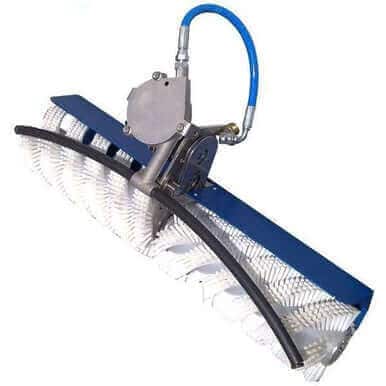 Rotary Brush 24 in (60cm) Water Powered SKU: Z159-134 | 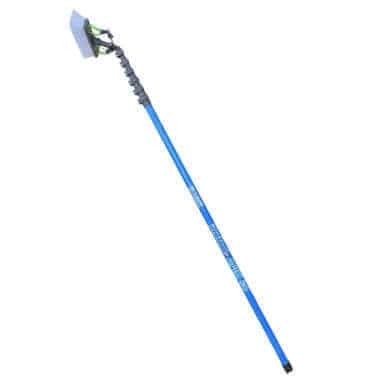 ProTool Apex Carbon Fiber Water Fed Pole SKU: 151-32M | ProTool DualForce 25 Solar Brush SKU: 159-206 |