
Water Fed Pole Techniques That Eliminate Spotting and Rework

Table of Contents
Water fed pole techniques separate the crews billing premium rates from the ones chasing callbacks. Spot-free results don't come from pressing harder — they come from understanding pure water chemistry, controlling your rinse sequence, and matching your gear to the job. This guide covers the scrub-and-rinse workflow that eliminates rework on every pane, from standard residential routes to deep-set commercial frames at 50+ feet.
Why Pure Water Demands Different Technique
Deionized or RO/DI water is chemically aggressive. Strip out every dissolved mineral and the water becomes a solvent that bonds with whatever it contacts — dirt, pollen, oxidation, bird residue. That's the entire mechanism. No surfactants, no soap film left behind to attract new grime. But the water alone won't do the work. Without mechanical agitation from the brush, pure water sheets over embedded contamination without lifting it.
This is why operators who spray and walk away get callbacks, while operators who understand the scrub-rinse relationship don't.
TDS: The Number That Matters
Your TDS meter is the single most important quality-control tool on the truck. Professional results require 0 ppm at the brush head — anything above 10 ppm risks visible spotting once the water evaporates. Cold water temperatures slow ion exchange in DI resin. High inlet pressure can bypass filtration stages on improperly regulated systems. Check your meter after every tank fill and again mid-route. If the number creeps, your resin is spent or your RO membrane needs flushing.
Hydrophilic vs. Hydrophobic Glass
Glass surface chemistry dictates your rinse strategy. Hydrophilic glass lets water sheet — gravity does most of the final rinse work. Hydrophobic glass (common on newer low-E coatings and glass treated with rain-repellent products) causes beading. Those beads trap microscopic particles between them, and when they dry, you get the "mystery spots" that appear 20 minutes after you've packed up.
The fix is straightforward: hydrophobic glass requires fan-jet rinsing for full coverage, while hydrophilic glass benefits from a slower top-down sheet. Identifying the surface type before you start saves time and eliminates guesswork on the rinse.
The 5-Step WFP Workflow
Standardizing this sequence is the only way to scale a crew without quality variation. Every technician follows the same steps, every pane gets the same treatment, regardless of building complexity.
Step 1–2: Frame Flush and Top Scrub
The frame is the primary source of post-clean spotting. Silt and oxidation accumulate in the top seal and side channels. If you touch the glass first, that debris bleeds onto your clean pane as water drains from the frame.
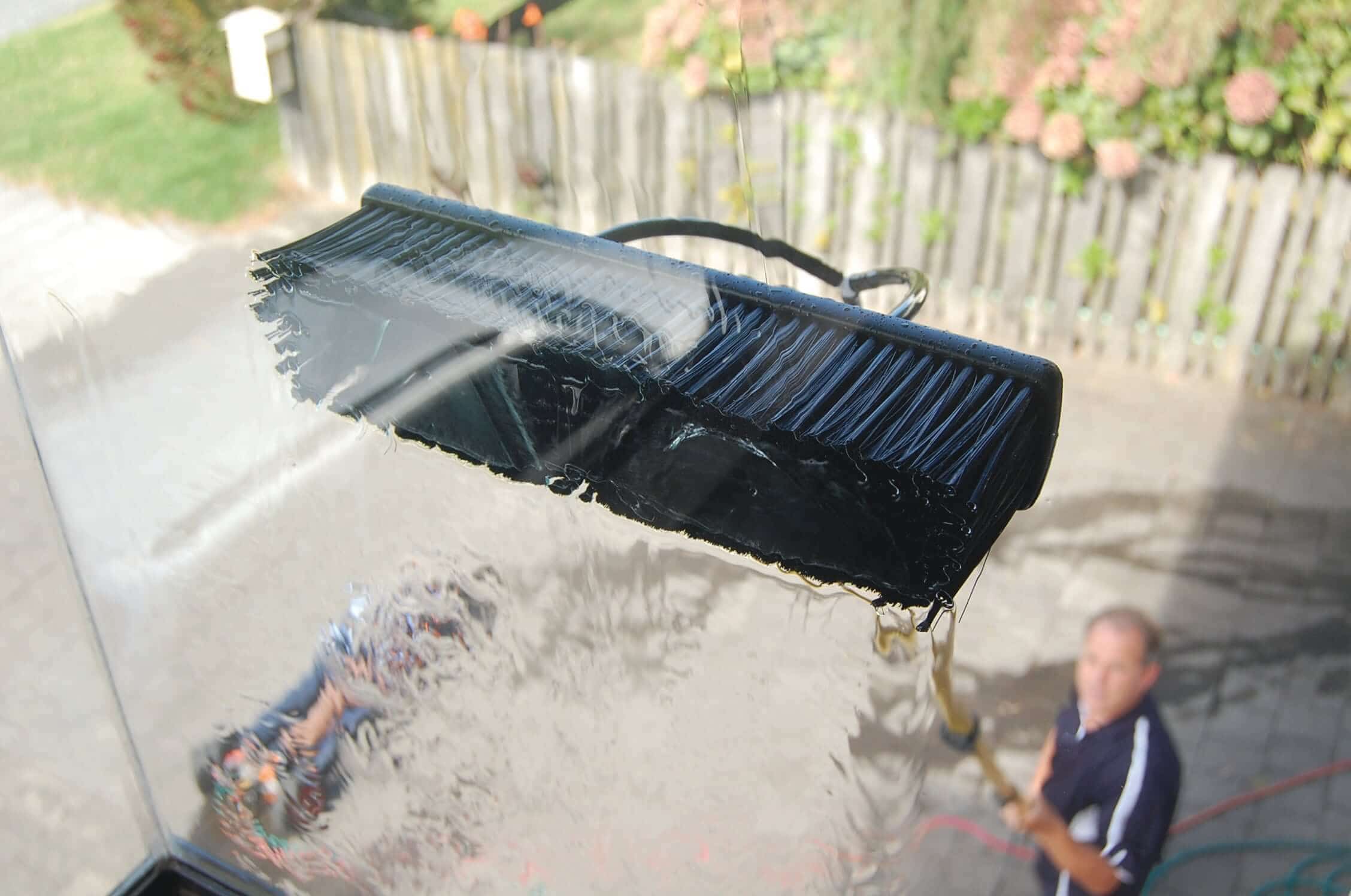
Begin by flushing the top and side frames with the brush head. "Mop" the top edge — the brush catches hidden debris that water alone misses. This proactive flush prevents dirty drip-down during the rinse phase. On first-time cleans or neglected properties, spend twice as long on the frame as you think you need.
Step 3: Agitation
Move to the glass using horizontal strokes, overlapping each pass by roughly 50%. That overlap matters — brush bristles deliver less pressure at their outer edges, so without overlap you leave untouched strips. Every square inch of the pane needs mechanical contact to break the static bond between contamination and glass.
Step 4–5: Pattern Rinse and Final Check
After scrubbing the full surface, lift the brush 2–4 inches off the glass for the final rinse. This distance lets the jets create a sheeting action that uses gravity to pull every remaining particle down and off the pane. Start at the top frame and work down without pausing.
Timing is critical. On hot days or in direct sun, you must finish the rinse before evaporation begins. Work smaller sections if ambient temperature is above 85°F. A booster pump helps maintain the volume needed to keep the glass wet long enough for a clean sheet-off.
High-Reach Technique: Managing Pole Flex Above 30 Feet
Above three stories, pole flex — "whip" — becomes the dominant technical challenge. The brush bounces, rinse patterns go uneven, and your arms burn out compensating. Refining water fed pole techniques at height means shifting from arm-driven movements to core-centered control.
Anchor the pole against your hip or use a support belt. Your body becomes the stabilizer. This reduces fatigue dramatically and keeps brush pressure consistent even at full extension on a high-modulus carbon fiber pole.
Gooseneck Selection for Deep Sills
Standard residential windows rarely need more than a slight brush angle. Commercial ledges are different — deep concrete or stone sills can block the pole entirely if your gooseneck angle is wrong. A 45-degree or adjustable gooseneck lets you reach the glass without the pole shaft hitting masonry. The pole's rigidity determines how much of your scrubbing force actually reaches the pane. Lower-grade hybrid poles absorb that energy as vibration, forcing you to work harder for the same result.
Working Around Architectural Obstacles
Juliet balconies, sunshades, deep reveals — these demand the "Pivot and Glide" approach. Instead of fighting the obstacle with vertical force, rotate the pole on its axis to slide the brush behind the barrier while maintaining glass contact.
- Side-to-side sweeping — best for sunshades and wide horizontal panes.
- Vertical strokes — for narrow sections where lateral movement is restricted.
- Angle compensation — adjust your distance from the building so rinse jets hit the top seal at a downward angle.
If you can't get the brush above the top frame due to an overhang, use the pole's natural flex to "flick" water onto the upper seal. It's not elegant, but it works.
Troubleshooting Spots When TDS Reads Zero
Zero TDS and still getting spots? It's not a filtration failure — it's almost always seal bleed or frame oxidation.
Seal Bleed
Pure water penetrates rubber gaskets and flushes out years of trapped silt. That dirty water drips onto the clean pane after you've moved on. The tell: spots appear 5–15 minutes after cleaning, concentrated near frame edges.
Prevention: keep the brush at least half an inch below the top seal on problem windows. Reduce water volume at the frame to avoid "charging" the gasket. On first-time cleans, use a dedicated stiff-bristle brush for the heavy scrub, then switch to a softer maintenance brush for the final pass.
Frame Oxidation
Common on older aluminum and painted frames. Pure water creates a milky, chalky runoff that ruins glass clarity. Look for the milky discharge during your initial scrub — that's your signal. Use the "Double Rinse" method: a heavy initial scrub and rinse to strip the bulk of the oxidation, then a second lighter rinse after the frames stop dripping.
Temperature and Evaporation
Heated pure water systems reduce surface tension of organic contaminants — effective for bird droppings and snail trails that cold water smears. In cold weather, slower evaporation actually helps, but an imperfect rinse has more time to redistribute particles before drying. In hot conditions, speed and volume are your allies. Work smaller sections and ensure the rinse follows the scrub immediately.
Gear Selection That Protects Your Margins
Poles: The 30-Foot Decision Point
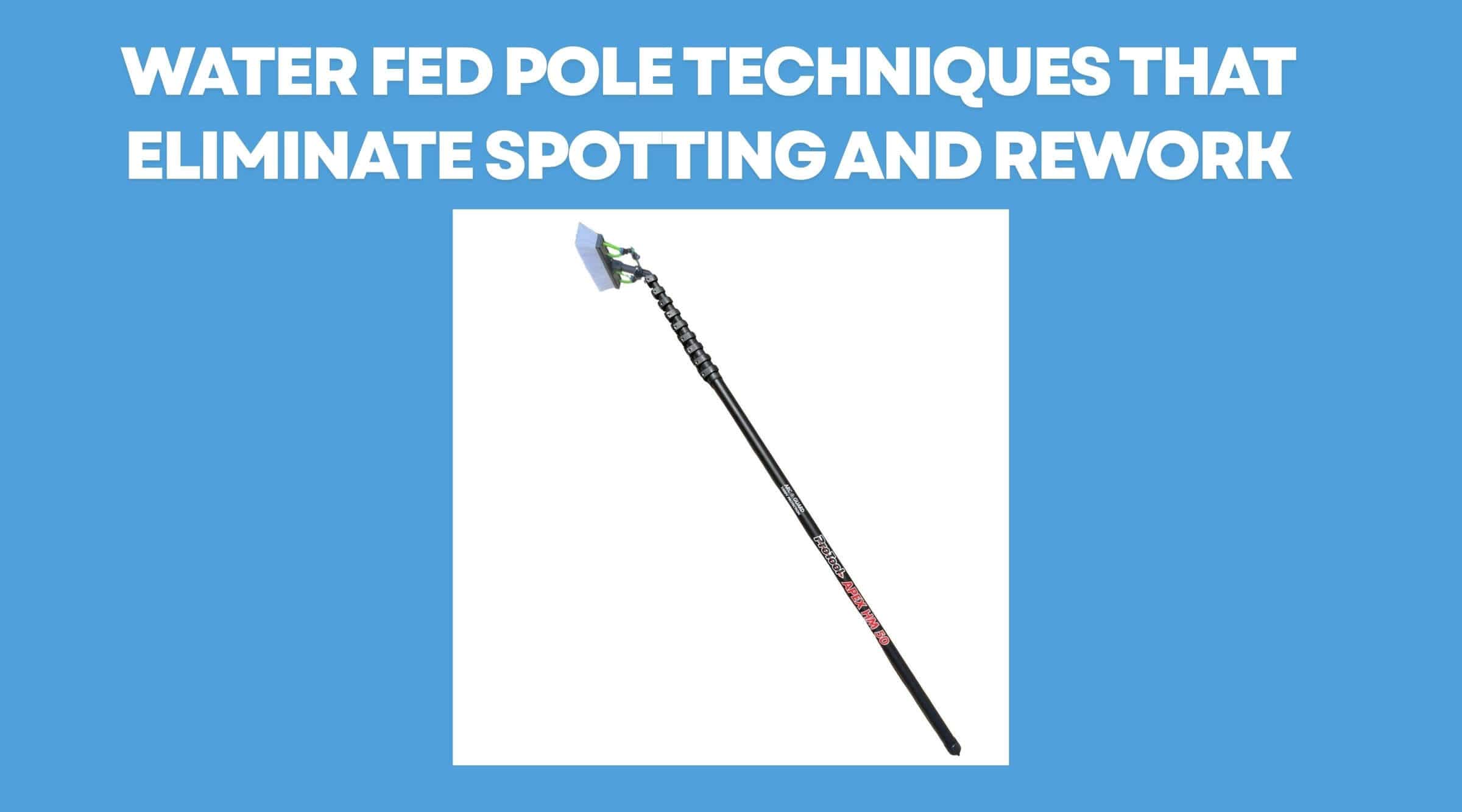
Below 30 feet, hybrid poles balance durability and cost for residential routes. Above three stories, you need high-modulus carbon fiber. The Gardiner SLX and ProTool Apex lines deliver the rigidity required to maintain consistent scrubbing pressure at 40–60 feet without pole bounce. Poles with longer individual sections mean fewer clamps and faster setup on multi-story commercial sites.
Filtration: DI-Only vs. RO/DI
A standalone DI tank works for low-TDS areas and light residential routes. In regions with input TDS above 150 ppm, resin replacement costs eat your margins fast. A multi-stage RO/DI system removes the bulk of dissolved solids before water reaches the resin, extending DI cartridge life dramatically. The ProTool HiFlo Pure Water Cart and ProTool HiFlo Ultra Cart both run dual-stage filtration with inline TDS monitoring — no guesswork on water quality.
Brushes: Match the Bristle to the Job
Natural boar's hair filaments (like those on Tucker LOCT brushes) provide superior agitation for first-time cleans and heavy organic debris. Synthetic nylon bristles are lighter and facilitate faster sheeting on regular maintenance routes. Dual-trim brushes — stiff outer, soft inner — offer a practical middle ground for mixed-route operators.
Maintenance That Prevents Failures
Flush your RO membrane on the schedule the manufacturer specifies, not when TDS spikes. Inspect pump diaphragms and check valves monthly. Replace DI resin when your inline meter consistently reads above 10 ppm — not higher. These are the habits that separate crews running clean, profitable routes from crews burning resin and chasing callbacks.
For a walkthrough of building a complete water fed pole system matched to your route density and local water conditions, see our pure water system selection guide.
Products Mentioned
 ProTool Apex Carbon Fiber Water Fed Pole SKU: 151-32M |  ProTool HiFlo Pure Water Cart Stainless Steel SKU: 150-0521 | 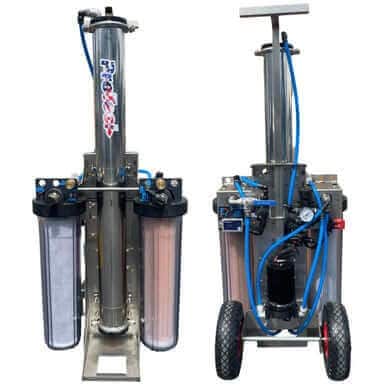 ProTool HiFlo Pure Water Ultra Cart SS 12V or 110V SKU: 150-0522 |