
Clean and Shine: Sanitizing Add-On for Window Cleaning & Pressure Washing

Table of Contents
- Introduction
- Why Sanitizing Is a Growing Add-On Service
- Clean & Shine: The Preferred Disinfectant
- Affordable Sprayer Options
- Understanding Droplet Size
- How to Apply Clean and Shine with a Sprayer
- Spraying Sanitizers Takes Practice
- Safety First: PPE and Precautions
- Adding Sanitizing to Your Service Offerings
- Conclusion
- FAQs
Interior and Exterior Sanitizing: A Natural Add-On for the Window Cleaning and Pressure Washing Industry
Introduction
The cleaning industry has always been about more than just appearance—it’s about health, safety, and protection. In recent years, demand for sanitizing services has skyrocketed, and many window cleaning and pressure washing companies are discovering that sanitizing is a natural and profitable add-on service.
Adding interior and exterior sanitizing allows cleaning professionals to meet customer needs beyond spotless windows or clean driveways. Businesses, schools, hospitals, restaurants, and homeowners all want their spaces not just looking clean, but also germ-free and safe.
Fortunately, sanitizing services are easy to integrate into an existing cleaning business. The equipment is affordable, the process is straightforward, and disinfectants like Clean and Shine make the job simple, effective, and budget-friendly. In this blog, we’ll dive into:
Why sanitizing is an essential add-on service
How Clean & Shine Disinfectant works
Affordable equipment options for sanitizing
The importance of droplet size when spraying disinfectants
Best practices for application and safety
Tips to build sanitizing into your service offerings
Why Sanitizing Is a Growing Add-On Service
For window cleaning and pressure washing professionals, sanitizing is the perfect extension of existing services. Here’s why:
Customer Demand: Since the pandemic, customers expect cleaners to address not only dirt and grime but also bacteria and viruses. Offering sanitizing meets this need.
Recurring Opportunities: Unlike windows or siding, which may only be cleaned seasonally, sanitizing can be offered weekly or monthly.
Affordable Investment: Equipment ranges from inexpensive trigger sprayers to professional electrostatic sprayers—making it accessible for businesses of all sizes.
High-Value Perception: Customers view sanitizing as an essential service, allowing businesses to charge premium rates while keeping material costs low.
Clean & Shine: The Preferred Disinfectant
At the heart of any sanitizing service is the disinfectant. Our top choice is Clean & Shine Disinfectant (Item #83-001)—an EPA-registered cleaner, deodorizer, and sanitizer designed for a wide variety of surfaces.
Key Features of Clean and Shine:
EPA-Registered: Meets rigorous standards for germ-killing effectiveness.
Broad Spectrum Protection: Kills Human Coronavirus, HIV-1, Herpes Simplex, Salmonella, Pseudomonas, Streptococcus, MRSA, and more.
Versatile Use: Safe for offices, schools, nursing homes, hospitals, food service environments, and more.
Surface Compatibility: Works on floors, walls, counters, glass, tile, and even non-porous food contact surfaces—with no rinse required.
Affordable Concentrate: Just 2 ounces per gallon of water—one gallon of concentrate makes 64 gallons of ready-to-use product.
Pleasant Scent: Light yellow liquid with a Summer Breeze fragrance for a fresh, clean finish.
This combination of effectiveness, safety, and affordability makes Clean & Shine an ideal product for professional cleaners expanding into sanitizing.
Affordable Sprayer Options
To apply sanitizers effectively, you’ll need a sprayer. Thankfully, sprayers range in price and complexity, so there’s an option for every budget.
Trigger Sprayers: Cost only a few dollars. Best for small jobs or targeted applications.
Electric Sprayers: Mid-range option, usually under $300. Provide consistent spray but don’t allow micron size adjustments.
ULV (Ultra-Low Volume) Sprayers: Produce fine mist sprays with adjustable droplet sizes. Great for offices, schools, and interior applications.
Electrostatic Sprayers: Advanced technology that charges droplets for better surface coverage. Excellent for large commercial clients.
Backpack Sprayers: Versatile for interior and exterior work, especially for cleaning large outdoor areas quickly.
Most professional sprayers cost $300 or less, while even high-end electrostatic models rarely exceed $750. This makes adding sanitizing services highly accessible.
Understanding Droplet Size
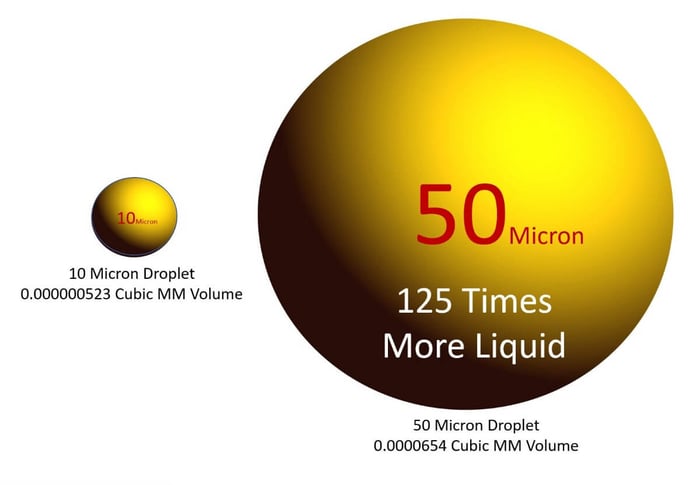
One of the most important concepts in sanitizing is droplet size, measured in microns. Droplets are spherical, meaning their volume increases exponentially as micron size increases.
For example:
A 50-micron droplet doesn’t just hold 5 times more liquid than a 10-micron droplet—it actually holds 125 times more liquid!
Why does this matter?
Small droplets (5–10 microns): Create a fine mist that lightly coats surfaces without over-wetting. Perfect for interior surfaces like desks, countertops, and electronics.
Large droplets (30–50 microns): Deliver heavier coverage. Ideal for outdoor tables, chairs, playground equipment, and high-touch exterior areas.
Sprayers like ULV and electrostatic units allow you to adjust micron size, while trigger sprayers do not. For fixed-output sprayers, you’ll need to adjust your spraying technique to control coverage.
How to Apply Clean and Shine with a Sprayer
Applying disinfectant correctly is crucial for both effectiveness and surface protection.
Prepare Your Solution
Mix Clean and Shine at 2 ounces per gallon of water.
Fill your sprayer with the prepared solution.
Apply Lightly
Spray just enough to moisten the surface.
Avoid pooling or dousing surfaces—too much liquid may damage surfaces or cause staining.
Adjust for Surface Type
Use fine mist (low microns) for delicate surfaces like electronics.
Use larger droplets (higher microns) for durable surfaces like tables, playground equipment, or outdoor furniture.
Allow Contact Time
Ensure the disinfectant remains on the surface long enough to kill pathogens.
Avoid wiping unless required by the label instructions.
Check Coverage
Just like spray painting, even coverage is key.
Move your sprayer smoothly across surfaces—too slow creates puddles, too fast misses spots.
Spraying Sanitizers Takes Practice
While sanitizing isn’t complicated, it does require practice and technique. Much like spray painting, finding the right pace ensures even coverage without over-application.
Trigger Sprayers: Move quickly to avoid wet spots.
Electric Sprayers: Provide more consistency but still require a steady hand.
ULV/Electrostatic Sprayers: Offer greater control and precision, but may take time to master adjustments.
With practice, you’ll quickly develop a feel for the right speed, distance, and coverage.
Safety First: PPE and Precautions
Sanitizing may seem simple, but remember—you’re working with chemicals and fine droplets. Always wear the proper personal protective equipment (PPE):
Masks/Respirators: Prevent inhalation of mist.
Gloves: Protect skin from irritation.
Eye Protection: Shields eyes from fine droplets.
Protective Clothing: Optional, but useful for large-scale jobs.
Following PPE guidelines ensures both you and your team remain safe while delivering professional results.
Adding Sanitizing to Your Service Offerings
Integrating sanitizing services into your existing business is straightforward:
Offer Package Deals: Add sanitizing to regular window cleaning or pressure washing jobs.
Promote Recurring Services: Position sanitizing as a weekly or monthly maintenance service.
Market to Commercial Clients: Schools, offices, gyms, and restaurants have ongoing needs.
Highlight Safety: Customers value peace of mind—emphasize EPA-registered disinfectants and safe application methods.
By marketing sanitizing alongside your existing services, you can grow revenue while providing customers with the clean, safe environments they expect.
Conclusion
Interior and exterior sanitizing has become a necessary and natural add-on service for the window cleaning and pressure washing industry. With affordable equipment, effective disinfectants like Clean and Shine, and a bit of practice, professionals can expand their offerings, increase revenue, and meet rising customer demand.
Whether you’re working in homes, schools, restaurants, or office buildings, sanitizing services are here to stay. By mastering techniques like droplet control and safe application, you’ll not only protect your customers but also set your business apart as a trusted, full-service cleaning provider.
👉 Ready to get started? Shop Clean and Shine Disinfectant and professional sprayers today at JRacenstein.com.
FAQs
Why should I add sanitizing services to my window cleaning or pressure washing business?
Sanitizing is a natural extension of cleaning services. It meets rising customer demand for germ-free spaces, creates recurring service opportunities, and requires minimal equipment investment—making it both profitable and simple to add.
What makes Clean & Shine Disinfectant a good choice for professional sanitizing?
Clean & Shine (Item #83-001) is EPA-registered, effective against a broad spectrum of pathogens (including Human Coronavirus, MRSA, and Salmonella), affordable (2 oz. per gallon mix ratio), and safe for multiple surfaces—without needing a rinse.
What equipment do I need to get started with sanitizing?
You can begin with affordable trigger sprayers or invest in ULV and electrostatic sprayers for larger jobs. Most professional sprayers cost under $300, and even top-tier units are usually under $750, making entry highly accessible.
How does droplet size affect disinfectant application?
Droplet size determines coverage and effectiveness. Fine mist (5–10 microns) coats delicate indoor surfaces without over-wetting, while larger droplets (30–50 microns) deliver heavier coverage for outdoor furniture, playgrounds, and high-touch exterior areas.