

Unger Rinse N Go : How to Get a Spot-Free Rinse

A spot-free rinse is the difference between a job that looks finished and one that isn't. Tap water leaves mineral deposits — calcium, magnesium, silica — on every surface it touches. On vehicle paint those spots etch into clear coat over time. On glass they harden into the same stubborn stains you charge customers to remove. Deionized (DI) water eliminates that problem at the source.
This guide covers how DI filtration works, how to test your water's TDS, how to set up and maintain a spot-free rinse system, and which equipment choices make sense depending on your workload.
Why Tap Water Leaves Spots
Water dissolves minerals from every pipe and source it contacts. When the water evaporates, those dissolved solids stay behind as visible deposits. The concentration is measured as Total Dissolved Solids (TDS), expressed in parts per million (ppm). Municipal water typically runs 100–500 ppm. Well water can be much higher.
For a spot-free rinse on glass, you need TDS at or below 10 ppm. For vehicles, 30 ppm or less is acceptable — the curved paint surface is more forgiving than flat glass. Anything above those thresholds and you're back to hand-drying or buffing out water marks.
How to Test Your TDS
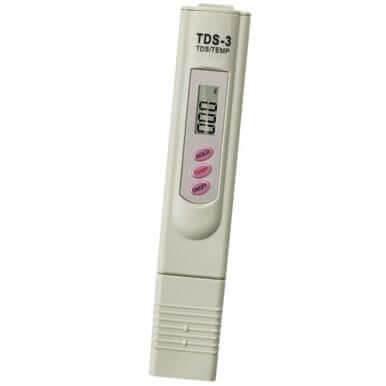
A handheld TDS meter gives you a reading in seconds. Remove the cap, power it on, and dip the probe end into the water you plan to use. The meter sends a small electrical current through the sample — higher conductivity means more dissolved minerals.
Test your source water first, then test the output after it passes through your DI filter. If the output reads above 10 ppm (for glass work) or 30 ppm (for vehicles), the resin is exhausted and needs replacement. An inline TDS meter mounted on your system lets you monitor output in real time without stopping to test manually.
How DI Filtration Creates Spot-Free Water
Deionization uses ion-exchange resin beads to swap dissolved minerals for hydrogen and hydroxide ions — which combine into pure water. The resin is packed inside a cartridge or bag that sits inline between your water source and the delivery hose. As water flows through, TDS drops from hundreds of ppm to single digits.
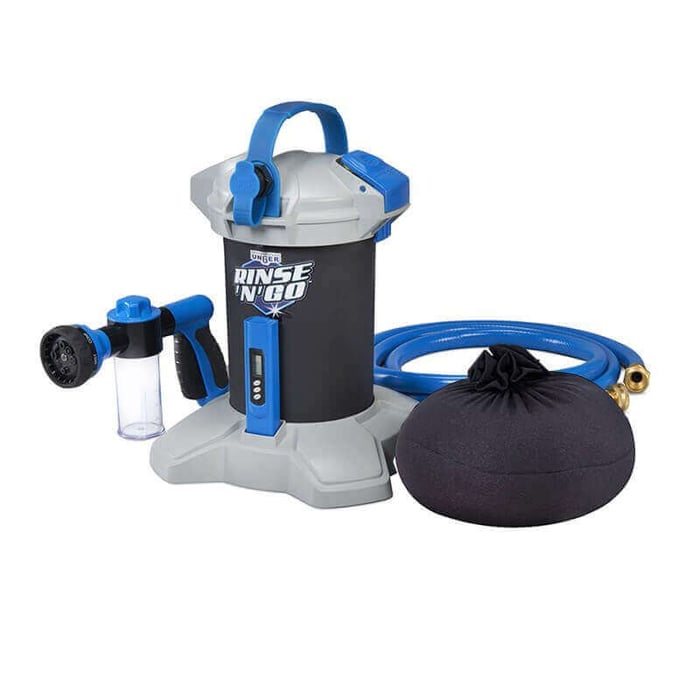
DI-only systems like the Unger Rinse & Go are the simplest entry point: connect to a garden hose, run water through the DI canister, and rinse. No electricity, no drain line, no complicated plumbing. The tradeoff is resin cost — DI resin is consumed proportionally to your source water's TDS, so high-TDS areas burn through it fast.
For higher-volume work or high-TDS source water, a reverse-osmosis (RO) stage upstream of the DI dramatically extends resin life. The RO membrane strips 95–98% of dissolved solids before the water ever hits the resin, so the DI only has to polish the last few ppm. ProTool RODI cart kits pair both stages on a single portable cart, and systems like the ProTool HydroPanel wall mount bring that same two-stage filtration to a permanent shop or garage installation.
Setting Up a Spot-Free Rinse System
Step 1: Connect to your water source
Run a garden hose from your spigot to the inlet of your DI unit (bottom port on most systems). Use a quick-connect garden hose fitting for faster hookup and disconnection.
Step 2: Connect your delivery hose
Attach your spray hose or garden hose to the outlet port (top of the unit). On the Unger Rinse & Go, the kit includes an 8-foot blue inlet hose and a soap-blasting nozzle for wash mode.
Step 3: Flush and test
Open the water and flush the system for 30 seconds to purge air and any loose resin fines. Then test the output with your TDS meter. You should see single-digit ppm. If not, the resin bag may not be seated properly — reseat it and test again.
Step 4: Rinse your surfaces
Use DI water only for the final rinse, not for the entire wash. Soap and do your initial rinse with regular tap water, then switch to the DI line for the final pass. This simple discipline cuts resin consumption dramatically.
Pro tip: Rinse into cracks, crevices, door jambs, and trim edges. Trapped tap water that drips out later leaves the streaks you just paid to prevent.
When and How to Change DI Resin
DI resin is a consumable. As it captures minerals, its capacity drops until TDS starts climbing in the output water. Monitor with your TDS meter — when the reading rises above your threshold (10 ppm for glass, 30 ppm for autos), it's time.
For the Unger Rinse & Go, the resin comes in a sealed bag. The kit ships with two bags. Replacement resin bags are available separately.
Resin change procedure
- Shut off the water source.
- Depressurize: squeeze the spray trigger until flow stops.
- Unlock the cap: press the locking lever on top of the unit, then turn the cap counterclockwise until it clicks free.
- Swap the bag: pull out the spent resin bag, drop in the fresh one.
- Reassemble: replace the cap, lock it in place, open the water, and flush for 30 seconds before use.
Important: Do not open a resin bag until you're ready to install it. Exposed resin absorbs contaminants from the air and loses capacity before it ever touches water.
DI-Only vs. RODI: Choosing the Right System
A DI-only system (like the Rinse & Go or a standalone DI housing with resin) is ideal for low-volume residential work — a few cars a week, occasional window touch-ups, homeowner solar panel rinses. It's compact, inexpensive to start, and requires zero installation.
An RODI system pays for itself when you're running through resin quickly. If your source water is above 200 ppm, an RO membrane upstream will slash your resin cost by 90% or more. The ProTool 511 Pure Water Cart is a good mid-range option for contractors adding spot-free rinse to auto detailing, solar, or water-fed-pole work. For higher throughput or permanent installation, the ProTool HiFlo Cart handles multi-user demand.
Applications Beyond Car Washing
DI water isn't just for vehicles. The same spot-free rinse principle applies to:
- Exterior windows: final-rinse glass after squeegee work on storefronts, or use with a water-fed pole for residential pure-water cleaning.
- Solar panels: mineral deposits reduce panel efficiency. A spot-free rinse with a solar brush system keeps output high without chemical residue.
- RVs and boats: large surface area makes hand-drying impractical. DI rinse eliminates it.
Products Mentioned
 TDS Meter Handheld TDS-3 SKU: 150-0199 | 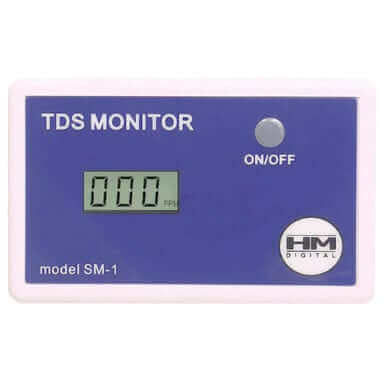 TDS Inline Meter - includes a 1/4 Tee SKU: 150-019 |  Rinse & Go System Unger SKU: 69-203 |
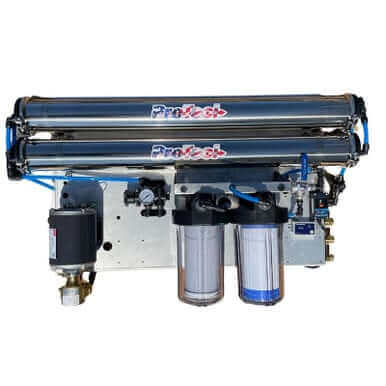 ProTool HydroPanel RODI Wall Mount SKU: 150-05346M | 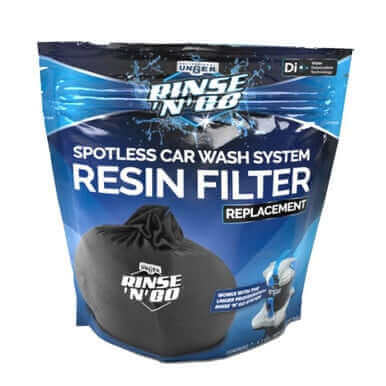 Rinse & Go System Resin Unger SKU: 69-204 | 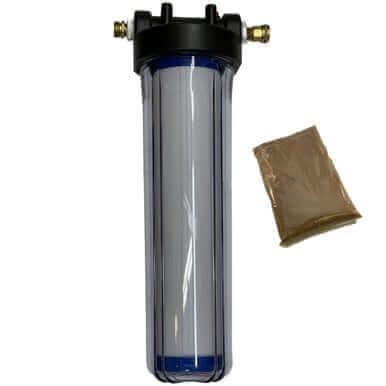 DI Resin Filter, Kit DIY, 20in Housing SKU: 150-060 |
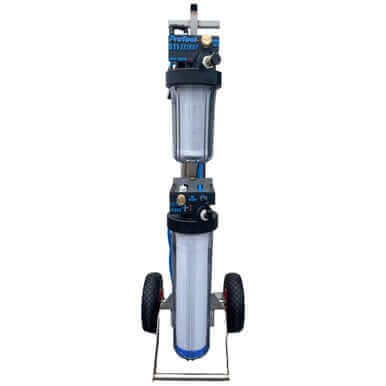 ProTool 511 Pure Water Cart SKU: 150-0515 | 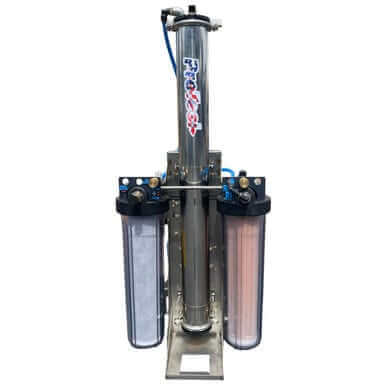 ProTool HiFlo Pure Water Cart Stainless Steel SKU: 150-0521 |