

Window Cleaning and Water Fed Poles
Window cleaning and water fed poles are two skill sets that every exterior cleaning contractor needs to command. Whether you're launching a new operation or bolting window work onto an existing pressure washing or janitorial business, the gap between "I bought a squeegee" and "I'm profitable" is mostly knowledge — tool selection, technique, water chemistry, and the ability to price work so it actually pays.
This training guide covers both disciplines from the ground up: traditional hand cleaning and pure water / water fed pole (WFP) systems. The goal is to get you past the learning-curve mistakes that cost real money — buying the wrong filtration, under-bidding route work, or destroying a pane of glass because nobody explained tin-side science.
Traditional Hand Cleaning Fundamentals
Tool Familiarization
Before you touch glass, know your tools cold. A professional window cleaner's core kit is a squeegee channel, handle, washer sleeve, and T-bar — plus a scraper, towels, and a bucket. Each component has trade-offs in weight, durability, and feel. Channels come in brass, stainless, and aluminum from brands like Ettore, Pulex, and Sorbo. Rubber matters more than most beginners realize — a quality replacement rubber that holds its edge through a full day is worth every cent over bargain rubber that rolls after two hours.
Mopping and Scrubbing
Mopping is where the real cleaning happens. The squeegee only removes water — if the glass isn't properly scrubbed first, you're sealing dirt under a streak-free finish that isn't streak-free. Use enough soap for lubrication (not suds), work your sleeve in overlapping passes, and hit the edges and corners where grime collects. A ProTool Soaker sleeve holds water well for residential work; switch to something more abrasive like a Pulex Abrasive Strip sleeve when you're dealing with construction debris or heavy oxidation.
Squeegeeing Technique
There are two core pulls: the straight pull (top to bottom or side to side) and the fanning technique. Straight pulls are predictable and easy to learn. Fanning is faster once you've built the muscle memory, but sloppy fanning leaves lines. Whichever method you use, keep constant pressure, overlap each stroke by about half an inch, and wipe your rubber between every pass. Detailing the edges with a damp towel is what separates a professional finish from an amateur one.
Water Fed Pole Systems: How They Work
A water fed pole delivers purified water — typically 0 TDS (total dissolved solids) — through a telescopic pole to a brush head on the glass. You scrub with the brush, rinse with pure water, and walk away. No squeegee, no ladder for most residential and mid-rise work. The water dries spot-free because there are no dissolved minerals left to leave residue.
Pure Water Science
Understanding water purification is non-negotiable if you're running a WFP system. There are three stages most professional systems use:
- Sediment and carbon pre-filtration — removes particulates and chlorine that would damage the RO membrane. Carbon and sediment filters are consumables; budget for them.
- Reverse osmosis (RO) — forces water through a semi-permeable membrane, rejecting 95–99% of dissolved solids. An RO membrane is the workhorse of any serious system.
- Deionization (DI) — polishes the RO output to 0 TDS using ion-exchange resin. Running DI after RO extends resin life dramatically compared to DI-only setups.
A TDS meter is your quality-control instrument. If your output reads above 10 ppm, something needs attention — a spent filter, a failing membrane, or a resin cartridge that's exhausted.
Choosing Your Equipment
The right system depends on your tap water quality, your volume, and whether you're working from a van, a truck, or out of a garage. A ProTool HiFlo Pure Water Cart is a strong mid-range option for operators running one or two poles. For higher volume or harder source water, a wall-mounted system like the ProTool HydroPanel lets you batch-produce pure water overnight and load your tank in the morning.
On the pole side, carbon fiber is the standard for anything over 20 feet. A ProTool Apex Carbon Fiber Pole or a Gardiner CLX 27ft will cover most residential work. Match the pole to a quality brush — the ProTool 4 Pencil-Jet Hybrid Brush gives good scrubbing power with efficient rinsing.
Glass Science: What You Need to Know
Not all glass is the same, and not knowing the difference can cost you a job — or a lawsuit. Tempered glass is more scratch-prone than annealed glass due to fabricating debris embedded in the surface during manufacturing. Before you scrape tempered glass, understand the risk. Heat-strengthened glass, Low-E coatings, and tinted films all have different tolerances for chemicals and abrasion. When in doubt, test an inconspicuous area first.
Tin-side versus air-side matters for stain removal and coating adhesion. The tin side (the side that sat on the molten tin bath during float-glass manufacturing) is more chemically reactive. Most exterior glass faces its tin side outward, which is why exterior hard-water stains respond differently to treatment than interior surface contamination.
Bidding and Selling Window Cleaning Work
Under-bidding is the most expensive mistake in this trade. Price per pane is the simplest model for residential route work: count the panes, multiply by your per-pane rate, and add for screens, tracks, hard-water stain removal, and access difficulty. Commercial work is typically bid per square foot of glass or per man-hour, with a premium for high-rise, rope access, or lift work.
When selling, lead with the result — not the process. Homeowners don't care about your TDS readings. They care that their windows will look perfect, stay cleaner longer (a real benefit of pure water cleaning), and that you won't damage their property. Commercial property managers care about reliability, insurance, and whether you can work within their tenant schedule.
System Maintenance
Neglected equipment fails at the worst time. Build these habits:
- Check TDS at the start of every job. Replace filters and resin before output quality drops, not after.
- Flush your RO membrane periodically — mineral scaling reduces output and shortens membrane life.
- Rinse and dry your poles, brushes, and hoses after each use. Standing water breeds bacteria and algae inside tubing.
- Inspect your hose reels, fittings, and pump connections weekly. A slow leak you ignore becomes a failed pump seal you can't ignore.
Safety for Water Fed Pole Operations
Water fed poles eliminate most ladder work, but they introduce their own hazards. A fully extended 40-foot carbon fiber pole near overhead power lines is a serious electrocution risk — carbon fiber conducts electricity. Maintain minimum safe distances from power lines at all times, and know your local regulations.
Ergonomics matter over a full day. Use a pole with a comfortable grip diameter, keep your arms at working height rather than overhead, and take breaks. Repetitive strain injuries end more careers than falls do in ground-level WFP work.
For any work requiring ladders, harnesses, or roof access, proper fall protection equipment is mandatory — not optional, not "for big jobs only." A roof work fall protection kit covers the basics for roof-adjacent cleaning.
Advanced Techniques
Once the fundamentals are solid, efficiency is the next lever. Multi-story residential WFP work benefits from working top-down so rinse water carries debris off lower panes. On commercial storefronts, combining a quick hand-clean at eye level with WFP for transoms and upper glass is often faster than committing fully to either method.
For hard-water stain removal, a ProTool ClearView 300 paired with a polishing pad and drill adapter handles most residential hard-water jobs without resorting to acid. Know when to upsell stain removal as an add-on service — it's high-margin work that most competitors skip.
Products Mentioned
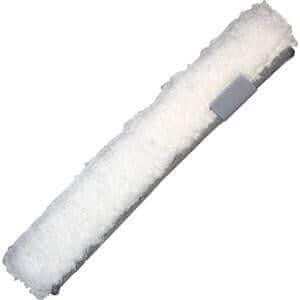 ProTool Sleeve The Soaker 10in SKU: 11-8101 | 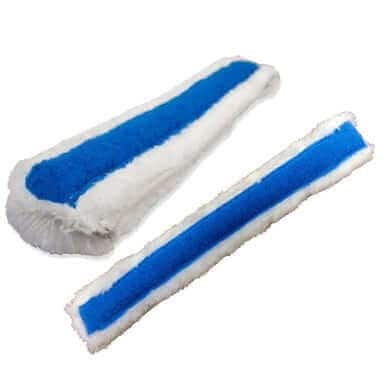 Pulex Sleeve Abrasive Strip SKU: 11-31M | 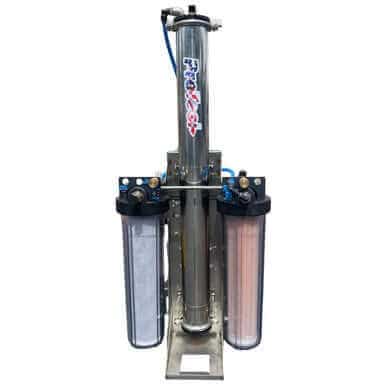 ProTool HiFlo Pure Water Cart Stainless Steel SKU: 150-0521 |
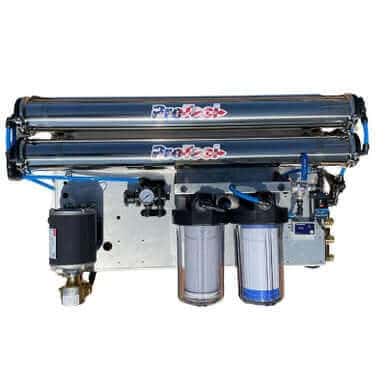 ProTool HydroPanel RODI Wall Mount SKU: 150-05346M | 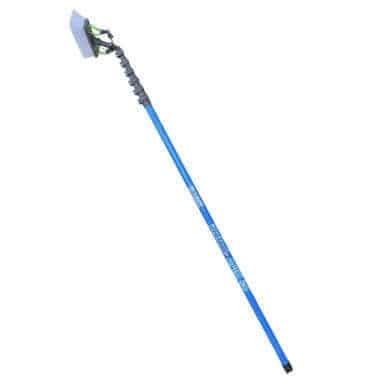 ProTool Apex Carbon Fiber Water Fed Pole SKU: 151-32M | 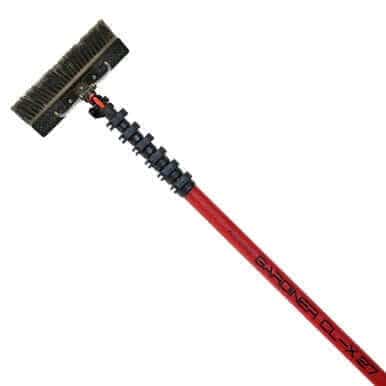 Gardiner CLX 27ft Pole Carbon Composite SKU: 155-4272 |
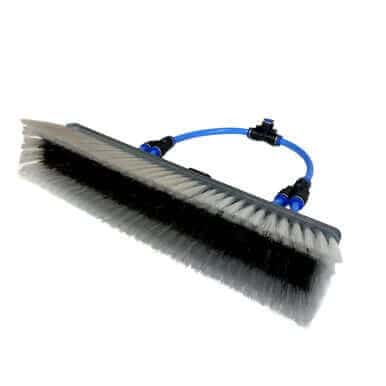 ProTool 4 Pencil-Jet Hybrid Brush 12in SKU: 151-211 | 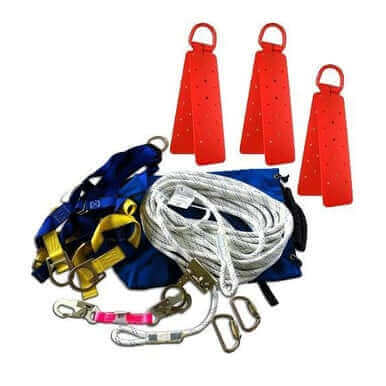 Roof work Fall Protection Kit SKU: 12-660 | 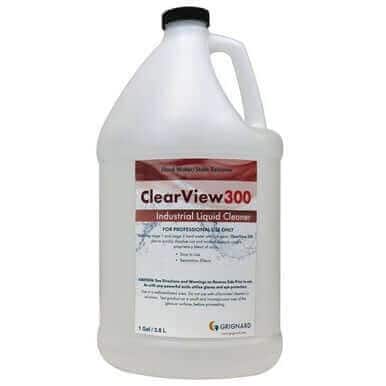 ProTool ClearView 300 Hard Water Stain Remover Gallon SKU: 86-515 |