Choosing the Right T-Bar Squeegee: Fixed vs. Swivel

The t-bar squeegee decision comes down to one question: how much of your route involves flat commercial glass versus tight residential panes with mullions, french doors, and odd angles? That single variable should drive the choice between a fixed and swivel t-bar — or more likely, tell you when to carry both.
Fixed T-Bars: Why Stability Matters on Commercial Glass
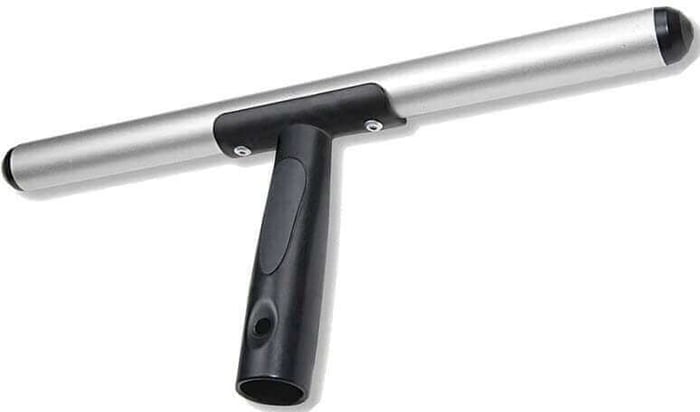
A fixed t-bar locks the sleeve parallel to your handle. No pivot, no play. That rigidity is the point — it lets you load a sleeve with solution and scrub a 6-foot storefront lite in two passes without the head flopping off-angle mid-stroke.
Where fixed t-bars earn their keep:
- Storefronts and commercial route work. Consistent pressure across wide glass means fewer dry spots and faster coverage.
- Pole work on flat facades. A fixed head on an extension pole doesn't wander — you scrub the pane you aimed at, not the frame next to it.
- New cleaners building technique. A fixed head forgives sloppy wrist mechanics because the sleeve stays where you put it.
The trade-off is obvious: when you hit a divided-lite window or need to scrub around hardware, a fixed t-bar forces you to reposition your whole arm instead of just tilting. On residential routes packed with french doors, that repositioning eats time.
The Ettore T-Bar Pro+ Fixed Aluminum is the workhorse here — lightweight aircraft aluminum, snaps onto Pro+ sleeves, and the fixed joint eliminates any wobble when you press into stubborn grime. For a budget-friendly plastic option, the Pulex T-Bar Plastic gets the job done on lighter route work.
Swivel T-Bars: Angled Access Without Repositioning
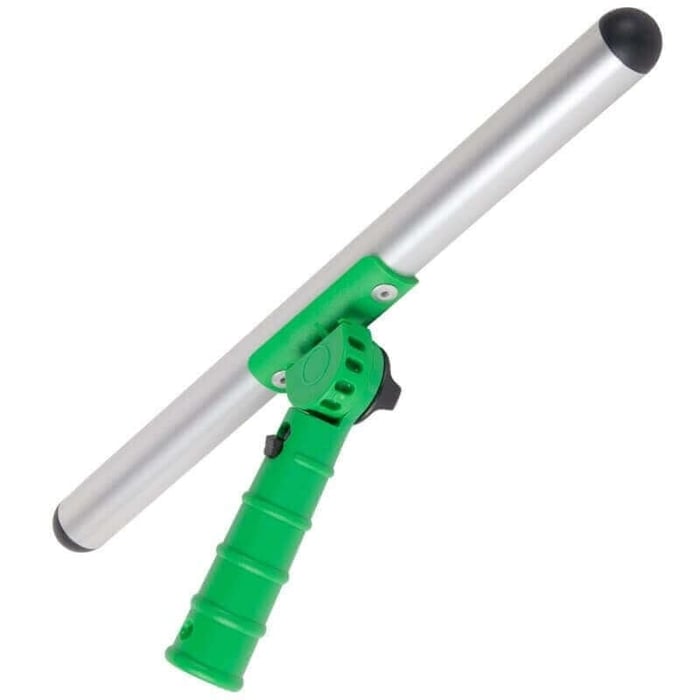
A swivel t-bar pivots at the handle junction, letting the sleeve head rotate to match the angle of the glass — or the angle your pole forces on you from the ground. That pivot is what makes residential work with mullions, transom windows, and skylights practical instead of painful.
Where swivel t-bars win:
- Residential routes. French doors, casement windows, divided lites — anywhere you need the sleeve to hug glass between narrow frames.
- High work on a pole. When you're scrubbing second-story glass from the ground, the swivel compensates for the steep pole angle so the sleeve still makes full contact with the pane.
- Tight interiors. Mirrors, sidelights next to front doors, glass partitions with hardware — the pivot lets you work around obstructions without awkward body contortions.
The downside: on wide-open commercial glass, a swivel head can drift during long horizontal passes, leaving uneven solution coverage. Experienced cleaners control this with wrist pressure, but it's an extra thing to manage.
The Pulex T-Bar Swivel is a solid mid-range pick with smooth pivot action. The Sorbo T-Bar Swivel is another reliable option, especially if you already run Sorbo sleeves. For Moerman fans, the Swivel Master T-Bar by Moerman pairs directly with Moerman's Click & Scrub pad system for aggressive scrubbing on neglected glass.
Choosing by Job Type — Not Skill Level
The common advice is "beginners should start fixed, then graduate to swivel." That framing is backwards. The choice is driven by the glass you clean, not how long you've been cleaning it.
| Factor | Fixed T-Bar | Swivel T-Bar |
|---|---|---|
| Best glass type | Large single-pane commercial | Divided-lite residential, mirrors, sidelights |
| Pole work | Flat facades, straight reach | Steep angles, second-story from ground |
| Speed advantage | Wide open glass — fewer strokes | Complex layouts — less repositioning |
| Control risk | None — head stays locked | Drift on long passes if wrist pressure is loose |
| Sleeve compatibility | Universal — any sleeve that fits the size | Universal — same sizing |
Most working cleaners carry both. A 14" or 18" fixed t-bar handles the storefronts; a 10" or 14" swivel handles the residential detail work. If you only buy one, look at your route mix. Eighty percent commercial? Go fixed. Eighty percent residential? Go swivel.
Sizing and Sleeve Pairing
T-bar size should match your washer sleeve and roughly match your squeegee channel. Running an 18" t-bar with a 14" channel means you're wetting glass you won't squeegee in the same pass — wasted motion.
Common professional pairings:
- 10" — Residential detail: sidelights, small casements. Pairs with a 10" channel.
- 14" — The all-rounder. Fits most residential panes and mid-size commercial lites.
- 18" — Commercial route standard. Covers large storefronts efficiently.
- 22"–24" — Large plate glass, atriums. Specialized, not everyday carry.
Browse the full lineup of professional t-bars by size and brand in the T-Bars category.
Maintenance Worth Mentioning
Fixed t-bars are essentially maintenance-free — rinse, dry, done. Swivel t-bars need periodic attention at the pivot joint. Grit and dried soap build up in the swivel mechanism and eventually make the action stiff or gritty. A quick rinse and occasional drop of silicone lubricant keeps the pivot smooth. If the swivel on a Pulex or Sorbo t-bar starts binding, disassemble the joint, clean the contact surfaces, and reassemble — it takes two minutes and saves you from fighting the tool all day.
Products Mentioned
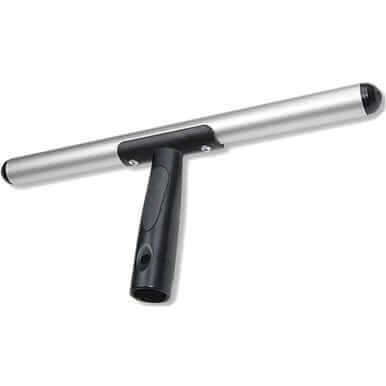 Ettore T-Bar Pro+ Fixed Aluminum SKU: 10-15M | 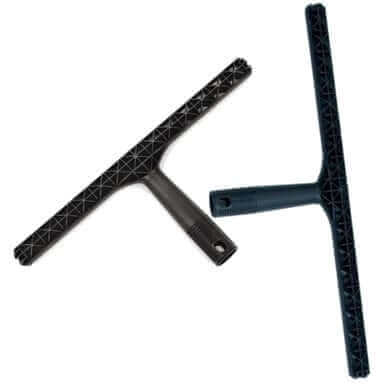 Pulex T-Bar Plastic SKU: 10-32M | 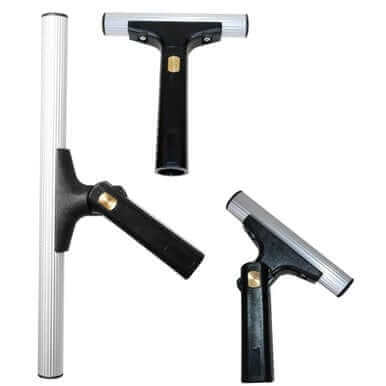 Pulex T-Bar Swivel SKU: 10-33M |
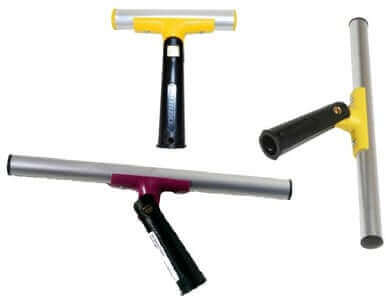 Sorbo T-Bar Swivel SKU: 10-42M | 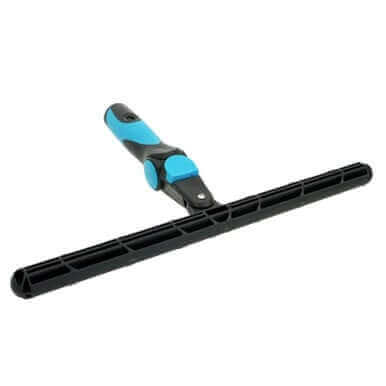 Swivel Master T-Bar by Moerman SKU: 10-83M |