Plant Wash Powder: Protecting Foliage During Softwash Jobs
Table of Contents
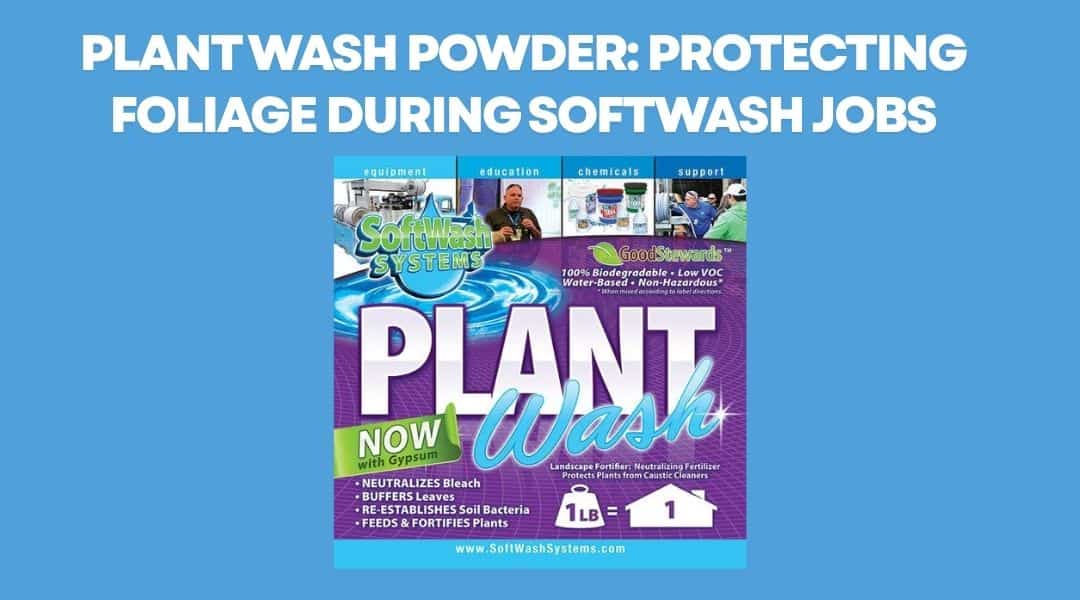
Plant Wash Powder is a foliage-care product built for softwash crews who work around landscaping. It neutralizes caustic residue, buffers leaves, and delivers nutrients — but it does not replace clean-water rinsing. That distinction matters more than most contractors realize, and ignoring it is how plant damage complaints start.
Why Foliage Protection Matters on Softwash Jobs
Sodium hypochlorite and sodium hydroxide are hard on plants. Overspray, roof runoff, and solution migration mean landscaping gets hit even when you're careful. The crew that treats foliage care as an afterthought is the crew that replaces shrubs out of pocket.
Before you pull a trigger, walk the property. Note every plant within drift range of the surfaces you're cleaning — including beds under eaves and along foundation lines where runoff concentrates. That assessment drives your rinse plan and tells you where Plant Wash Powder fits.
What Plant Wash Powder Actually Does
The product serves four functions, and keeping them straight matters for planning:
- Caustic neutralization — counteracts SH and NaOH residue on leaf surfaces and in surrounding soil.
- Leaf buffering — coats foliage with a buffering agent to reduce chemical contact damage.
- Foliar fertilization — delivers nutrients through leaf tissue, which is faster uptake than soil feeding.
- Nutrient restoration — replenishes the root zone and supports beneficial soil bacteria that caustic runoff kills.
None of these replace rinsing. They supplement it. A contractor who skips the rinse steps because they applied Plant Wash Powder has misunderstood the product.
Plant Wash Powder vs. Clean-Water Rinsing
These are complementary steps with different jobs. Rinsing physically dilutes and flushes chemical residue. Plant Wash Powder adds neutralization and nutrient support that water alone cannot provide. Treating one as a substitute for the other is a planning failure.
| Step | Role | Key Detail |
|---|---|---|
| Clean-water rinsing | Dilutes and flushes caustic residue from leaves and soil | Required before, during, and after cleaning per product directions |
| Plant Wash Powder | Neutralizes caustic residue, buffers leaves, delivers nutrients | Applied via hose-end sprayer per label directions |
Skipping a rinse because you applied the powder is like skipping a safety line because you're wearing a harness. Both do something; neither covers the other's job.
Application Workflow
Sequence matters. Here is the field-ready order, drawn from the product directions:
- Read the current label. Do not estimate dilution, dosage, or sprayer settings. The label governs.
- Pre-clean rinse. Saturate all landscaping in the work zone with clean water before any chemical hits the surface.
- Clean with mid-job rinses. Rinse plants with clean water during the cleaning process, especially on long dwell-time applications or windy days where drift increases.
- Apply Plant Wash Powder. Use the hose-end sprayer method. Let the cup fill with water, then apply evenly over landscape plants. Follow label directions — do not invent a ratio.
- Post-clean rinse. Final clean-water rinse after cleaning is complete.
The powder application slots into this sequence; it does not replace any step. Build the rinse plan into your crew briefing so nobody treats product application as a reason to skip a flush.
Hose-End Sprayer Tips
The product specifies a hose-end style garden sprayer. "Even coverage" means uniform distribution across foliage — it does not mean soak until dripping. Do not improvise concentrate ratios or spray settings beyond what the label states. If the label does not specify a setting, use even fan coverage and move on.
When to Use Plant Wash Powder
Not every softwash job needs it. The deciding factors:
- Caustic chemicals in play. If you're running SH or NaOH, and landscaping is within drift or runoff range, the product is relevant.
- High-value landscaping. Mature plantings, specimen trees, or anything the homeowner specifically calls out. The cost of the product is trivial next to a plant replacement claim.
- Repeat clients. Demonstrating foliage care builds trust and justifies premium pricing on maintenance contracts.
When none of these apply — a commercial building with no landscaping within 20 feet of your work zone, for example — you can skip it and save the time.
Setting Expectations
Plant Wash Powder supports foliage health. It does not guarantee that every plant survives every exposure. Plant species, health, soil conditions, chemical concentration, dwell time, and weather all affect outcomes. Tell the customer you have a foliage protection process — do not promise zero impact. That is honest, defensible, and how experienced contractors handle it.
Build It Into the Briefing
Make foliage care a line item in your pre-job walkthrough, not something you remember halfway through the wash. Identify plants, plan rinses, stage the hose-end sprayer with the powder loaded, and assign rinse duties to a crew member. A 5-minute briefing prevents a $500 plant replacement argument.
Stock Plant Wash Powder alongside your softwash chemicals so it is on the truck when the job calls for it — not back at the shop when you realize you need it on site.
Products Mentioned
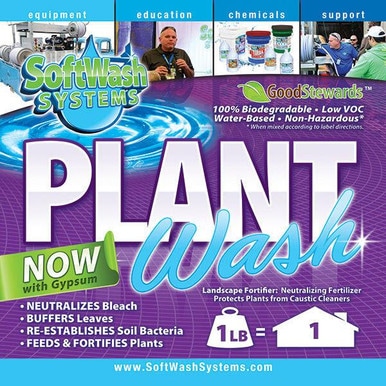 Plant Wash Powder 25LB SKU: 83-69 | 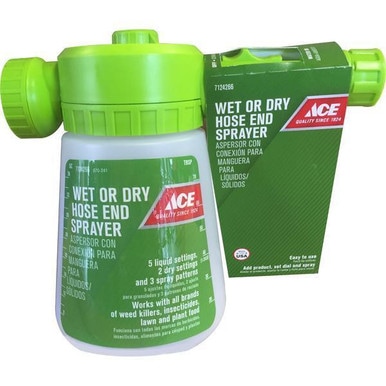 Hose End Sprayer Plant Wash SKU: 150-0761 | Hose End Sprayer Plant Wash SKU: 150-0761 |
Hose End Sprayer Plant Wash SKU: 150-0761 | Plant Wash Powder 25LB SKU: 83-69 |