
F9 Double Eagle vs F9 Groundskeeper

F9 Double Eagle vs F9 Groundskeeper is the comparison every hardscape contractor eventually needs to sort out. Both are Front 9 products, both clean concrete — but they solve different problems at different depths. Double Eagle is a high-pH degreaser that saponifies surface-level oil and grease. Groundskeeper is a low-pH maintenance cleaner that pulls subsurface stains and leaves a hydrophobic finish. Use the wrong one first and you waste chemical and time. Use them in sequence and you get results neither delivers alone.
F9 Double Eagle: The Heavy-Duty Concrete Degreaser
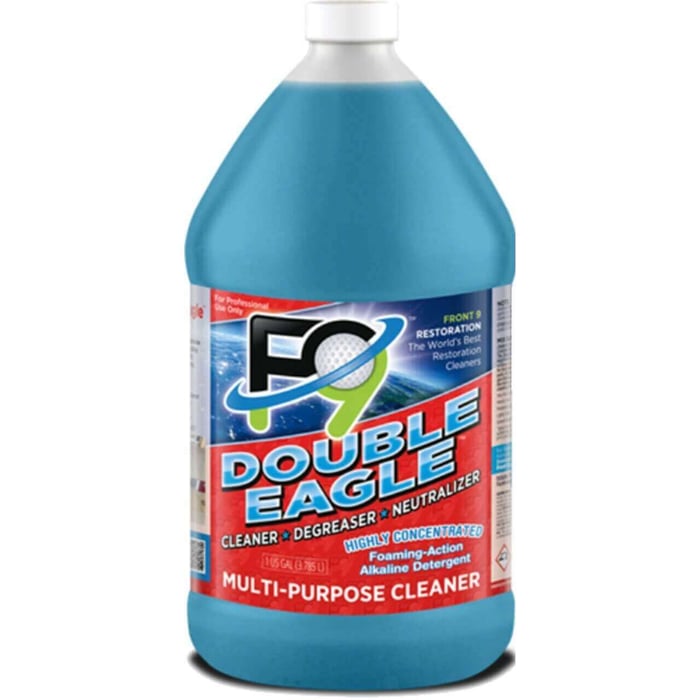
F9 Double Eagle is formulated for dumpster pads, gas station aprons, loading docks, drive-thru lanes, and commercial kitchen floors — anywhere thick hydrocarbon or food-fat buildup sits on the surface. It saponifies organic oils (converts them into soap) so they rinse clean instead of smearing.
Double Eagle also doubles as a neutralizer. After an acidic treatment with F9 Efflo or F9 BARC, applying Double Eagle brings the surface pH back to neutral and prevents flash damage. That dual role — degreaser plus neutralizer — is why most F9 contractors keep it on the truck regardless of the job type.
What Double Eagle Handles
- Thick oil, grease, and hydrocarbon films — the stuff that beads water and resists a standard house-wash mix.
- Food fats and cooking oils — restaurant drive-thrus, grease-trap overflow areas.
- Tire marks and rubber transfer — parking structures, warehouse floors.
- Post-acid neutralization — brings pH back up after F9 Efflo or BARC treatments.
Surface note: Double Eagle is safe on concrete, brick, pavers, tile, stone, and grout. Do not use it on asphalt — the alkaline formula will soften tar binders.
F9 Groundskeeper: Maintenance Cleaner and Stain Extractor
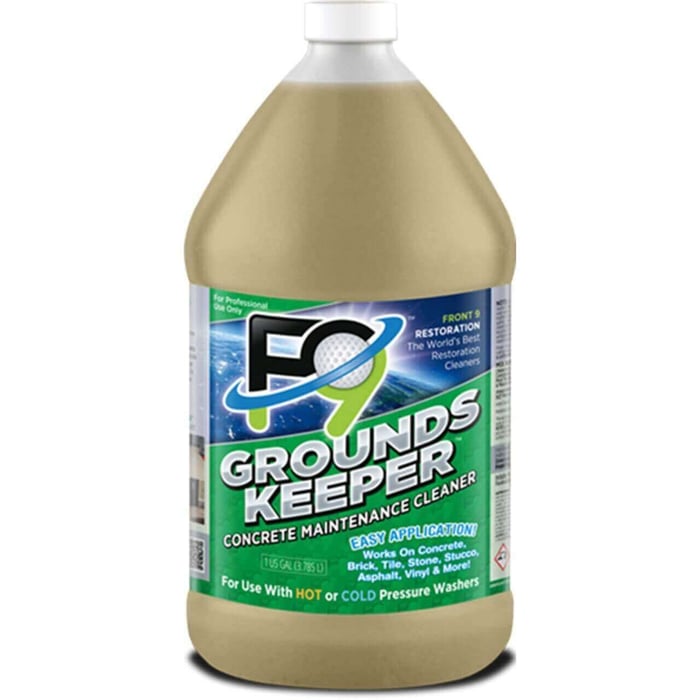
F9 Groundskeeper works where Double Eagle stops — below the surface. It is a low-pH, highly buffered formula that pulls embedded caustics, light oil shadows, dirt discoloration, tire ghosting, and mild rust staining out of the pore structure of concrete.
The real payoff is what happens after the rinse. Groundskeeper leaves a hydrophobic conditioning layer that makes the surface resist future staining and cuts maintenance cleaning time by 20–40% on subsequent visits. That is where the recurring-revenue argument lives: the first application sells the maintenance contract.
What Groundskeeper Handles
- Subsurface stain shadows — the discoloration that remains after surface grease has been removed.
- Light oil, dirt, and tire ghosting — not heavy buildup, but the embedded haze that dulls concrete.
- Concrete whitening and color restoration — brings back the "extra pop" clients notice immediately.
- Hydrophobic surface conditioning — reduces stain absorption and speeds future cleaning cycles.
Groundskeeper is safe on the same surfaces as Double Eagle: concrete, brick, pavers, tile, stone, and grout.
Double Eagle vs Groundskeeper: Side-by-Side
| F9 Double Eagle | F9 Groundskeeper | |
|---|---|---|
| Primary job | Surface-level degreasing | Subsurface stain extraction |
| pH | High (alkaline) | Low (acidic, highly buffered) |
| Targets | Heavy oil, grease, food fats, tire marks | Embedded stains, light oil shadows, caustic residue |
| Secondary role | Neutralizes acidic F9 products | Hydrophobic conditioning, whitening |
| Asphalt safe? | No | No direct contraindication; test first |
| Best for | Heavy restoration, pre-treatment | Maintenance contracts, final-step finishing |
The Two-Step Workflow: Using Both Products Together
Most commercial concrete jobs benefit from running both products in sequence. Here is the field-tested workflow:
- Sweep or rinse loose debris. Get gravel, leaves, and surface dirt off before applying chemistry.
- Apply F9 Double Eagle to oily zones. Let it dwell per the F9 Cookbook dilution chart — typically 2–5 minutes on moderate buildup, longer on heavy dumpster pads.
- Pressure rinse. Hot water improves saponification, but cold works on lighter grease.
- Apply F9 Groundskeeper over the entire surface. Dwell 2–5 minutes.
- Rinse. The surface dries cleaner, whiter, and with a hydrophobic finish that resists re-staining.
Step 2 removes what sits on top. Step 4 pulls what hides underneath. Skip either one and the client sees a difference — usually within the first rain.
Where Contractors Use These Products
Heavy restoration (Double Eagle leads): gas stations, restaurant drive-thrus, loading docks, dumpster pads, industrial facilities, commercial kitchen floors.
Maintenance contracts (Groundskeeper leads): HOA common areas, retail storefronts, parking garages, car dealership lots, municipal sidewalks. Groundskeeper's hydrophobic conditioning cuts labor on recurring visits — that 20–40% faster claim shows up on your second clean and every clean after.
For jobs that involve rust or efflorescence alongside grease, the full F9 lineup stacks: F9 BARC for rust, F9 Efflo for calcium deposits, Double Eagle to neutralize and degrease, Groundskeeper to finish. The F9 Cookbook maps the correct sequence for over 140 scenarios.
The F9 Cookbook
The F9 Cookbook is a 100-page laminated manual covering dilution ratios, dwell times, application order, and surface-specific cautions for every F9 product. If you are running F9 chemistry on client sites, the Cookbook pays for itself the first time it keeps you from guessing at a dilution ratio on an unfamiliar surface.
Safety Notes
- Wear chemical-resistant gloves, eye protection, and appropriate footwear. Both products are concentrated.
- Double Eagle must not be applied to asphalt.
- Always follow the Cookbook's dilution charts — stronger is not better and wastes product.
- Spot-test on an inconspicuous area before full application, especially on colored or stamped concrete.
- Rinse thoroughly. Residual chemistry left to dry can leave hazing.
Bulk Sizing
Both products are available in gallon and larger sizes. For high-volume commercial work, the Double Eagle 5-gallon and Groundskeeper 5-gallon pails cut per-ounce cost significantly. The Double Eagle 55-gallon kit is available for fleet-scale operations. If you are bidding maintenance contracts, price your chemical by the drum, not the gallon.
Products Mentioned
 F9 Double Eagle Degreaser Gal SKU: 320-618 | 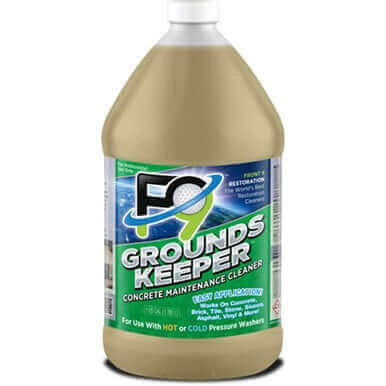 F9 GroundsKeeper Concrete Cleaner Gal SKU: 320-619 | 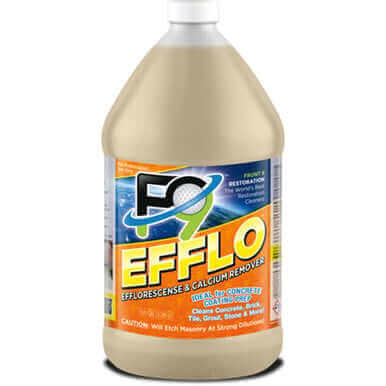 F9 Efflorescence/Calcium Remover Front9 Restoration SKU: 320-62M |
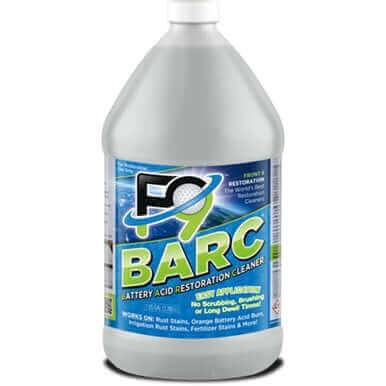 Front9 Restoration Rust Remover F9 B.A.R.C. SKU: 320-61M | 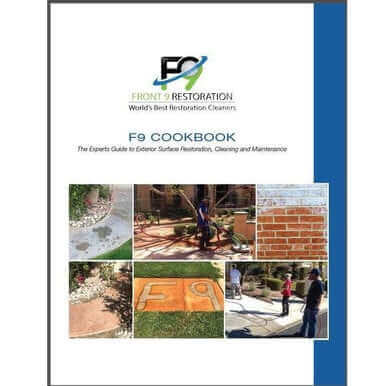 F9 CookBook Laminated SKU: 80-62 | 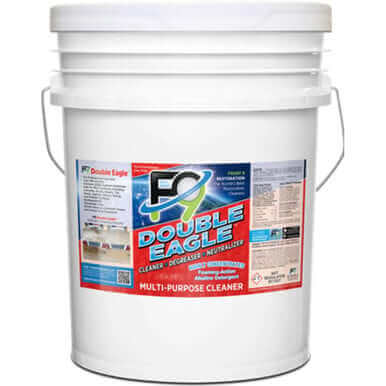 F9 Double Eagle Degreaser 5 Gal SKU: 320-6181 |
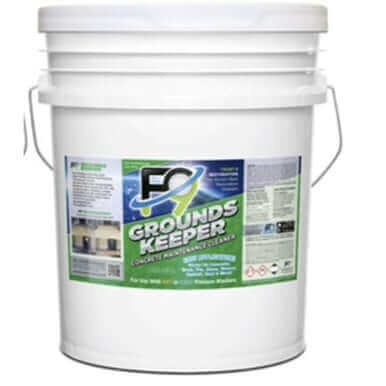 F9 GroundsKeeper Concrete Cleaner 5 Gal SKU: 320-6190 | 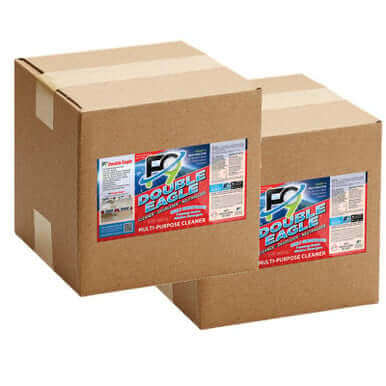 F9 Double Eagle Degreaser 55 Gal Kit SKU: 320-6182 |