Commercial Pressure Washer Guide for Professional Contractors
Table of Contents
If you're choosing a commercial pressure washer based on PSI alone, you're overpaying for a machine that slows your crew down on every job. High pressure strips paint. High flow rate moves debris and cuts cleaning time in half. A commercial pressure washer has to balance raw power with mechanical durability to survive a full work week — and it has to be serviceable when something wears out, not thrown away.
What Makes a Pressure Washer Commercial Grade
"Commercial grade" gets slapped on everything. For a contractor, it means one thing: duty cycle. Consumer units are engineered for 30–50 hours of total operational life. A real commercial pressure washer runs continuously for eight hours or more, daily, because it manages heat, friction, and vibration through heavy-duty frames and bypass systems that circulate water when the trigger is released. These machines are designed to be rebuilt, not replaced.
Triplex Pumps: The Only Pump Worth Buying
Residential units use axial pumps — a wobble plate moving pistons. They're cheap and disposable. Triplex pumps use a crankshaft and connecting rods, which drops internal friction and supports higher GPM without sacrificing longevity. Look for forged brass manifolds and solid ceramic plungers. Ceramic resists heat and corrosion that would degrade stainless steel quickly.
The real advantage is modularity. When a valve or seal wears, you replace that part — not the whole pump assembly. That's what drives long-term ROI in a fleet. For pump replacements and rebuild kits, J.Racenstein stocks pump assemblies and parts from General Pump, AR, and Comet.
Engine Selection
Honda GX series engines are the industry standard for a reason: cast-iron cylinder sleeves, advanced cooling fins, and a 2,000–5,000 hour lifespan. They start on the first pull after months of heavy use. Replacement parts — carburetors, air filters, mufflers — are a same-day sourcing task.
Consumer engines lack these features and often warp or fail after a single heavy season. If you can't get a replacement Honda GX air filter or muffler quickly, you're losing money every day the machine sits.
- Oil Alert Systems — low-oil shutdown sensors protect the engine from seizing if a leak occurs on site.
- Cooling Design — advanced airflow prevents throttle-down or overheat during 10-hour summer shifts.
- Parts Availability — Honda GX parts are stocked everywhere. Off-brand consumer engines mean weeks of downtime.
PSI vs. GPM: Why Flow Rate Wins
PSI breaks the bond between dirt and surface. GPM moves the debris away. The metric that matters is Cleaning Units: PSI × GPM. A machine at 3,000 PSI and 8 GPM produces 24,000 CU. A machine at 4,000 PSI and 4 GPM produces only 16,000 CU — and cleans dramatically slower.
PSI determines what you can clean. GPM determines how fast you finish. For any serious contractor, 4.0 GPM is the floor. That's the minimum to run a 16–20 inch surface cleaner effectively. Moving to 8.0 GPM lets you run a 28–30 inch surface cleaner, cutting labor on large concrete jobs by 50% or more.
Match Specs to the Substrate
Cleaning brick or wood with excessive PSI etches the surface permanently. In those scenarios, you use high GPM with larger nozzle orifices to flush organic growth while dropping effective pressure at the surface. Industrial concrete and heavy machinery often need 3,500+ PSI to penetrate grease. Correct nozzle selection protects the property and the equipment — consult a nozzle chart before every new substrate.
The ROI of High-Flow Systems
Labor is the highest variable cost in pressure washing. An 8 GPM machine lets a tech walk at a steady pace behind a 30-inch surface cleaner. With a 4 GPM unit, the tech has to slow down to prevent tiger stripes — or make a second pass. That speed difference is your margin.
High flow also reduces chemical cost. Faster rinsing prevents detergents from drying on the surface, eliminating streaks and re-work. If you're scaling operations, the PressurePro 8.0 GPM cold water skid is the workhorse that pays for itself in fewer labor hours per job.
Hot Water vs. Cold Water: Choose by Contaminant
This isn't a preference decision — it's chemistry. Cold water breaks mechanical bonds: mud, loose dirt, sand. It's the standard for residential house washing and general maintenance. But hydrocarbons, fats, and oils don't respond to cold water the same way.
Water at ~200°F acts as a catalyst that breaks the molecular bonds in grease. Oil viscosity drops, allowing emulsification and flushing with far less chemical intervention. Without heat, oil smears across the surface, requiring excessive detergent and repetitive passes.
When You Need a Hot Water Unit
Hot water is mandatory for gas station pads, fast-food drive-throughs, and heavy equipment degreasing — anywhere grease accumulation is a safety or aesthetic concern. Heat also increases chemical reactivity. Degreasers paired with a burner work at lower concentrations, saving chemical cost per job.
The trade-off is maintenance. Burner coils need regular soot inspection, fuel filters need replacing, and thermostat reliability is critical to prevent dangerous temperature spikes. J.Racenstein stocks hot box systems from PressurePro — portable and stationary units from 4 GPM to 8+ GPM that bolt onto existing cold water skids.
Cold Water: Simpler, Lighter, Fewer Failure Points
For contractors focused on siding, roofs, windows, and soft washing, a cold water commercial pressure washer is the better tool. No heating coils to scale. No burner electrical to troubleshoot. Less weight on the truck. Higher operational uptime.
The PressurePro 4.0 GPM cold water units — available in direct drive, belt drive, and skid-mount configurations — cover the majority of residential and light commercial work. Belt drive is the choice for crews running eight hours a day: lower RPM, less vibration, cooler pump temps.
Building the Rig: Components That Matter
A commercial pressure washer is only as good as the hardware between the pump and the nozzle. Every component has to handle the pressure, heat, and chemical exposure of the job.
Unloader valve — the most critical safety component. It diverts water into a bypass loop when the trigger is released. A bad unloader causes pressure spikes that destroy pump seals and manifolds.
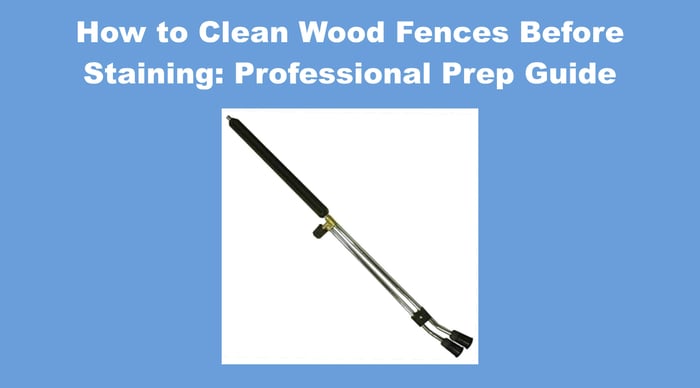
Chemical injection — downstream injectors introduce detergent after the pump, protecting internal chambers from corrosive chemicals. For higher-concentration applications (heavy degreasing, organic growth), the X-Jet M5 allows direct chemical application at the nozzle without running chemicals through the pump.
Surface Cleaners
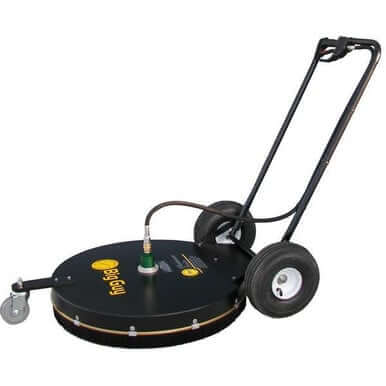
For flatwork, a surface cleaner is mandatory. Follow the four-inch-per-GPM rule: a 4 GPM machine pairs with a 16-inch cleaner; an 8 GPM unit supports a 32-inch model. Using a cleaner too large for your flow produces poor rotation and inconsistent results.
The ProTool 18" surface cleaner handles 4–5 GPM rigs. For 8+ GPM systems, the Whisper Wash 28" Big Guy is built for all-day commercial production. Maintain the swivel joint and spray bar nozzles regularly — vibration from a worn swivel fatigues the operator and damages the equipment.
Hose Selection and Management
Standard retail hoses leave scuff marks on commercial property. Professionals use non-marking, wire-braided hoses. Single-wire braid covers most 4,000 PSI work. Double-wire braid adds the safety margin for high-heat or ultra-high-pressure systems.
ProTool 4000 PSI single-wire hose is the go-to for daily commercial use — available in 50 and 100 ft lengths with quick connects installed. Manage hoses on heavy-duty reels to prevent the internal wire fatigue caused by kinking.
Sourcing and Serviceability
The real test of a commercial pressure washer is what happens when a pump seal fails during a high-priority contract. J.Racenstein stocks deep inventory of triplex pump rebuild components, O-rings and seals, unloaders and regulators, and quick connects — the parts that keep rigs running instead of sitting on a trailer waiting for a back-ordered widget.
Beyond parts, J.Racenstein supports custom skid builds tailored to specific truck or trailer setups. Need a low-profile cold water unit for a window cleaning rig? A high-volume hot water system for industrial degreasing? A dual-purpose soft wash and pressure washing skid? These are built around your operation, not a generic spec sheet.
Preparing for the 2026 Season
High-demand months create regional shortages of critical engine parts and high-flow pumps. Plan fleet upgrades early and stock common wear items — O-rings, thermal relief valves, pump oil — before the season hits.
Commercial contracts frequently mandate safety compliance for crews working at height. J.Racenstein stocks a full line of fall protection and safety equipment — harnesses, lanyards, anchors, and helmets — to keep your crew compliant and your contracts intact.
Products Mentioned
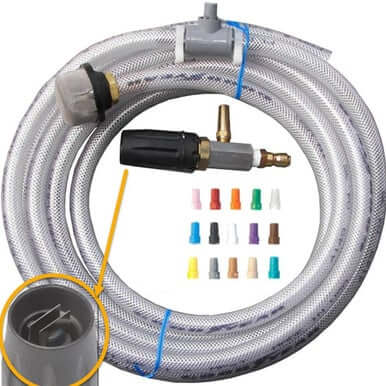 X-Jet M5 Variable Spray SKU: 74-53M | 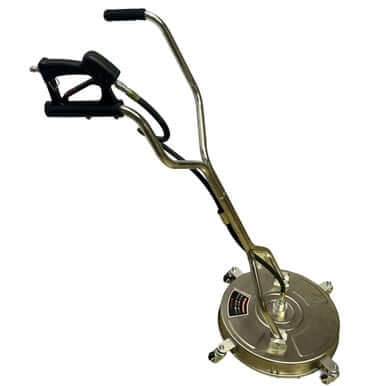 Surface Cleaner 18in Protool 4000psi SKU: 74-3795 | 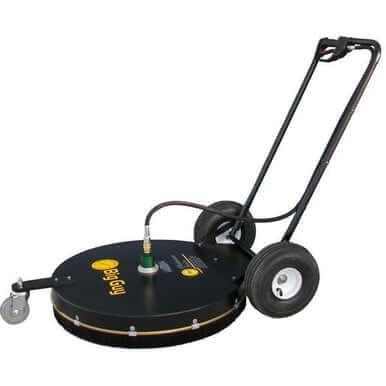 Whisper Wash 28in Big Guy 4 Nozzle w/whe SKU: 74-3812 |
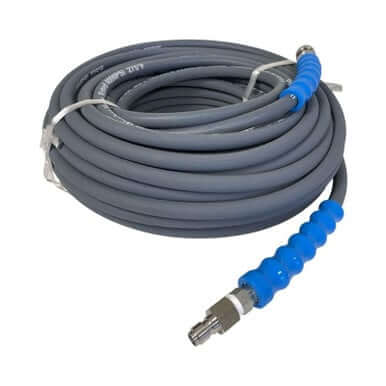 ProTool Pressure Washing Hose 4000psi 1 Wire SKU: 74-36M |