Commercial Pressure Washers: The Professional's Buying Guide
Table of Contents
Commercial pressure washers separate productive crews from crews that limp through jobs. The wrong machine costs you hours per week in slower rinse times, premature seal failures, and jobs you have to turn down. This guide covers what actually matters when you're buying: the GPM-vs-PSI tradeoff most contractors get backwards, drive-type longevity, hot water ROI, and which configuration — cart, skid, or trailer — fits the work you're actually doing.
Why Pro-Grade Machines Pay for Themselves
Consumer washers from big-box stores are built for weekend driveway duty — 50 to 100 hours before something fails. A commercial unit with a triplex plunger pump and a Honda or Vanguard engine is built for thousands of hours. The math is simple: one mid-season breakdown that kills a contract costs more than the price difference between a consumer and commercial machine.
The components that matter most:
- Cast iron cylinder sleeves — outlast aluminum bores by a wide margin under sustained heat and friction.
- Triplex plunger pumps (CAT, General Pump, AR) — ceramic plungers, brass manifolds, field-serviceable with off-the-shelf parts. Axial cam pumps in consumer units are disposable.
- Low-oil shutdown — prevents engine seizure on a job site where you're running hard and might miss a level check.
On electric units for indoor work, look for commercial-rated motors that tolerate the voltage sags common on shared job-site circuits.
GPM vs. PSI: Which Spec Actually Drives Profitability
Most contractors shopping for their first commercial machine fixate on PSI. Experienced operators know GPM is usually the bigger lever on job speed.
PSI is the force that breaks contaminants loose. GPM is the flow that sweeps them off the surface. A machine that hits hard but rinses slowly keeps you on the trigger longer per square foot — and time on the trigger is the single biggest variable in your labor cost.
PSI by Surface Type
- 1,500–2,000 PSI — vinyl siding, soft wood, vehicles. Higher pressure etches or splinters.
- 2,500–3,000 PSI — residential concrete, brick pavers, general-purpose work.
- 3,500–4,000+ PSI — commercial flatwork, paint stripping, embedded industrial stains.
Why 4.0 GPM Is the Professional Floor
Below 4.0 GPM, you're leaving money on the table in rinse time. Pair a 4.0 GPM cold water machine with a quality surface cleaner and you'll cut flatwork time dramatically compared to a higher-PSI, lower-flow unit. Before every job, confirm the client's water supply can feed the GPM you need — starving the pump destroys seals fast.
Cleaning Units: The Apples-to-Apples Comparison
Multiply PSI × GPM to get Cleaning Units (CU). It's the only honest way to compare machines across spec sheets:
- 4,000 PSI × 4.0 GPM = 16,000 CU
- 3,000 PSI × 5.0 GPM = 15,000 CU
Machine A edges Machine B in raw cleaning power, but Machine B's extra gallon per minute may finish residential flatwork faster. Context matters — CU gives you the starting point, not the final answer.
Power Source and Drive Type
Gas Engines
Gas is the default for mobile contractors. No cord, no outlet hunt, maximum PSI and GPM available. The trade-offs — exhaust, noise, oil changes — are manageable when you're working outdoors on residential and commercial exteriors all day.
Direct Drive vs. Belt Drive
This is the decision that determines how long your pump lasts.
Direct drive bolts the pump straight to the crankshaft. The pump spins at engine speed — around 3,400 RPM. Compact, cheaper, and fine for lighter-duty or occasional use. But the high RPM and direct vibration transfer chew through seals and bearings faster.
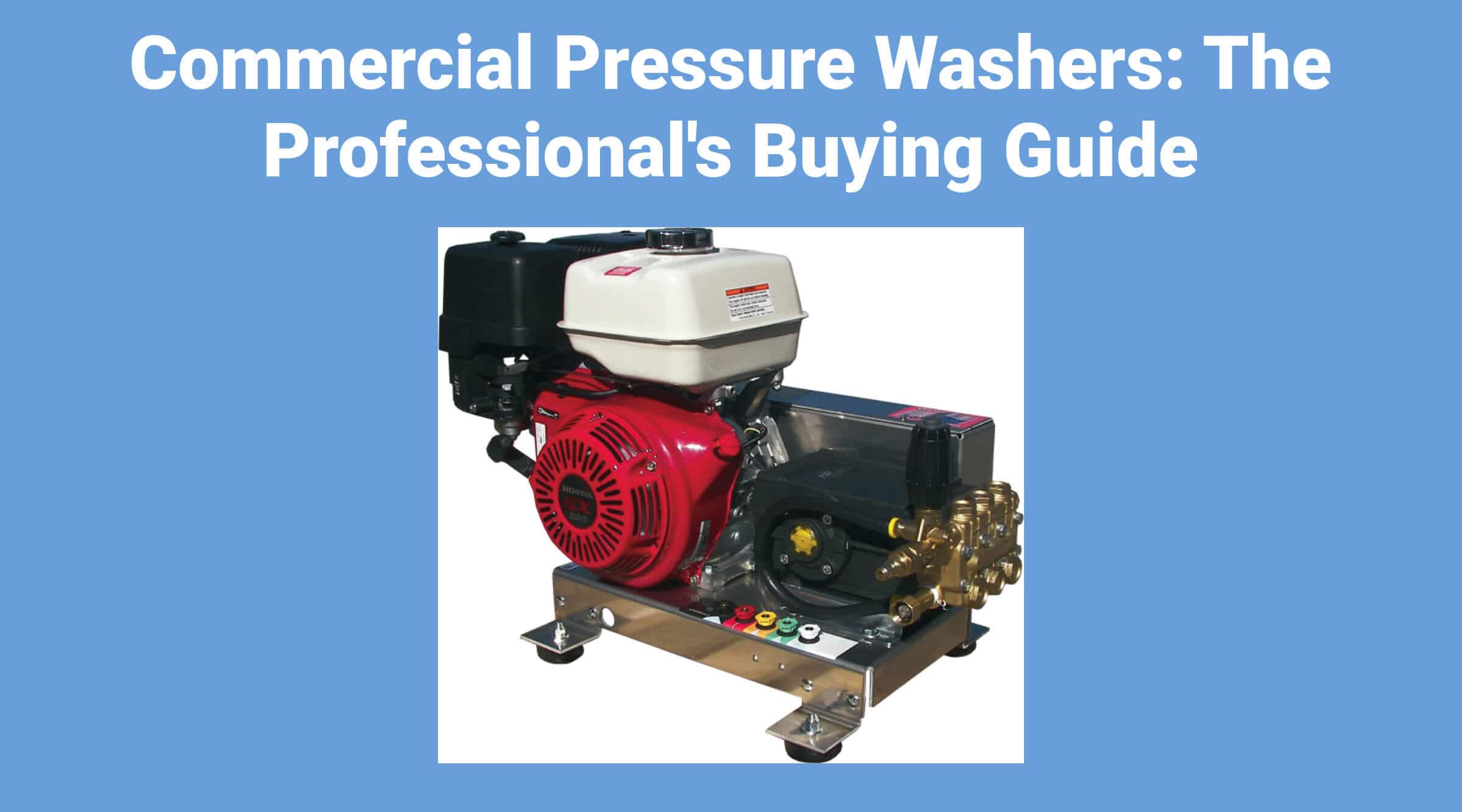
Belt drive uses pulleys to drop the pump down to ~1,450 RPM. Less heat, less vibration, significantly longer pump life. If you're running a machine daily, the belt-drive premium pays for itself in avoided pump rebuilds and reduced downtime. The 4.0 GPM / 4,000 PSI belt-drive skid from PressurePro is a strong example of a daily-duty rig built around this principle.
Electric Motors
Zero exhaust, low noise — required for indoor work, food processing facilities, and noise-sensitive sites. Most commercial electric units need 230V. Plan your circuit access before you quote the job.
Hot Water vs. Cold Water: When Heat Pays for Itself
Cold water handles the majority of exterior cleaning work: house washing, concrete, mildew, organic buildup. Simpler mechanically, lighter, cheaper to buy and maintain.
Hot water earns its keep when you hit grease, oil, or heavy petroleum-based contamination. An integrated diesel burner pushes water above 200°F, breaking molecular bonds that cold water and chemicals alone can't touch efficiently. The result: faster job completion and reduced chemical consumption on the jobs that need it.
Industries Where Hot Water Is Non-Negotiable
- Fleet and transportation — engine degreasing, hydraulic fluid on trailers, road film buildup.
- Construction — heavy equipment caked with grease and gear oil.
- Food service — kitchen exhaust hoods, dumpster pads, loading docks with grease traps.
If more than 30% of your revenue comes from grease-heavy work, a hot box add-on or a dedicated hot water skid will shorten job times enough to justify the investment inside one season.
Configuration: Carts, Skids, and Trailers
Wheel-Mounted Carts
Best for on-site maneuverability — through gates, around buildings, over varied terrain. You're loading and unloading by hand, and you depend on the client's water supply or a separate buffer tank. Good fit for property maintenance, mobile detailing, and smaller operations.
Skid-Mounted Units
The foundation of a dedicated cleaning rig. Bolted to a truck bed or van floor, paired with buffer tanks and hose reels, a skid turns your vehicle into a self-contained cleaning platform. A pressure washing skid is typically the first major purchase when an operator moves from "guy with a pressure washer" to a professional setup.
Trailer-Mounted Systems
Turn-key rigs: machine, tank, reels, chemical storage, all mounted on a single or dual-axle trailer. You pull up self-contained and ready to work. Highest upfront cost, but also the fastest setup time and the most professional image on site. Custom-built trailer packages let you spec exactly the GPM, tank size, and reel configuration your workload demands.
Matching the Machine to Your Workflow
Buying a commercial pressure washer is a capacity decision, not a features decision. Start with the work: what surfaces, what contaminants, how many hours per week, and how far you're driving between jobs. Then match GPM and PSI to the surfaces, drive type to the duty cycle, power source to the environment, and configuration to your vehicle and route density.
J.Racenstein stocks commercial pressure washers from PressurePro and BE, along with pumps, surface cleaners, pressure washing chemicals, and every fitting and hose you need to build or maintain a rig. If you're scaling up from a cart to a skid, or speccing a custom trailer, the equipment is here — and so is the advice from people who've built rigs for a living.
Products Mentioned
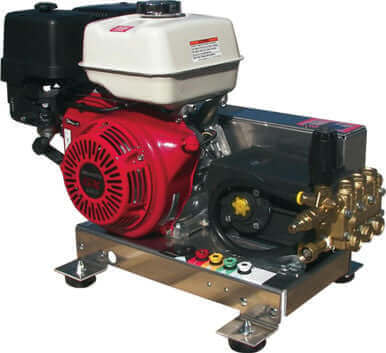 4.0g 4000psi Cold Belt GP Skid SKU: 74-1108 |