
Gardiner Water Fed Poles: Selection, Setup, and Field Best Practices
Table of Contents
- What Separates a Gardiner Pole from Everything Else
- Material Grades: Matching Composite to Working Height
- Gardiner Water Fed Poles vs. Traditional Extension Poles
- Clamp Setup, Field Assembly, and Handling
- Building an Efficient Gardiner Setup
- Choosing the Right Configuration for Your Operation
- Products Mentioned
Gardiner water fed poles are the reference standard for pure-water window cleaning at height. But buying one without understanding material grades, clamp mechanics, and working-angle physics is how contractors end up with a pole that fights them on every job. This guide covers what actually matters when you're choosing, configuring, and maintaining Gardiner equipment in the field.
What Separates a Gardiner Pole from Everything Else
A Gardiner pole isn't just a long stick with a brush on the end. It's an integrated fluid-delivery system: composite tubing engineered for axial stiffness, specialized brush heads with pencil or fan jets, internal or external microbore hose routing, and Smart Clamp locking mechanisms with replaceable wear shims. Every component is designed to transmit scrubbing force and deliver purified water at elevation without the operator muscling through excessive flex.
Rigidity is the single most important performance factor above 30 feet. When a pole deflects, the brush bounces off the glass, you lose tactile feedback, and you waste DI water chasing a head that won't stay planted. Gardiner addresses this with fiber orientation — carbon strands woven in axial patterns that resist both bending moments and torsional twist during lateral scrubbing strokes. That structural discipline is why a Gardiner CLX 27ft at full extension feels fundamentally different from a generic carbon pole at the same reach.
Material Grades: Matching Composite to Working Height
Gardiner builds poles across four distinct composite tiers. Choosing the wrong one wastes money or creates unsafe working conditions — sometimes both.
- Hybrid Composite (CLX Series): Carbon and glass fiber blended for durability and economy. The workhorse for ground-to-three-story residential cleaning. The CLX 32ft handles most residential route work without the price tag of pure carbon.
- Standard Carbon Fiber (SLX Series): The sweet spot for mixed residential and light commercial — roughly 30 to 45 feet. The SLX 39ft gives you the stiffness to work four-story buildings from the ground without the weight penalty of hybrid construction.
- High-Modulus Carbon (Ultimate Series): Extreme working heights — 50 to 90 feet. Thinner tube walls, dramatically higher flexural modulus, and featherweight top sections. The Ultimate 68ft HM Carbon Kevlar keeps deflection manageable in conditions that would make a standard carbon pole uncontrollable.
- Xtreme Series (High-Modulus Sectional): Purpose-built for the tallest commercial work. The X3 Xtreme 80ft is a sectional design that trades one-piece convenience for maximum rigidity at extreme elevation.
The decision framework is simple: document what percentage of your jobs fall into each height tier. If 80% of your work is two-story residential, a CLX or SLX covers you. If you're bidding mid-rise commercial, you need Ultimate or Xtreme — and the budget that comes with it.
Working Height vs. Pole Length
A 40-foot pole does not clean 40-foot windows. Your working angle should sit between 65 and 70 degrees from horizontal — steep enough for brush pressure, shallow enough that rinse water runs down the glass instead of onto you. Factor in your grip height (typically chest level, adding 3–4 feet) and the standoff distance, and a 40-foot window line usually demands 42 to 45 feet of true pole reach.
Never clean directly overhead at 90 degrees. Debris falls on you, you can't see the glass, and you lose all directional control of the brush.
Gardiner Water Fed Poles vs. Traditional Extension Poles
| Factor | Gardiner Water Fed Pole | Traditional Extension Pole |
|---|---|---|
| Cleaning Method | Continuous purified water + bristle agitation from ground level | Manual soap, squeegee, and detailing from ladder or at arm's reach |
| Water Delivery | Integrated microbore hose to pencil/fan jets at brush head | None — bucket dip and carry |
| Construction | Hybrid composite, standard carbon, or high-mod carbon fiber | Extruded aluminum or basic fiberglass |
| Practical Max Height | 40–90 ft with brush control | 15–25 ft before squeegee technique breaks down |
| Rinse Quality | Spot-free DI/RO water — no touch-up needed | Manual edge wiping and detailing required |
Traditional poles — like the Garelick Quik Lok or Ettore Interlock — still earn their place for interior work, covered walkways, and anywhere pure-water runoff isn't acceptable. But for exterior commercial and high-volume residential, the productivity gap is enormous. A single tech with a Gardiner pole and a ProTool HiFlo Pure Water Cart cleans more square footage per hour than a two-person ladder crew running squeegees.
Clamp Setup, Field Assembly, and Handling
Carbon fiber is engineered for axial stiffness, not point-impact resistance. Treat it accordingly.
Smart Clamp Calibration
- Clean first. Wipe every section with a damp microfiber before assembly. Silica sand or road grit between sliding sections acts as an abrasive compound that scores the resin.
- Set lever tension. The clamp lever should close with firm thumb pressure — nothing more. If a section slips under load, open the lever and tighten the adjustment bolt one-quarter turn with a hex key. Re-test. Never force it.
- Inspect shims. Gardiner clamps use replaceable internal wear shims. Check them for embedded grit and uneven wear. A worn shim means direct plastic-on-composite friction, which damages the tube.
- Respect the stop line. Never extend a section past its printed stop indicator. Insufficient overlap puts extreme leverage on the clamp housing and the upper lip of the outer tube — that's how sections split.
- Check hose routing. Internal hose needs slack at every section transition. A pinched hose at full extension kills water flow and can bind the sections.
Body Mechanics at Height
You cannot arm-wrestle a 50-foot pole. Operators who try burn out by lunch.
Stand in a balanced boxer's stance — feet shoulder-width, one slightly forward. Grip the base section with hands chest-width apart. Initiate every scrubbing stroke through your legs and core, not your shoulders. Your arms guide; your body generates the force. This transfers real scrubbing pressure to the brush head at 50 feet without destroying your rotator cuffs.
Manage the delivery hose. Step on the trailing hose or loop it through a breakaway clip at your waist. An unmanaged 100-foot hose dragging on the pole base wrecks your balance and makes fine brush adjustments impossible. When moving between window bays, collapse upper sections before walking — never carry a fully extended pole upright across a job site.
Building an Efficient Gardiner Setup
Brush and Gooseneck Configuration
The connection between the pole tip and the glass determines how effectively you transfer cleaning power. Get it wrong and you're fighting the architecture instead of cleaning it.
- Goosenecks: Gardiner's Quick-LoQ goosenecks let you swap brush heads and adjust working angles in seconds without tools. Short neck for flat commercial glazing; long neck for deep-set residential windows with overhanging sills.
- Brush filament: Dual-trim monofilament for general maintenance — outer bristles splay into frame corners while stiffer inner bristles scrub glass. Flocked bristles for delicate residential or solar panel coatings. Boar's hair brushes for heavy organic matter, bird droppings, or commercial grease.
- Jet selection: Pencil jets for windy conditions and hydrophobic glass — targeted high-velocity streams break surface tension. Fan jets for hydrophilic glass — sheeting water action flushes dirt rapidly down the pane.
- Scraper/pad holders: For construction cleanup, Quick-LoQ pad holders accept non-scratch scrub pads for paint overspray or stucco slurry at height.
Pure Water Supply
None of this works without purified water at 0 PPM TDS. A ProTool HiFlo Ultra Cart with dual RO membranes and a 20-inch DI cartridge gives most residential and light commercial operations the flow rate and water quality to keep a Gardiner pole producing all day. For high-volume commercial, a ProTool HydroPanel wall mount fills tanks overnight at higher throughput.
Maintenance and Storage
At shift end: disconnect the water line, drain internal fluid lines, and wipe each section as you collapse it. In coastal environments with airborne salt, disassemble weekly, flush tube interiors with clean water, and dry completely before reassembly.
Keep a heavy-duty rubber base cap on the bottom section at all times — bare composite on concrete chips and delaminates the resin matrix. During vehicle transit, never clamp bare carbon tubes in metal ladder racks. Use padded pole bags or interior PVC conduit storage. Heat and UV exposure degrade resin bonds over time; store out of direct sun when possible.
Choosing the Right Configuration for Your Operation
A residential route business focusing on one-to-three-story homes gets the most value from a compact CLX 27ft hybrid paired with the ProTool 511 Pure Water Cart — quick setup, minimal weight, and enough stiffness for the work. Commercial contractors hitting four-to-six-story buildings need an Ultimate 57ft HM Carbon Kevlar and a HiFlo MAX Cart to maintain productivity at height without compromising safety.
For operations that span both, Gardiner's telescopic extension packs let a single base system adapt from two-story residential to multi-story commercial by adding or dropping sections.
Products Mentioned
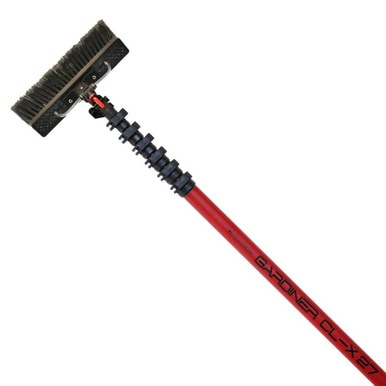 Gardiner CLX 27ft Pole Carbon Composite SKU: 155-4272 | 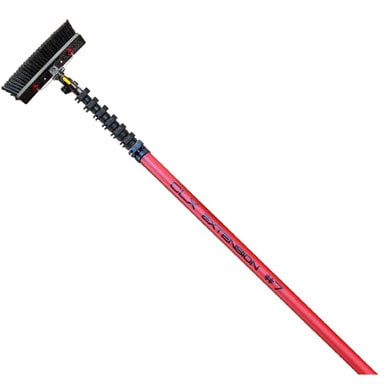 Gardiner CLX 32ft Pole Carbon Composite SKU: 155-4322 | 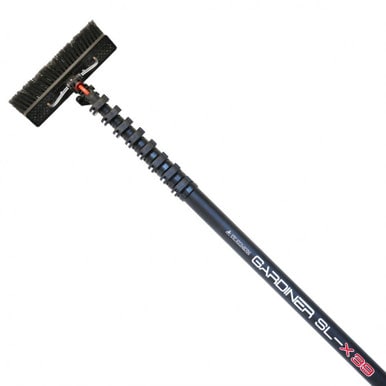 Gardiner SLX 39ft Tele Pole Carbon Complete SKU: 155-4391 |
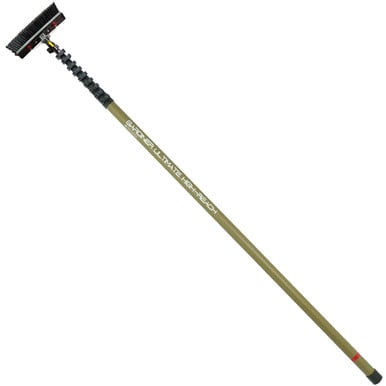 Gardiner Ultimate 68ft Tele Pole HM Carbon Kevlar SKU: 155-4468 | 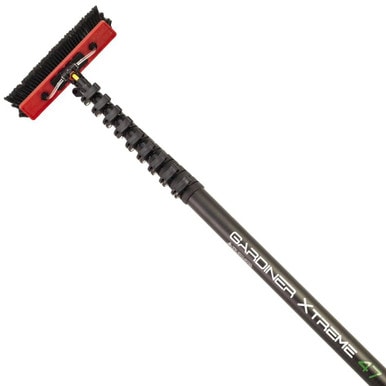 Gardiner X3 Xtreme 80ft High Modulus Carbon Pole SKU: 155-580 | 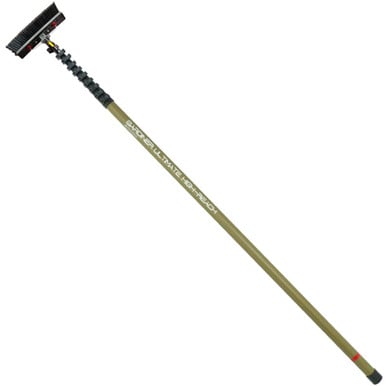 Gardiner Ultimate 57ft Tele Pole HM Carbon Kevlar SKU: 155-4467 |
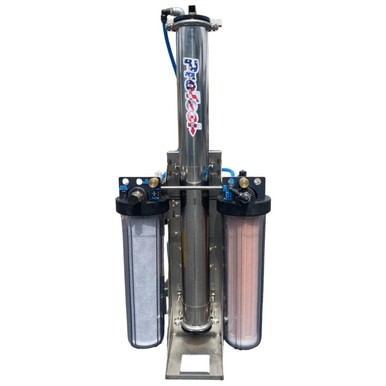 ProTool HiFlo Pure Water Cart Stainless Steel SKU: 150-0521 | 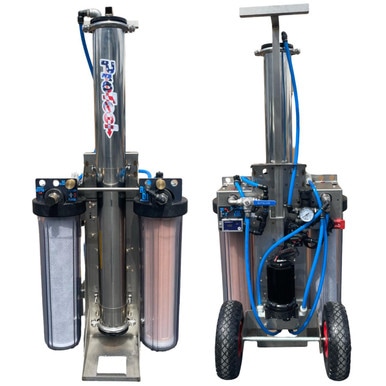 ProTool HiFlo Pure Water Ultra Cart SS 12V or 110V SKU: 150-0522 | 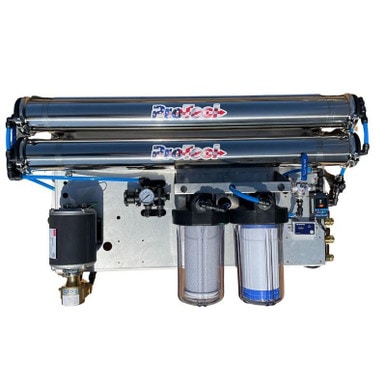 ProTool HydroPanel RODI Wall Mount SKU: 150-05346M |
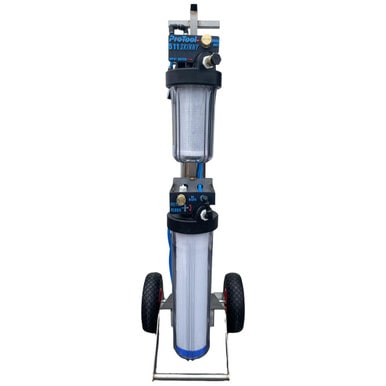 ProTool 511 Pure Water Cart SKU: 150-0515 | 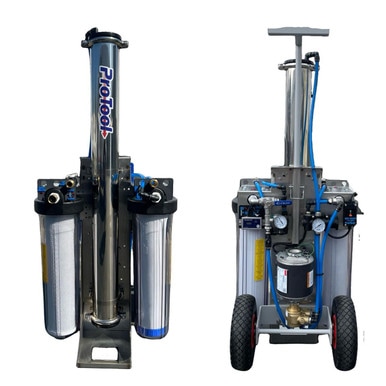 ProTool HiFlo Pure Water Cart MAX SS 110V SKU: 150-0523 | 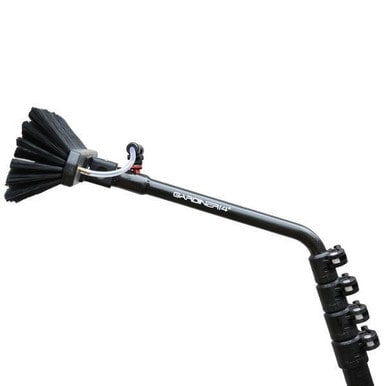 Gardiner Gooseneck Carbon 14in 55deg Quick-Loq SKU: 157-4053 |
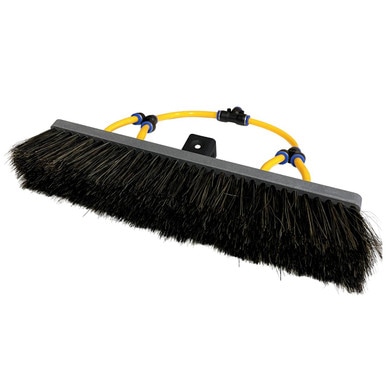 ProTool 4 Pencil-Jet Boar's Hair Brush 12in SKU: 151-221 | 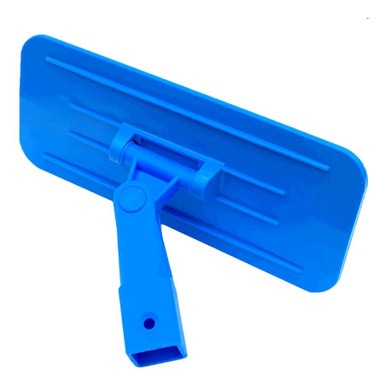 Gardiner Quick-LoQ Swivel Pad Holder (Doodlebug) SKU: 157-4042 |