How to Read a Pressure Washer Nozzle Chart

Table of Contents
- The Foundation: Understanding PSI, GPM, and Orifice Size
- The Professional Pressure Washer Nozzle Chart Explained
- Nozzle Spray Patterns: Matching the Angle to the Surface
- Beyond the Basics: Specialized Nozzles for Professionals
- From Chart to Job Site: Putting Your Knowledge to Work
- Frequently Asked Questions
- What happens if I use a pressure washer nozzle with too small an orifice?
- What happens if I use a nozzle with an orifice that is too large?
- How do I find my pressure washer's rated PSI and GPM?
- How often should professional pressure washer nozzles be replaced?
- Can a worn-out nozzle affect my pressure washer's performance?
- Why is my pressure washer pulsing? Could it be the nozzle?
- FAQs
For the professional exterior cleaner, the line between a perfect clean and costly damage is razor-thin. Selecting the wrong nozzle can mean stripping paint, etching concrete, or simply wasting valuable time with an inefficient spray pattern. This uncertainty, often stemming from confusion over the pressure washer nozzle chart, not only impacts job quality but can also lead to premature wear on your pump and unloader valve-an expensive, preventable problem.
This definitive guide eliminates that risk. We provide a comprehensive, professional-grade chart and, more importantly, deliver the essential knowledge to use it with precision. You will learn the critical relationship between your machine's GPM, its target PSI, and the correct nozzle orifice size required for peak performance. The result is absolute confidence on the job site, allowing you to clean faster and more effectively while protecting both your client's property and your valuable equipment. Stop guessing and start operating with expert accuracy.
The Foundation: Understanding PSI, GPM, and Orifice Size
Before you can effectively use a pressure washer nozzle chart, you must have a professional-grade understanding of the three variables that govern its output: PSI, GPM, and nozzle orifice size. These core factors work in tandem to determine your system's cleaning power, operational efficiency, and overall safety. The nozzle itself is the critical component that converts your machine's water flow into a high-velocity, usable stream of pressure. A mismatch between these elements can lead to substandard cleaning results, or worse, cause premature wear and damage to your pump and unloader.
For a clear visual breakdown of how these components interact, review the following guide:
PSI (Pounds per Square Inch): The Force
PSI, or Pounds per Square Inch, measures the force of the water stream exiting the nozzle. Think of it as the 'punch' your water delivers. A higher PSI provides more aggressive cleaning power, which is essential for stripping old paint or blasting away stubborn organic growth from concrete. This is the raw force that performs the heavy lifting on tough, durable surfaces.
GPM (Gallons Per Minute): The Flow
GPM, or Gallons Per Minute, quantifies the volume of water moving through your pressure washer's pump and out the nozzle. This is the 'weight' behind the punch. A higher GPM delivers superior rinsing capability, allowing you to clear away dislodged dirt and debris much faster. For large surface areas like commercial buildings or long driveways, a high GPM is the key to job site efficiency.
Nozzle Orifice Size: The Critical Link
This is the most critical and often misunderstood variable for professionals. The orifice is the precisely machined hole in the nozzle tip. Its size creates a restriction on the water flow (GPM), which is what generates the machine's resulting pressure (PSI). While various Pressure washer nozzles have different spray patterns, it's the orifice size that must be correctly matched to your machine's specs. Using an orifice that is too small will over-pressurize the system and strain the pump, while one that is too large will fail to generate the required pressure. This is precisely why a pressure washer nozzle chart is an indispensable tool for every job.
The Professional Pressure Washer Nozzle Chart Explained
For any exterior cleaning professional, the pressure washer nozzle chart is the single most critical tool for achieving optimal performance and preventing surface damage. It’s not about guesswork; it's about precision. This chart is the key to matching your machine's flow rate (GPM) with your desired cleaning pressure (PSI) to determine the exact nozzle orifice size required for the job. Using the wrong size can lead to inefficient cleaning, potential damage to your pump, or stripping paint and etching surfaces.
Below is a standard professional nozzle chart. We will walk through the exact steps to use it correctly.
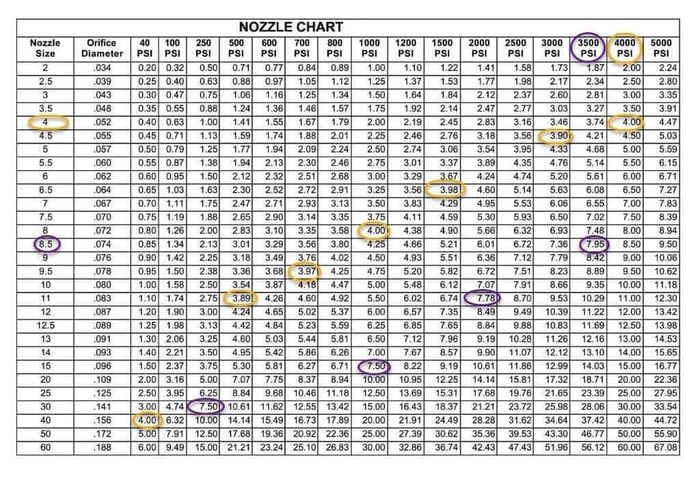
A standard pressure washer nozzle chart used to find the correct orifice size.
How to Use the Chart: A Step-by-Step Guide
Finding your required orifice size is a straightforward process. Follow these three steps:
- Step 1: Locate your pressure washer's GPM (Gallons Per Minute) rating in the far-left column.
- Step 2: Find your target cleaning PSI (Pounds per Square Inch) along the top row.
- Step 3: Follow the GPM row across and the PSI column down. The number where they intersect is the nozzle orifice size you need.
Decoding Nozzle Numbers (e.g., 40045)
Professional-grade nozzles use a standard numbering system that tells you everything you need to know. Let's use 40045 as an example:
- The first two digits (40) represent the spray angle or fan width in degrees. In this case, it's a 40° fan.
- The last two or three digits (045) represent the orifice size. You place a decimal point in the middle, making this a 4.5 orifice.
This simple code instantly communicates both the spray pattern and the orifice diameter, allowing you to select the precise tool for the task.
Practical Example
Let's apply this to a real-world scenario. You have a 4 GPM pressure washer and need to clean a brick facade, targeting approximately 2000 PSI to avoid damaging the mortar. Choosing the right pressure is critical, different surfaces require specific pressure levels. Using the chart, you would find the 4.0 GPM row and follow it across until it intersects with the 2000 PSI column. The chart indicates you need a nozzle with a 5.5 orifice size to achieve that pressure safely and effectively.
Nozzle Spray Patterns: Matching the Angle to the Surface
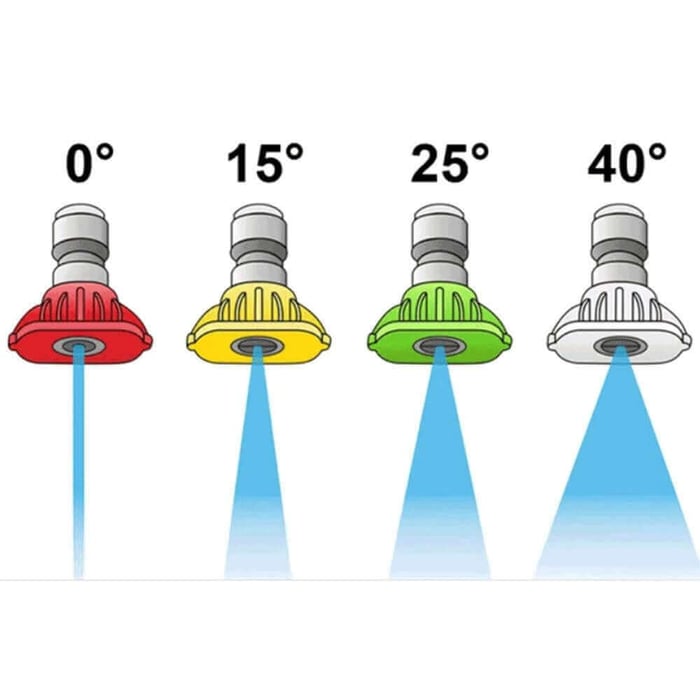
Once you've used a pressure washer nozzle chart to determine the correct orifice size for your machine, the next critical decision is selecting the spray pattern angle. This angle dictates the width of the water fan and, consequently, the impact force delivered to the surface. A wider angle disperses the pressure over a larger area, reducing the impact force but increasing work speed. Conversely, a narrow angle concentrates that force for aggressive cleaning. Selecting the wrong angle is a common mistake that can be as damaging as using the wrong pressure, leading to etched concrete or splintered wood.
For professionals, mastering these angles is non-negotiable for achieving efficient, damage-free results.
0° (Red Nozzle): Concentrated Power, High Risk
The red 0° nozzle delivers a concentrated, pinpoint stream of water with maximum PSI. This is a high-performance, high-risk tool designed for extreme applications. Use it with extreme caution for tasks like removing caked-on mud from heavy equipment or targeting wasp nests from a distance. Never use it for general cleaning, as it can easily scar wood, gouge siding, and etch concrete.
15° (Yellow Nozzle): Stripping and Surface Prep
The yellow 15° nozzle produces a narrow, powerful fan of water, functioning like a high-pressure scraper. It is the professional’s choice for intensive stripping and surface preparation. This nozzle is ideal for removing peeling paint, heavy mildew stains, or rust from hard, unpainted surfaces like concrete, steel, and masonry before recoating. It provides the aggressive force needed for serious restoration work.
25° (Green Nozzle): The All-Purpose Cleaner
Consider the green 25° nozzle your versatile, everyday workhorse. It offers the best balance of cleaning power and surface coverage, making it the most frequently used nozzle for a wide range of general cleaning tasks. It’s the go-to choice for safely and efficiently cleaning decks, vinyl siding, driveways, brick patios, and most vehicles without causing damage.
40°/65° (White/Black Nozzles): Low-Pressure Applications
These nozzles are designed for low-pressure rinsing and chemical application, not aggressive cleaning. Understanding their specific roles is key to a complete, professional cleaning process.
- 40° (White Nozzle): Produces a wide, gentle spray perfect for cleaning fragile surfaces. Use it on windows, screens, and vehicles, or for a final rinse on any surface where high impact could cause damage.
- 65° (Black Nozzle): This is your soaping nozzle. It has the widest spray pattern and a larger orifice, which creates low pressure to activate your downstream chemical injector. Use it exclusively for applying detergents, pre-soaks, and other cleaning solutions.
Equipping your rig with a full set ensures you have the right tool for every job. Find a complete selection of professional-grade pressure washer nozzles for any application on our site.
Beyond the Basics: Specialized Nozzles for Professionals
While a standard 4- or 5-piece nozzle set is the foundation of any professional setup, true efficiency comes from having the right tool for a specific task. Understanding a basic pressure washer nozzle chart is crucial, but specialized nozzles solve unique problems that standard tips simply can't. Investing in a high-performance specialty nozzle isn't an expense; it's a direct investment in saving labor hours and delivering superior results for your clients.
These professional-grade tools are engineered for specific challenges, allowing you to clean faster, more effectively, and with greater precision.
Turbo / Rotary Nozzles
A turbo nozzle delivers the best of both worlds: the intense, focused power of a 0° red tip combined with the wider fan of a 25° green tip. It achieves this by rotating a zero-degree stream in a circular cone pattern at thousands of RPM. This heavy-duty action is ideal for blasting away years of accumulated grime, oil stains, and organic growth from hard surfaces like concrete and masonry without leaving the "zebra stripes" common with a standard 0° nozzle.
Variable & Adjustable Nozzles
For jobs that demand constant switching between different pressures and spray patterns, a variable nozzle offers unmatched convenience. These all-in-one tools allow you to adjust the spray angle on the fly, eliminating the need to stop and swap out individual tips. While they may not offer the same peak performance as a dedicated fixed nozzle, their versatility makes them a valuable asset for multi-stage cleaning and rinsing tasks where speed is paramount.
Nozzles for Chemical Application (X-Jet, M5-Twist)
Proper chemical application is key to professional soft washing and exterior cleaning. Standard soap nozzles have limitations, which is where specialized chemical injectors shine. These tools are engineered to draw and apply cleaning solutions accurately at low pressure, ensuring effective dwell time without damaging surfaces.
- The X-Jet: A long-range nozzle that draws chemicals from a separate pail, allowing you to apply solutions to high eaves and second-story siding without a ladder.
- The M5-Twist: A versatile nozzle that allows you to switch from low-pressure chemical application to a high-pressure rinse pattern simply by twisting the nozzle body.
Expanding your arsenal beyond the standard tips on a pressure washer nozzle chart is a hallmark of a professional operator. The right specialty nozzle transforms your pressure washer from a generic tool into a precision cleaning system, maximizing your effectiveness on every job site. Ready to upgrade your toolkit? Shop our full range of professional pressure washer nozzles and find the high-performance solutions you need to work smarter, not harder.
From Chart to Job Site: Putting Your Knowledge to Work
Mastering your equipment begins with understanding its core components. As this guide has shown, the relationship between PSI, GPM, and orifice size is fundamental to achieving optimal results safely. By learning to correctly interpret a pressure washer nozzle chart, you gain the ability to select the precise spray angle and orifice for any surface, from delicate wood to heavy-duty concrete. This professional skill is what separates a quick rinse from a flawless, damage-free clean, boosting both your efficiency and your reputation.
Now, translate that knowledge into superior performance with the right tools. J. Racenstein is the professional's choice, offering an extensive selection of durable, high-performance nozzles for every application. When you need guidance, our expert support team is ready to help you choose the right equipment for the job. Paired with fast shipping to get you back to work quickly, we are your dedicated partner in the field. Find the perfect professional-grade nozzle for your machine.
FAQs
What happens if I use a pressure washer nozzle with too small an orifice?
Using a nozzle with an orifice that is too small creates excessive back-pressure, forcing your machine to operate above its rated PSI. This strains the pump, engine, and unloader valve, leading to premature wear and potential failure. The water flow will be restricted, and the engine may labor or stall. This is a critical error that can cause costly damage to professional-grade equipment and should be avoided to ensure system longevity and safety.
What happens if I use a nozzle with an orifice that is too large?
Selecting a nozzle with an overly large orifice will cause a significant drop in pressure (PSI) at the tip. While this will not damage your pressure washer, it severely compromises cleaning performance. You will lose the focused, high-impact stream required for effective cleaning, resulting in longer work times and wasted resources. To maintain job site efficiency, it is essential to use a nozzle sized correctly for your machine's specifications.
How do I find my pressure washer's rated PSI and GPM?
Your pressure washer's rated PSI (Pounds per Square Inch) and GPM (Gallons Per Minute) are typically displayed on a data plate or sticker affixed to the machine's frame, engine, or pump housing. This information is fundamental for equipment operation and component selection. If the plate is missing or unreadable, consult your owner's manual for the official manufacturer specifications. Always use these factory ratings to ensure you select the correct accessories.
How often should professional pressure washer nozzles be replaced?
For full-time professionals, nozzles are wear items that require regular replacement to maintain peak performance. A general guideline is to replace your primary nozzles every two to three months of consistent use. Over time, the high-pressure water flow erodes the orifice, causing it to enlarge. This leads to a loss of pressure and a less defined spray pattern. Proactive replacement is a key part of a professional maintenance schedule.