Pressure Washer Hose Selection for Professional Contractors

Table of Contents
A burst hose mid-job costs you the client's confidence and the rest of your afternoon. A heavy rubber hose that scuffs white vinyl siding costs you a callback. The pressure washer hose is the single component most contractors under-spec, and it directly controls what actually reaches the surface. This guide covers how to choose the right pressure washer hose — PSI and diameter matching, wire-braid construction, fittings, and the maintenance habits that keep your rig reliable.
Pressure Washer Hose Specifications That Actually Matter
PSI and Temperature Ratings
Your hose's working PSI must exceed your machine's maximum output — not match it. Running an underrated hose is not a performance issue; it is a burst risk. If you run a hot water unit, the hose needs to be rated for elevated temperatures as well. Standard cold-water hoses degrade fast under heat, and a softened inner tube will balloon and fail without warning.
Inner Diameter: Where Flow Lives
Inner diameter (ID) controls flow rate and friction loss. A larger ID reduces pressure drop but adds weight and bulk. Here is where most contractors should land:
- 2–4 GPM machines: 1/4" works for short runs; 3/8" is better for anything over 50 feet.
- 4–6 GPM machines: 3/8" is the professional standard.
- 6+ GPM machines: 1/2" is necessary on long runs to avoid starving the nozzle.
The 3/8" hose dominates the commercial market because it balances flow, weight, and maneuverability for the widest range of rigs. If you are running an 8 GPM cold water pressure washer, step up to 1/2" — the friction penalty on a 200-foot pull will cost you real cleaning power otherwise.
Length and Friction Loss
Every foot of hose creates friction. A typical 100-foot section of 3/8" hose drops roughly 50 PSI at the nozzle. Two ways to manage this:
- Deploy only what you need. A hose reel lets you pull exactly the footage the job demands instead of dragging 300 feet across a driveway.
- Use a short whip hose from machine to reel. A 4–6 foot whip connector hose isolates vibration from the pump and keeps your main run intact longer.
Hose Construction: What Separates Pro Gear from Box-Store Hose
A professional pressure washer hose is a three-layer assembly. Each layer does a specific job, and cutting corners on any one of them shortens the hose's working life dramatically.
- Inner tube: Synthetic rubber or thermoplastic. Resists chemicals, heat, and the constant flow of water under pressure.
- Reinforcement layer: High-tensile steel wire braiding. This is the structural backbone — it determines burst pressure.
- Outer cover: Protects against abrasion, UV, oil, and surface marking.
Single-Wire vs. Double-Wire Braid
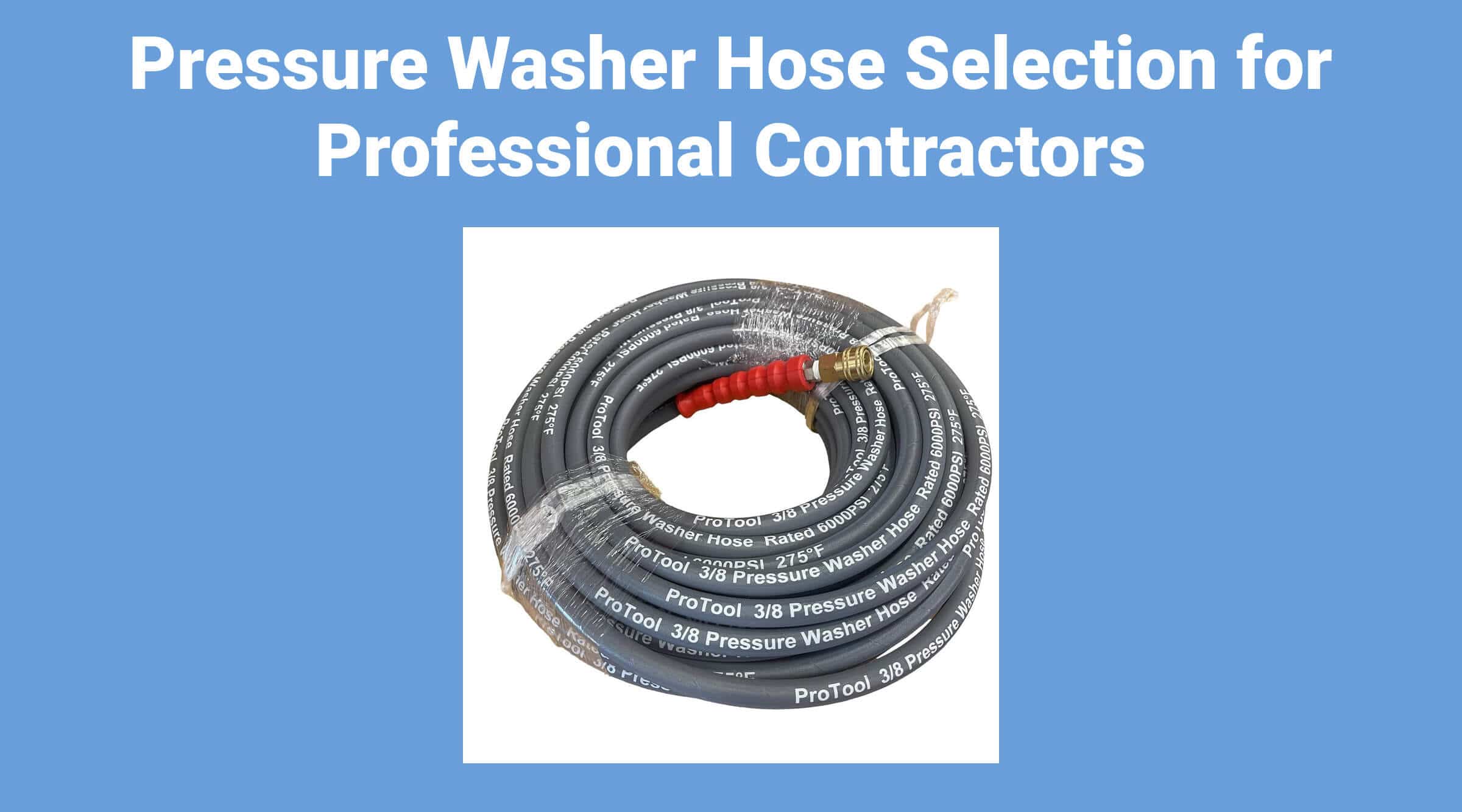
A single-wire braid hose is lighter, more flexible, and rated to roughly 4,000–4,500 PSI — adequate for most 4 GPM rigs. A double-wire braid pushes working pressure to 6,000 PSI with a significantly higher burst margin. The ProTool 6,000 PSI 2-wire hose is the benchmark here: steel-reinforced, quick-connect fittings pre-installed, and built to survive daily use on commercial jobs. If you are running a 4 GPM rig at 4,000 PSI on concrete all day, the double-wire option gives you headroom you will eventually need.
Outer Cover: Non-Marking Matters
Black rubber hoses leave scuff marks on vinyl siding, painted decks, pavers, and pool surrounds. A non-marking hose — typically gray or blue polyurethane or specialty rubber — eliminates that problem. For house wash and residential work, non-marking is not optional; it is part of the deliverable. The PressurePro Flextral hose and the Simpson Monster Hose both come in non-marking gray with quick-connect fittings and bend restrictors included.
Kink Resistance
A kink starves your pump of flow and puts stress on the unloader. The fix is not technique — it is hose quality. Premium hoses use tighter braid patterns and more pliable cover compounds that resist kinking even in cold weather. If you are fighting kinks constantly, you have a materials problem, not a handling problem.
Fittings and Connectors: The Most Common Failure Point
Most pressure loss on a rig traces back to fittings, not hose. A worn O-ring, a mismatched thread, or a corroded brass coupler can cost you 10–15% of your working pressure before water ever reaches the gun.
M22 vs. NPT Threads
- M22 (22 mm metric): Common on electric and consumer-grade machines. Sealed with an internal O-ring.
- NPT (National Pipe Thread): The US professional standard for gas-powered equipment. Tapered threads that seal as they tighten.
Forcing an M22 onto an NPT port strips both threads permanently. If your rig mixes standards, use a proper M22 twist-connect adapter — not pipe tape and force.
Quick-Disconnects
Standardize every connection point on your rig — machine to reel, reel to hose, hose to gun, gun to lance — with quick-disconnect couplers. This turns a 10-minute teardown into 90 seconds. Brass QDs are the baseline; stainless steel quick connects resist corrosion from sodium hypochlorite and last significantly longer if you are doing soft wash work alongside pressure washing.
Swivels and Bend Restrictors
A live swivel between gun and hose eliminates twist. Without one, the hose fights you on every turn and kinks at the fitting — exactly where it is weakest. Bend restrictors are stiff collars that slide over the hose at each fitting and prevent the sharp-angle stress that causes premature failure at crimp points. Both are inexpensive and should be on every hose you own.
Maintenance: Protecting a Hose That Protects Your Schedule
A burst at 4,000 PSI is not a leak — it is a laceration hazard. Hose maintenance is safety maintenance.
Daily Inspection Checklist
- Outer cover: Look for cuts, deep abrasion, blisters, or bulges. Any bubbling under pressure means the inner tube has failed — retire the hose immediately.
- Fittings and crimps: Check for corrosion, cracked threads, and any weeping at the crimp collar.
- O-rings: Inspect QD O-rings for cracks, flattening, or missing material. A 50-cent O-ring prevents a leak that wastes your entire day.
Storage and Handling
- Relieve pressure from pump, hose, and gun before coiling.
- Coil loosely on a reel — tight bends permanently deform the wire braid.
- Never drive over a hose. Even a pickup tire crushes the internal structure and creates an invisible weak point.
- Store out of UV. A truck box or enclosed trailer keeps the outer cover from going brittle.
Repair vs. Replace
A leaking O-ring at a fitting is a field fix. A leaking hose body is a replacement. If you can see wire braid through the outer cover, or if the hose blisters under pressure, it is done. Field splice kits exist, but a crimped splice at 4,000 PSI is a liability you do not need. Replace the hose, keep the receipt, and move on.
Browse the full lineup of professional pressure washer hoses and hose reels to find the right match for your rig.
Products Mentioned
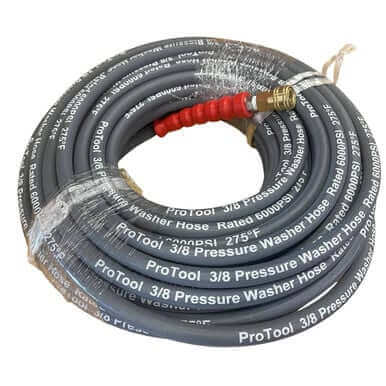 ProTool Pressure Washer Hose 50ft 2 Wire 6000psi with Quick Connects SKU: 74-3521 | 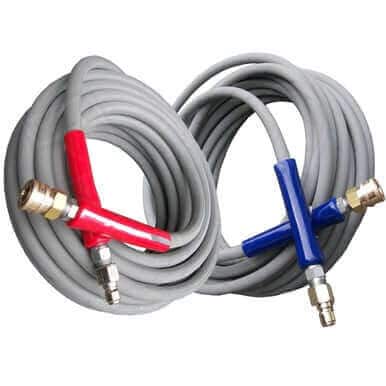 PressurePro Flextral Pressure Washer Hose SKU: 74-33M | 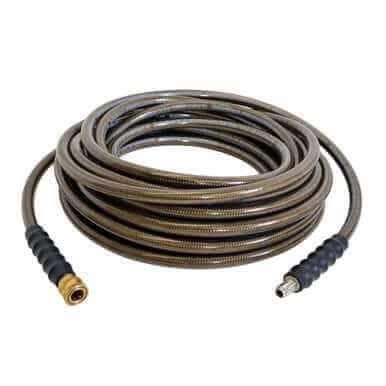 Simpson Monster Hose Pressure Washer 4500psi SKU: 74-31M |