Sodium Hypochlorite for Soft Washing: What Every Contractor Needs to Know

Table of Contents
Sodium hypochlorite for soft washing is the single most important chemical in your rig, and the one most likely to cost you money if you misunderstand it. A batch that's too hot scorches siding and kills landscaping. A batch that's too weak wastes your day and your client's patience. The difference between those outcomes is technical knowledge — not guesswork.
This guide covers what SH actually is at the chemical level, how to calculate mix ratios for different substrates, which surfactants matter and why, and the safety and storage protocols that keep you compliant and out of the emergency room.
What SH Is — and What It Isn't
SH is the industry shorthand for sodium hypochlorite (NaOCl), the active ingredient in bleach and the backbone of every professional soft wash operation. It kills mold, mildew, algae, lichen, and bacteria at the cellular level through oxidation — stripping electrons from organic matter until cell walls collapse. That's why SH doesn't just remove stains. It sanitizes the surface and delays regrowth in a way that pressure alone never will.
Professional-grade SH ships at 10–12.5% concentration. That matters because the household bleach sitting on a hardware store shelf tops out at 3–6% and is loaded with stabilizers, thickeners, and fragrances that gum up soft wash pumps and produce inconsistent results. If you're pulling from a retail jug, you're not running a professional operation — you're improvising.
How SH Actually Cleans: Oxidation, pH, and Why It Matters
SH works through oxidation. Its hypochlorite ion (OCl⁻) attacks the chromophores — the color-producing molecules — inside organic growth, rendering them colorless while simultaneously destroying the organism's cell structure. That dual action is why a single application both kills the growth and removes the stain.
pH plays a direct role. SH solutions sit between pH 11 and 13, making them strongly alkaline. That alkalinity helps dissolve fats, oils, and acidic organic soils on contact — but it also affects stability. A higher pH keeps the chemical more stable in storage, while a slightly lower pH makes it more reactive on the surface. In practice, your surfactant choice and dilution ratio handle that balance for you.
The practical takeaway: pressure washing alone shears off the visible layer of algae or mold but leaves the root structure embedded in the substrate. SH penetrates and kills the organism completely. On roofing, vinyl siding, and concrete where growth embeds deep into porous material, that chemical kill is the only path to results that last.
Mix Ratios: Start Weak, Adjust on Site
There is no universal SH ratio. Every job requires you to match concentration to substrate, growth severity, and ambient conditions. The professional approach is to start at the low end of the range, test an inconspicuous area, and increase only if the surface demands it.
These starting points assume 12.5% SH as your base stock:
- Asphalt shingle roofs: 3–5% applied solution for heavy algae, lichen, and Gloeocapsa magma (black streaks).
- Vinyl siding: 0.5–1.5% for common green mildew and organic film.
- Concrete and brick: 2–4% for deep-set organic stains on hard, porous substrates.
- Stucco and EIFS: 1% or less — these finishes discolor fast at higher concentrations.
Why Surfactants Are Non-Negotiable
SH on its own beads up and runs off vertical surfaces before it can work. A surfactant breaks the water's surface tension so the solution sheets evenly across the substrate and clings long enough for the chemistry to finish. Without one, you're wasting chemical and getting uneven results.
ProTool Sticky is purpose-built for SH batches — it extends dwell time, stays stable in sodium hypochlorite, and carries a lemon scent that masks chlorine odor on residential jobs. For crews that want odor control as a separate additive, ProTool Lemony handles that without affecting surfactant performance. Both are formulated to be copper-safe, which matters on homes with copper flashing or gutters.
After application and rinse, a ProTool Post Rinse neutralizes residual SH on the surface, eliminating streaking and reducing the risk of hard-water spotting — especially useful on windows and painted trim adjacent to the wash area.
Field Variables That Change Your Ratio
- Temperature: Heat accelerates the oxidation reaction. On a 95°F day, a 3% roof mix may flash (dry and leave white residue) before it finishes working. Drop the concentration or shorten dwell time.
- Growth severity: Light green film on north-facing siding needs far less chemical than a decade of black algae baked into asphalt shingles.
- Dwell time: Stronger mixes need less contact time. If you're running a weaker ratio, let it sit longer — but never let it dry on the surface.
- SH freshness: A drum that's been sitting in the sun for six weeks may have degraded from 12.5% to 8% or lower. Always factor actual concentration, not label concentration.
Equipment: Batching and Applying SH Right
Consistent results require equipment designed for chemical delivery — not jury-rigged garden hose setups. A proper soft wash rig gives you metered chemical flow, even spray patterns, and the ability to adjust on the fly.
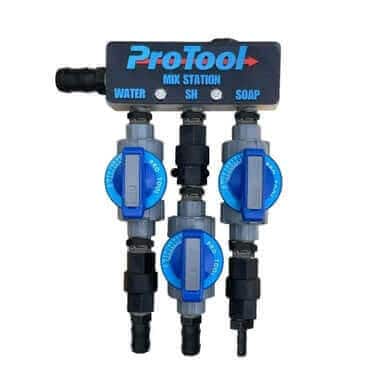
The ProTool BPX25–P40 Soft Wash Sprayer Skid pairs a Comet BPX25 dual-diaphragm pump with a Comet P40 for high-flow delivery. Both pumps are chemical-resistant and self-priming — critical when you're drawing SH from a tank. For contractors building out a rig incrementally, the ProTool Soft Wash Metering Block lets you proportion SH, surfactant, and water precisely at the manifold instead of eyeballing ratios in a batch tank.
Browse the full lineup of soft wash equipment — pumps, skids, metering manifolds, and spray guns — to match your operation's scale.
Safety and Storage: The Non-Negotiable Protocols
SH is a hazardous chemical. Mishandling it produces chemical burns, respiratory damage, and — if mixed with acids — deadly chlorine gas. Every crew member who touches a drum, hose, or spray gun needs to know these protocols cold.
Required PPE
- Eyes: Chemical splash goggles — not safety glasses. Standard eyewear leaves gaps where splash enters. J. Racenstein carries splash-proof goggles rated for chemical exposure.
- Hands: Nitrile gloves or heavy-duty PVC. Latex degrades on contact with SH.
- Lungs: A half-face respirator with chlorine-rated cartridges. Chlorine vapor concentrates fast in enclosed spaces and around the batch tank.
- Skin: Long sleeves, pants, and waterproof closed-toe boots. A single splash on exposed skin starts burning in seconds.
Storage Rules
- Store in a cool, dark, ventilated area. UV light and heat degrade SH faster than anything else — a drum left in direct sun can lose half its strength in weeks.
- Always use vented caps. SH offgasses continuously. A sealed container builds pressure until it ruptures.
- Keep SH isolated from acids, ammonia, and other chemicals. SH + acid = chlorine gas. There is no safe way to combine them.
- Fresh SH at 12.5% holds usable strength for roughly 30–60 days under proper storage. Rotate inventory accordingly.
Spill and Exposure Response
- Skin: Flush with cool water for at least 15 minutes.
- Eyes: Flush continuously for 15 minutes at an eyewash station. Seek medical attention immediately.
- Spills: Contain and dilute with water. Prevent runoff from entering storm drains — that's an environmental violation in most jurisdictions.
- Keep the SDS (Safety Data Sheet) for sodium hypochlorite on your truck at all times. First responders need it.
Protecting the Property
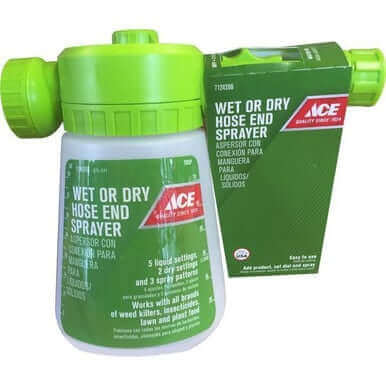
SH kills plants on contact. Before every application, thoroughly pre-wet all vegetation with plain water, cover high-value plantings with plastic sheeting, and perform a full post-job rinse of surrounding landscaping. Plant Wash Powder applied through a hose-end sprayer neutralizes residual SH in the soil and restores pH to plant-safe levels — a step that separates contractors who get callbacks from those who don't.
For a walkthrough of SH application technique and rig setup, this field overview on YouTube covers the fundamentals.
Products Mentioned
 Sodium Hypochlorite (SH) 12.5 per gallon (NJ Warehouse only) SKU: 83-00 | 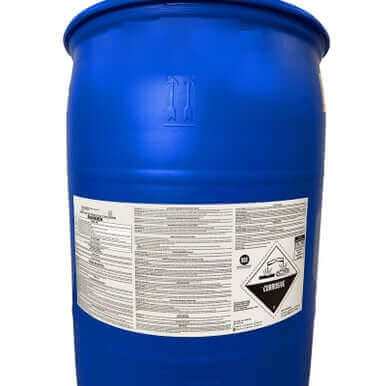 Sodium Hypochlorite (SH) 12.5 55 gallon drum SKU: 83-000 | 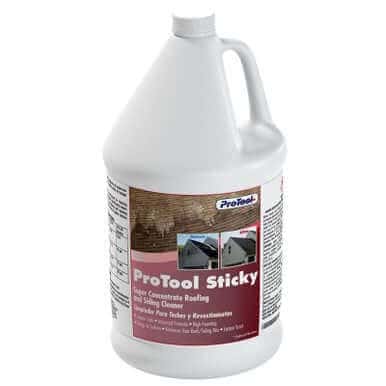 ProTool Sticky SKU: 83-07M |
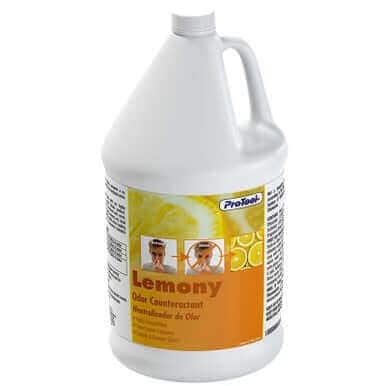 ProTool Lemony SKU: 83-05M | 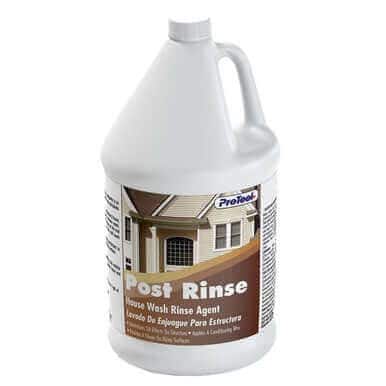 ProTool Post Rinse SKU: 83-03M | 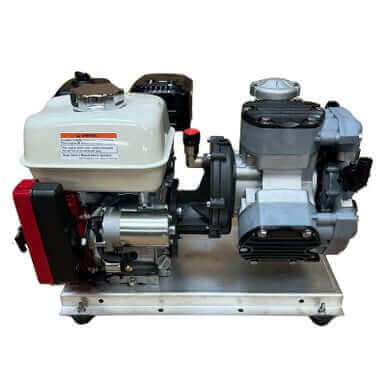 BPX25 - P40 Soft Wash Sprayer Skid SKU: 150-0432M |
 Soft Wash Metering Block SKU: 150-0454M |  Goggles Splash Proof SKU: 58-75 | 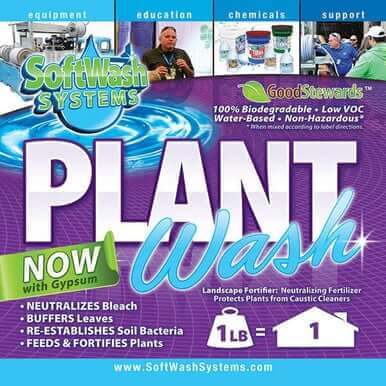 Plant Wash Powder 25LB SKU: 83-69 |
 Hose End Sprayer Plant Wash SKU: 150-0761 |