Soft Washing Vinyl Siding: The Professional Contractor's Playbook

Table of Contents
Soft washing vinyl siding is the only method worth running on a residential crew truck in 2026. High-pressure blasting drives water behind panels, scars substrates, and burns through landscaping goodwill. Manual scrubbing is a labor sinkhole. The professional move is low-pressure chemical delivery — 60–100 PSI, biocide-driven — that kills organic growth at the root and rinses clean without callbacks.
This guide covers the equipment, chemistry, and execution sequence that separate a profitable siding crew from one still chasing streaks with a surface cleaner.
Why Soap and a Garden Hose Fails
Vinyl is PVC-based cladding with a micro-porous surface texture. Organisms like Gloeocapsa magma (the green-black algae colonizing every north-facing wall in humid climates) and mildew don't sit on top — they anchor into those pores. A consumer detergent rinses the visible layer and leaves the root system intact. Regrowth starts within weeks.
High PSI compensates for weak chemistry by brute force, and the tradeoffs are brutal: tiger striping, siding fatigue, and moisture trapped behind panels against house wrap where it feeds hidden mold for years. The manufacturer's warranty language is clear — exceed ~1,000 PSI and you own the damage.
The Real Cost of Manual Scrubbing
Calculate the labor hours to hand-scrub a two-story colonial and the margin disappears. Beyond economics, scrubbing pushes fine particulates deeper into the wood-grain texture instead of lifting them. And laddering a crew member with a brush on a second story trades a cleaning problem for a safety problem. Chemical-assisted soft washing is faster, safer, and more uniform.
Soft Wash Chemistry: What Actually Works
The active agent is Sodium Hypochlorite (SH) at 12.5% stock concentration, diluted to a 0.5%–1.5% "hit" on the wall. SH is a biocide — it kills algae, mold, and mildew spores rather than relocating them. Two supporting chemistries make it work on vertical surfaces:
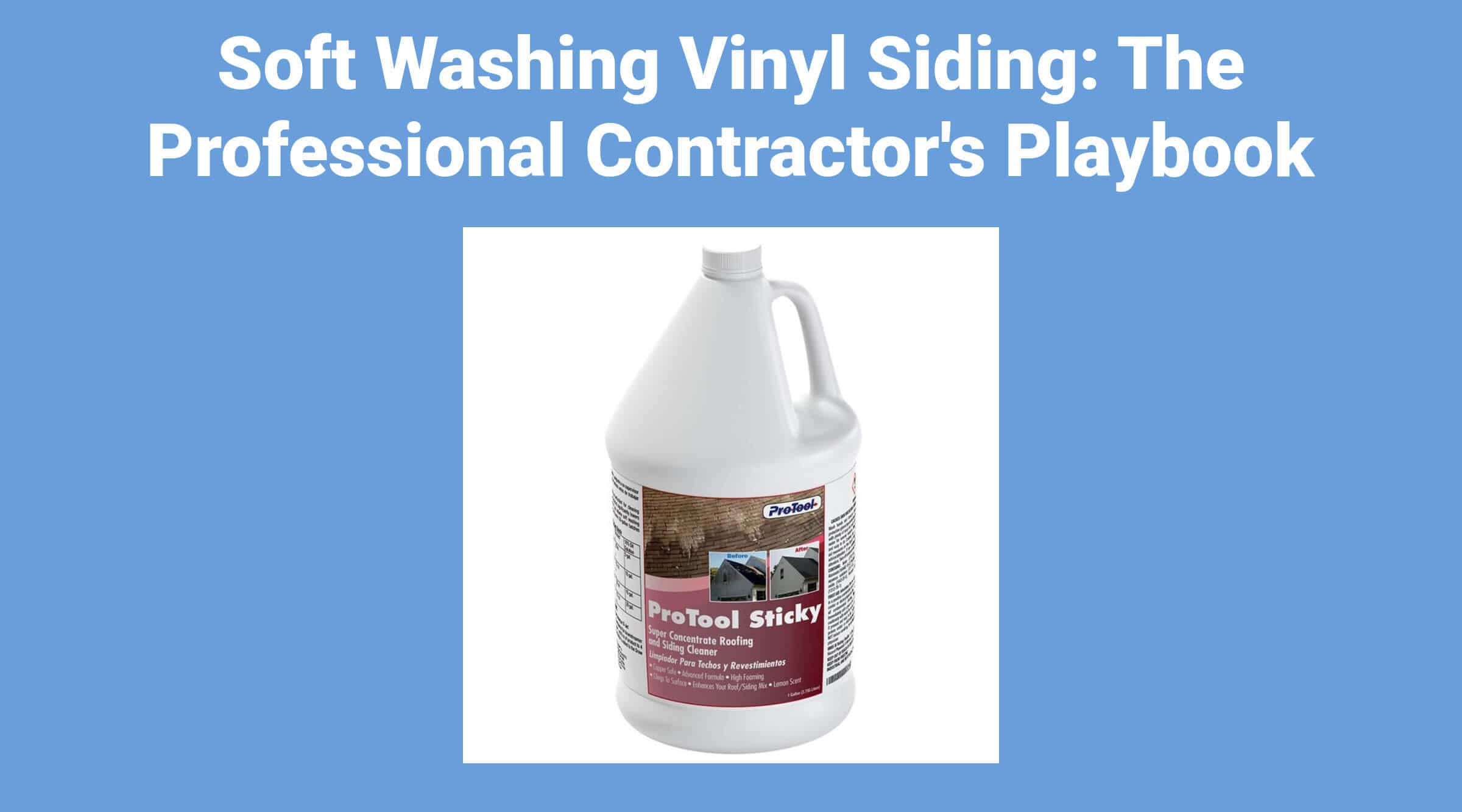
- Surfactants — reduce surface tension so the solution clings to the vinyl profile instead of sheeting off. Increased dwell time means the SH actually finishes the job. ProTool Sticky is purpose-built for this: it extends dwell without foaming out of control on a hot wall.
- Neutralizers — applied post-wash to protect window frames, hardware, and landscaping from residual oxidizer. ProTool Post Rinse handles this step and doubles as a plant-safe rinse aid.
North-facing walls caked in green algae need a hotter ratio (closer to 1.5%). Maintenance washes on lightly soiled south-facing walls can run leaner (0.5%) to conserve chemical stock. Adjusting mix strength per wall orientation is where experienced crews gain speed without sacrificing results.
Equipment Selection: Delivery Systems That Matter
Consumer-grade pressure washers with bolt-on soap tanks are not soft wash equipment. The professional tier breaks into three delivery categories:
Downstream Injectors
The workhorse. Chemical enters the line after the pump, so your pump internals never touch SH. High-volume, efficient on standard residential work. A quality downstream injector matched to your machine's GPM is the baseline for any house-wash rig.
X-Jets
When you need a hotter mix than downstreaming delivers — heavy organic growth, textured surfaces — the X-Jet M5 bypasses the high-pressure hose entirely and draws concentrate from a bucket at the operator's feet. Higher chemical concentration, zero pump exposure, and reach to second-story peaks from the ground.
Dedicated Soft Wash Pumps
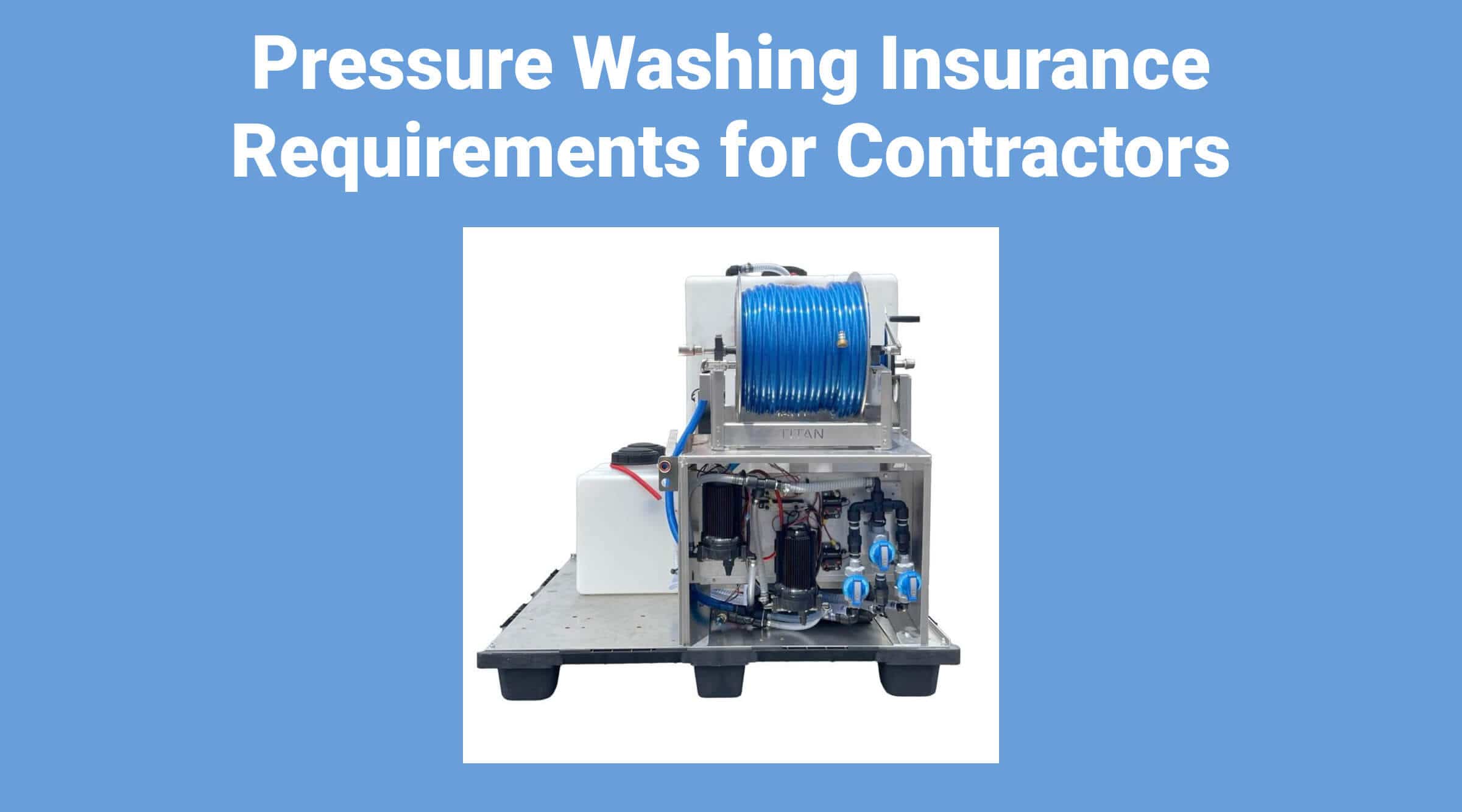
For maximum control at true low pressure, a dedicated 12V diaphragm pump system removes the pressure washer from the equation entirely. The ProTool BPX25 Soft Wash Skid runs a Comet BPX25 pump — chemical-resistant internals, consistent output, and precise application through calibrated metering plates. For crews running daily residential routes, a purpose-built skid pays for itself in labor savings within a season.
Hose and Tip Selection
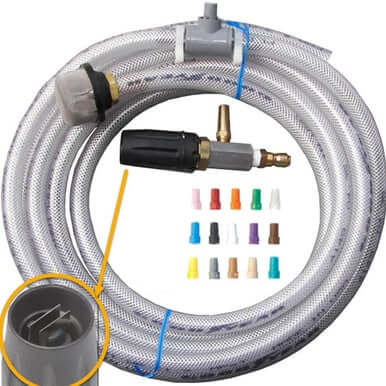
Your hose must be SH-rated. Standard rubber pressure hose degrades fast with bleach exposure. Run low-pressure braided hose from pump to gun on a dedicated soft wash rig. Tip selection controls your pattern and reach — ProTool metering plates let you dial fan width and flow without swapping nozzles mid-job.
PPE is non-negotiable when handling 12.5% SH. Chemical-resistant nitrile gloves, splash-proof goggles, and respiratory protection are baseline crew requirements — not optional upgrades.
The 5-Step Execution Workflow
Consistent results come from a consistent process. This is the sequence that eliminates callbacks:
Step 1: Pre-Wash Inspection
Walk the property before unloading equipment. Identify loose laps, damaged seals, exposed electrical outlets, and doorbells. Tape off electrical penetrations. Note any heavy oxidation for the customer conversation (more on that below). Flag areas where spray angle must stay downward to prevent water intrusion at weep holes, lap joints, and window casings.
Step 2: Vegetation Saturation
Thoroughly soak all grass, shrubs, and flower beds with fresh water before any chemical touches the structure. Saturated plant cells won't absorb the SH solution. This is your insurance policy against chemical burn complaints. Post-job, rinse vegetation again and apply ProTool Post Rinse as a neutralizing safeguard.
Step 3: Bottom-Up Application
Apply the soft wash solution from the bottom of the wall upward. Chemical running down onto dry siding creates permanent "clean streaks" — visible lines where diluted solution contacted unwetted vinyl. Bottom-up application keeps the surface uniformly wetted ahead of the chemical front.
Step 4: Dwell Time Management
Watch the wall. Organic matter transitions from green or brown to clear as the SH neutralizes it. That color change is your signal — the biocide has done its work. Never let the solution dry on the surface. On hot days, work smaller sections or mist-wet the wall ahead of application to extend working time.
Step 5: Top-Down Rinse
Rinse from the top down with high-volume, low-pressure water. This flushes soap and debris out from behind siding laps and J-channels, preventing "soap weep" — the milky drip that appears hours after you leave and triggers a callback. Take the extra 30 seconds per section. It's cheaper than driving back.
Oxidation: The Job-Killer You Must Diagnose Early
Oxidation is UV degradation of the vinyl's factory finish. It presents as a white, chalky film — and it's the single most common source of customer disputes on siding work. Standard SH mixes will not remove it. In fact, a bleach wash over oxidized vinyl often makes it look worse by creating uneven run marks in the chalk layer.
The Finger Test
Before quoting, swipe a dry finger across a sun-exposed section and a shaded section. If white chalk transfers to your skin, the siding is oxidized. Communicate this to the customer during the estimate — not after the wash. Oxidation removal is a separate, premium service with different chemistry and higher labor.
Restoration Chemistry
Oxidation removal requires a dedicated restoration chemical that breaks the static bond of the chalk layer. ProTool Gutter Bomb is formulated for exactly this — it dissolves oxidation on vinyl and aluminum without the PSI that damages the substrate. For broader oxidation and gutter-tiger-stripe work, the oxidation removers category covers the full range of professional options.
The technique: apply the restoration chemical to a manageable section, agitate lightly with a soft-bristle brush to lift the chalk, and rinse with low pressure before the product dries. Price this as a line item — it's skilled work that generic house-wash crews can't replicate.
Runoff Management and Compliance
SH-based washes generate chemical runoff. In 2026, local regulations on stormwater discharge are tightening, and your liability follows. The mitigation protocol is straightforward:
- Pre-soak all vegetation and soil within the drip line.
- Apply neutralizing agents to sensitive landscaping during and after the wash.
- Avoid direct spray into storm drains or waterways.
- Document your protection steps with timestamped photos — they resolve disputes before they escalate.
Compliance isn't overhead. It's a selling point. Property managers and HOA boards hire crews that can demonstrate environmental responsibility, and they pay more for it.
Building the Rig
For crews entering soft wash or upgrading from a cobbled-together setup, the equipment path scales with volume:
- Starter: Existing pressure washer + quality downstream injector + X-Jet M5 for hot-mix situations + ProTool Sticky surfactant. Low capital, immediate capability.
- Owner-Operator: ProTool BPX25 Soft Wash Skid with dedicated metering block, hose reel, and tank setup. Purpose-built for daily residential routes.
- Multi-Crew: Dual-user soft wash and pure water skid — soft wash and water-fed capability on the same platform, two operators working simultaneously.
Every rig should carry nitrile gloves, splash goggles, and a neutralizer as standard loadout — not afterthoughts pulled from under the seat.
Products Mentioned
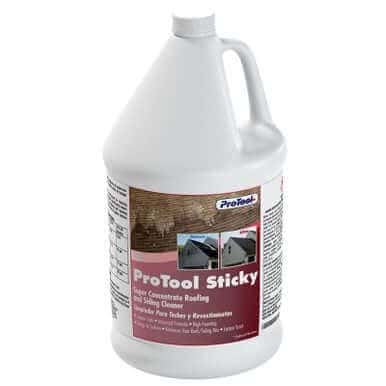 ProTool Sticky SKU: 83-07M | 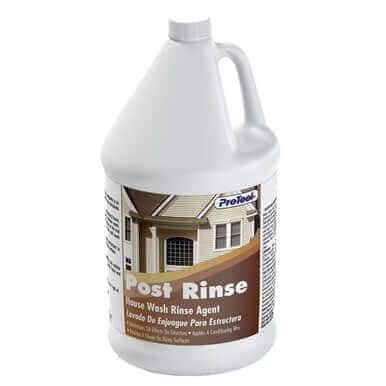 ProTool Post Rinse SKU: 83-03M | 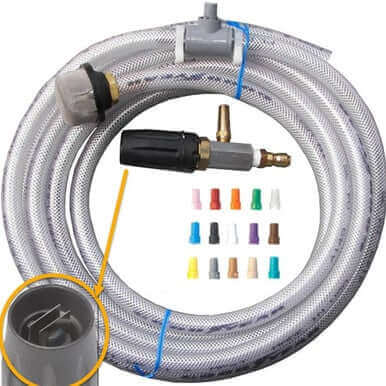 X-Jet M5 Variable Spray SKU: 74-53M |
 BPX25 - P40 Soft Wash Sprayer Skid SKU: 150-0432M | 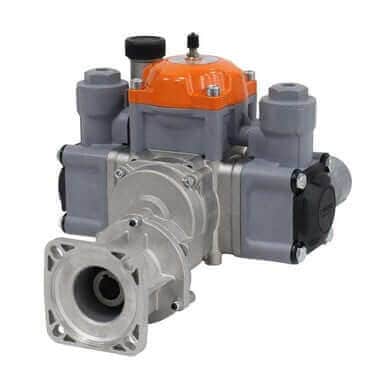 Comet BPX25 GR pump SKU: 150-0432 | 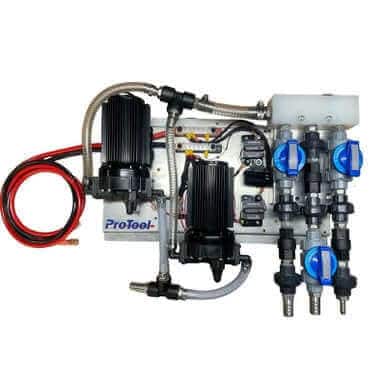 ProTool Soft Wash Metering Plates SKU: 150-045M |
 Goggles Splash Proof SKU: 58-75 | 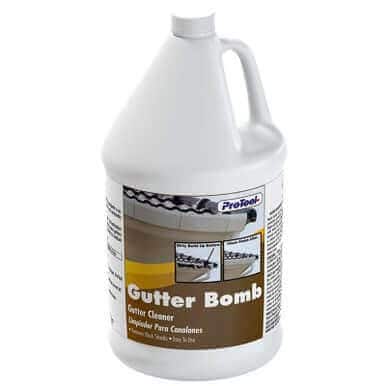 ProTool Gutter Bomb - Gutter Cleaner - Oxidation Remover SKU: 89-82M | 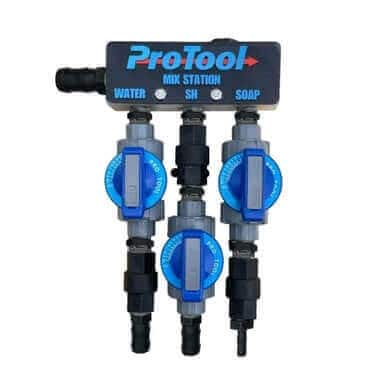 Soft Wash Metering Block SKU: 150-0454M |
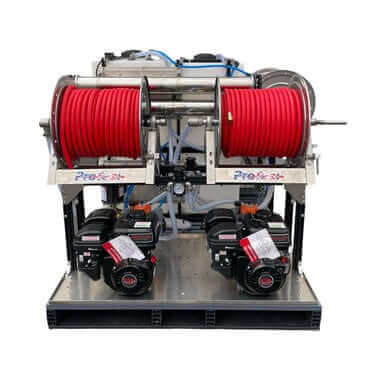 ProTool Dual User Pure Water and Soft Wash Skid BPX 25 SKU: 892-40100 | ProTool Post Rinse SKU: 83-03M |