X-Jet Nozzles Explained: When and Why Contractors Use Them

Table of Contents
Professional contractors argue about X-Jet nozzles the way they argue about surface cleaners — everybody has an opinion, and half of them are wrong. The core question is straightforward: when does an external chemical injection system outperform a standard downstream injector enough to justify carrying one on your rig? The answer depends on the job, your machine, and what you're spraying.
This guide breaks down what X-Jet nozzles actually do, how to size them to your pressure washer, and the specific scenarios where they earn their place on the truck. If you've been guessing at proportioner colors or running SH through your pump because you didn't want to deal with a second system, this is for you.
What an X-Jet Actually Does
An X-Jet is an external chemical injection system that attaches to the end of your pressure washer wand. It uses the venturi effect — high-velocity water at the nozzle tip creates a vacuum that siphons chemical from a separate container through a dedicated hose. The chemical never touches your pump, unloader, high-pressure hose, or trigger gun.
That last point matters more than most contractors realize early in their career. Running sodium hypochlorite or strong degreasers through your pump and hose accelerates seal degradation and corrodes internal components. An X-Jet eliminates that damage path entirely.
What's in the Kit
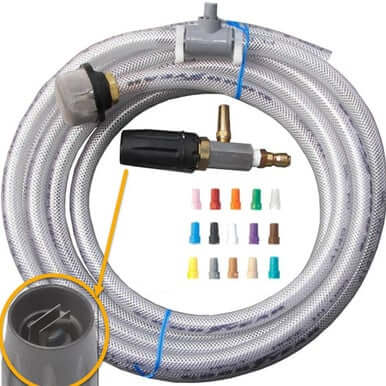
A complete X-Jet kit includes:
- Nozzle body with a 1/4-inch quick-connect plug for your wand.
- Interchangeable tips — a long-range "shooter" for reaching upper stories and a fan tip for broader coverage on lower surfaces.
- Chemical hose with a weighted strainer and ball valve for on/off chemical control.
- Color-coded proportioners — plastic inserts that seat in the nozzle body and control dilution ratio without batch mixing.
X-Jet vs. Downstream Injector
Most contractors already own a downstream injector. It's the default. The X-Jet doesn't replace it — it covers the gaps where downstreaming falls short.
Reach
A downstream injector's effective chemical reach drops with hose length and pressure loss. On a 200-foot hose run to a three-story gable, you may get soap up there, but the concentration is weak and the volume is thin. An X-Jet introduces chemical at the nozzle tip, so pressure loss in the main hose doesn't affect chemical delivery. Depending on GPM, you can project solution 40 feet or more from the ground — enough to treat most residential two- and three-story exteriors without a ladder.
Chemical Strength
This is where the X-Jet earns its keep. A downstream injector dilutes your chemical significantly — typical draw ratios run 10:1 to 20:1 depending on hose length, injector condition, and pressure settings. That's fine for a light house wash. It's not fine for heavy algae on north-facing siding, stubborn oxidation, or any situation where you need the mix to do real work on contact.
The X-Jet siphons directly from your pail. With the right proportioner, you control the ratio precisely — from a light rinse-level dilution up to near-straight chemical. For jobs that demand a stronger hit, there's no comparison.
Equipment Protection
Every ounce of SH or acid that runs through your pump, hose, and reel shortens their service life. Seals degrade, fittings corrode, and you end up rebuilding a pump that should have had another season in it. The X-Jet bypasses all of that. If you're running corrosive chemicals regularly — roof mixes, heavy SH concentrations, masonry acids — an external injection system pays for itself in avoided repairs.
Original X-Jet vs. X-Jet M5
Two models, same core function, different workflow.
Original X-Jet
The Original is the industry workhorse. Reliable, cost-effective, proven. You switch between chemical application and rinse using the ball valve. To change spray pattern — fan to stream or vice versa — you physically swap the nozzle tip. Simple, but it means stopping to change tips when you transition between applying soap on siding and shooting solution up to a peak.
X-Jet M5
The X-Jet M5 adds a twist-adjustable nozzle. One turn transitions from a tight, long-range stream to a wide fan pattern without swapping tips. On jobs with frequent pattern changes — a house with mixed siding heights, dormers, and ground-level sections — the M5 saves meaningful time. It costs more, but contractors doing high-volume residential work tend to prefer it for the workflow improvement.
GPM Sizing
An X-Jet that doesn't match your machine's flow rate won't draw chemical properly. Too large a nozzle on a small machine means no venturi suction. Too small means excessive back-pressure and poor performance. Match your machine:
- X-Jet #9: 3–4 GPM machines
- X-Jet #13: 5–6 GPM machines
- X-Jet #16: 7–8 GPM machines
Check your machine's spec plate before ordering. Running a #16 on a 4 GPM rig is a common and expensive mistake.
When to Reach for the X-Jet
The X-Jet isn't an every-job tool. It shines in specific scenarios where a downstream injector doesn't deliver.
Multi-Story Exteriors
Two- and three-story buildings are the X-Jet's natural habitat. Projecting chemical 30–40 feet from the ground eliminates ladder work for soap application. Your crew stays on the ground, applies from a safe position, and moves faster. The safety and speed improvement on tall residential work alone justifies ownership for most wash contractors.
Corrosive Chemical Application
Any time you're running strong SH mixes, heavy degreasers, or masonry-safe acids, keep them out of your pump. The X-Jet's external draw path means your pressure washer pump, hose reel, and trigger gun never see the corrosive material. This is non-negotiable for contractors who value their equipment.
Precise Chemical Control
The proportioner system gives you repeatable dilution ratios job after job. Unlike downstream injectors where draw rate varies with hose length, pressure fluctuations, and injector wear, the X-Jet proportioners deliver consistent concentration. That means consistent results, controlled chemical costs, and fewer callbacks.
- Start with a weaker proportioner than you think you need and test on an inconspicuous area.
- Strengthening the mix is easy — switching proportioners takes seconds. Fixing over-application takes real time.
Setup, Operation, and Maintenance
Assembly
With the pressure washer off:
- Attach the X-Jet body to your wand via the quick-connect plug. Confirm a solid click.
- Insert the correct proportioner into the hose barb on the nozzle body.
- Press the chemical intake hose onto the barb, seating it firmly over the proportioner. Drop the weighted strainer into your chemical pail.
Flushing After Every Job
This is the step contractors skip — and then wonder why their X-Jet stops drawing chemical. SH residue crystallizes inside the nozzle body and proportioner seats. After every use:
- Pull the chemical hose from your solution pail.
- Drop it into a bucket of clean water.
- Run the pressure washer for at least 60 seconds, flushing clean water through the entire chemical path.
Sixty seconds. That's all it takes to prevent the most common X-Jet failure mode. Skip it regularly and you'll be buying replacement proportioner tips and wondering what went wrong.
Replacement Parts
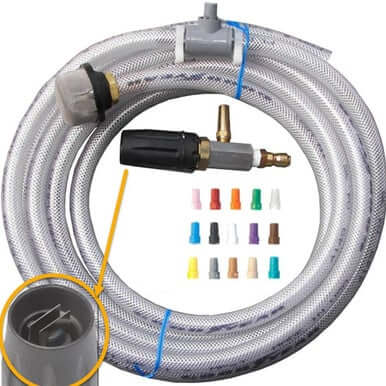
Proportioners wear, strainers clog, and hoses eventually need replacement. Keep spares on the truck. The X-Jet category covers the full range — nozzle bodies, proportioner tip sets, 5-gallon pail systems, and draw tube assemblies.
Products Mentioned
 X-Jet M5 Variable Spray SKU: 74-53M | 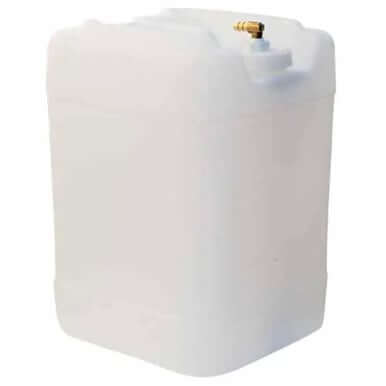 X-Jet 5 Gallon Pail with plumbing SKU: 74-5715 | 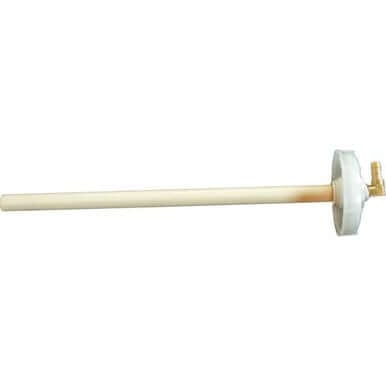 DrawTube Replacement Assembly X-JetPail SKU: 74-5716 |