
Solar Panel Cleaning Brush Guide: How to Choose the Right Tool
Table of Contents
A solar panel cleaning brush is the single most consequential tool choice in solar O&M. The wrong one scratches the anti-reflective coating — a few hundred nanometers thick — and permanently reduces output. The right one restores the 15–25% energy loss that NREL attributes to soiling, job after job, without touching the warranty. This guide covers bristle materials, brush geometry, manual vs. rotary systems, contaminant matching, and maintenance protocols so you can spec the correct brush for every array you service.
Solar Brushes vs. Standard Window Brushes
Window brushes and solar brushes both run on pure water, but the similarities end there. Window brushes are 10–14 inches wide, built for vertical glass with frames that act as catch points. Solar modules are wide, continuous, horizontal or tilted surfaces where debris bonds uniformly to the laminate. A 10-inch brush on a commercial array is a productivity killer.
Professional solar brushes run 18–24 inches. The wider head isn't just faster — it maintains a consistent cleaning path across PV modules so you don't leave lap marks. Pair that with a ProTool 4 Pencil-Jet Hybrid Brush or a Gardiner TaperTec Ultimate Brush and you're covering real acreage per stroke.
Weight and balance matter more on solar than on windows. You're running long-reach poles at low angles — a heavy brush head creates pole flex that makes even pressure impossible. Too light and you can't break through baked-on contaminants. Professional-grade blocks like the ProTool Boar's Hair Brush are engineered to balance these forces at full extension.
Why Window Brushes Damage Panels
Standard window brushes use stiff bristles designed for architectural glass. Those bristles micro-scratch modern ARC coatings, permanently reducing light transmittance and voiding manufacturer warranties. Metal-backed or aluminum-housed brushes compound the problem in high-voltage environments — they're an arcing liability. Professional solar brushes use non-conductive plastic or composite blocks. If you're building out a solar cleaning rig, start with poles and brushes designed for the application: browse Solar Panel Cleaning Brushes.
Bristle Materials: Nylon, Boar's Hair, and Hybrids
Material selection is where you protect or destroy the ARC. Every bristle type trades agitation power against surface safety — there's no universal winner.
Nylon is the workhorse for routine maintenance. High durability, excellent glide, low water retention so the brush stays light. It handles light-to-medium soil — pollen, fine dust, thin film — and lasts the longest. For most residential and light commercial work, nylon is the default.
Boar's hair has a natural microscopic "tooth" that gets under heavy particulates — bird droppings, dried mud, lichen. It's more aggressive, which is exactly the point when you need it. The trade-off: natural fibers trap grit at the bristle base. You need higher water flow to flush that grit continuously, or it becomes an abrasive against the glass. Boar's hair also degrades faster than nylon, especially under UV.
Hybrid brushes surround a boar's hair core with a nylon outer ring. The core does the deep scrubbing; the nylon perimeter ensures smooth glide and protects the panel edges. This is the go-to configuration for mixed-contaminant sites.
Flagged vs. Unflagged Bristles
Flagged bristles (split ends) hold more water and create a softer contact surface. Sounds ideal, but those split ends trap fine silt and grit. Unflagged bristles are easier to keep clean and offer more precision. For professional solar work, unflagged is the safer bet.
Stiffness and Energy Yield
Stiff bristles clean faster in the short term but risk compromising ARC integrity over hundreds of cycles. Medium-soft bristles are the optimal balance for nearly all professional solar applications — enough agitation to break contaminant bonds without marring the coating. Any residue left behind, or any micro-marring caused by the brush, reduces light transmittance to the cells. The panel doesn't forgive accumulated damage.
Manual Water-Fed Brushes vs. Rotary Systems
The manual-to-rotary transition is a scaling decision. Manual brushes on water-fed poles give you precision and tactile feedback — you feel what the brush is doing. For residential and small commercial, that control matters. You can work around frames, mounting hardware, and micro-inverters without risking damage.
But manual agitation becomes a bottleneck once arrays hit commercial scale. Your crew fatigues, cleaning time per megawatt climbs, and consistency drops. That's when rotary systems earn their ROI.
Water-Powered Rotary Mechanics
Water-powered rotary brushes use hydraulic pressure from your pure water filtration system to drive the brush head — no batteries, no external power on the roof. The ProTool DualForce 25 uses counter-rotating dual heads that neutralize torque, preventing the brush from "walking" and making it dramatically easier to guide over long runs. Single-head units like the 24-inch Water Powered Rotary Brush offer a compact profile for tighter spaces.
Watch for pressure fluctuations on tilted arrays — rotational force can pull the pole if flow drops. Consistent water pressure from your RODI system is non-negotiable for rotary work.
When to Stay Manual
Manual agitation remains the superior choice for residential detail and small commercial where you're working around obstructions. The correct gooseneck — like the Gardiner 14-inch 55° Carbon Gooseneck — keeps bristles flat against the glass at full pole extension. Pair it with a soft nylon brush and a ProTool HydroBoost for consistent flow, and you have a residential rig that's fast and safe.
Matching Your Brush to Environmental Contaminants
Assess the site before you pull a brush off the truck. A solar panel cleaning brush that handles desert dust will fail on organic growth in a humid climate. Match the bristle architecture to the contaminant.
Debris-to-Tool Framework
- Fine dust / pollen: Soft nylon bristles with high-flow rinse bars. Minimal mechanical force — let the water do the work.
- Bird droppings / bee excrement: Hybrid brushes or nylon with high-density bristle centers. The increased bristle count provides targeted agitation without excessive downward pressure.
- Lichen / moss: 100% boar's hair for maximum bite. These organisms root into micro-pores of the glass and frame edges — natural fibers get underneath them.
- Industrial soot: Stiff nylon or hybrid brushes with auxiliary scrub pads mounted to the gooseneck for localized heavy soiling.
Dry brushing is prohibited in professional solar O&M. Dry particulates act as abrasives against the laminate. Every stroke needs water.
Arid vs. Humid Climates
Arid regions produce electrostatically bonded mineral dust. High-flow rinse bars help neutralize the charge. Humid regions generate organic growth and sticky tree sap that require more frequent cleaning cycles and aggressive bristle architecture to prevent lichen from etching the glass. Warmer water softens sticky contaminants and makes mechanical agitation more effective — consider a Warm Water Skid if sap is a recurring problem.
Maintenance and Storage: Protecting Your Investment
A professional solar panel cleaning brush is capital equipment, not a consumable. Treat it accordingly and it lasts; neglect it and you're replacing heads every few weeks and risking ARC damage from degraded bristles.
Daily Rinse Protocol
After every shift, flush the brush head thoroughly with pure water. Trapped grit at the bristle base hardens overnight and becomes an abrasive on the next job. A clean brush maintains the correct scrub-to-rinse ratio and prevents secondary contamination of the module surface.
Weekly Inspection
Check for bristle splaying, thinning, or permanent deformation. When filaments lose their spring-back, agitation efficiency drops and the operator compensates with more pressure and longer dwell time — both bad outcomes. Replace heads every 3–6 months depending on volume. J.Racenstein stocks rotary brush replacement parts and complete brush heads so you can swap without replacing the entire assembly.
Cross-Contamination
Never use a solar brush for window cleaning or siding work. Window cleaning chemicals leave residues on the filaments that streak PV glass and attract dust. If you must clean the brush head with anything beyond pure water, use only a mild pH-neutral detergent. Inspect jet nozzles for mineral buildup — even with pure water, particulates can clog orifices, creating dry spots during the scrub cycle.
Storage
Never rest a brush on its filaments. That causes permanent bristle deformation and ruins the agitation pattern. Store brushes hanging or block-down. UV degrades nylon — if your gear rides in an open truck bed, cover or bag the brush heads between sites. Protect them from oil, grease, and road debris during transport.
Products Mentioned
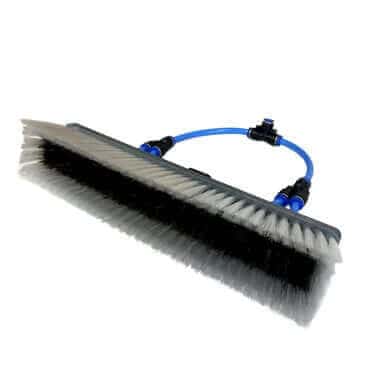 ProTool 4 Pencil-Jet Hybrid Brush 12in SKU: 151-211 | 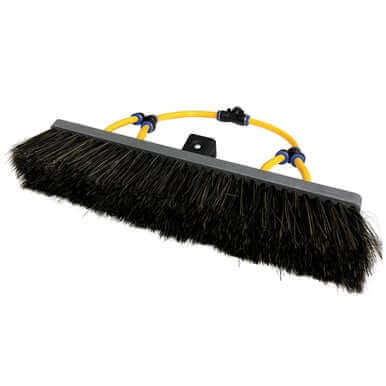 ProTool 4 Pencil-Jet Boar's Hair Brush 12in SKU: 151-221 | 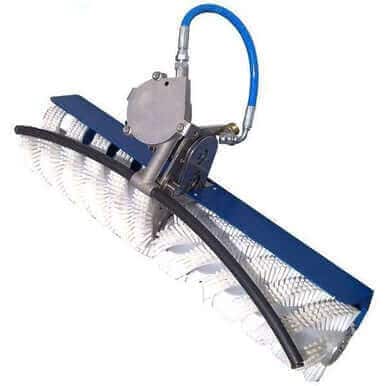 Rotary Brush 24 in (60cm) Water Powered SKU: Z159-134 |
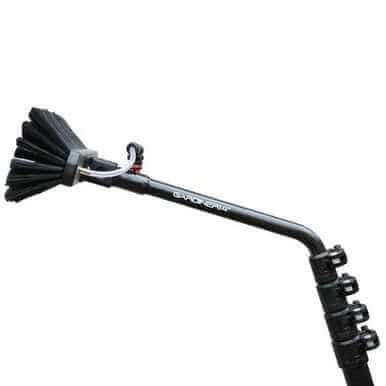 Gardiner Gooseneck Carbon 14in 55deg Quick-Loq SKU: 157-4053 | 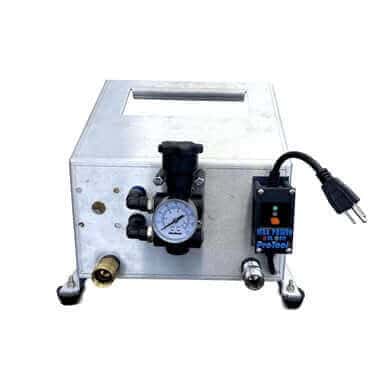 ProTool HydroBoost Portable Water Fed Pole Booster Pump SKU: 150-061M | 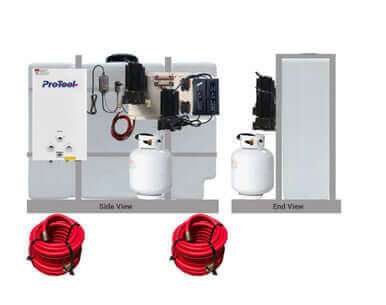 Warm Water Skid for RO production and Cleaning Systems SKU: 150-073 |